
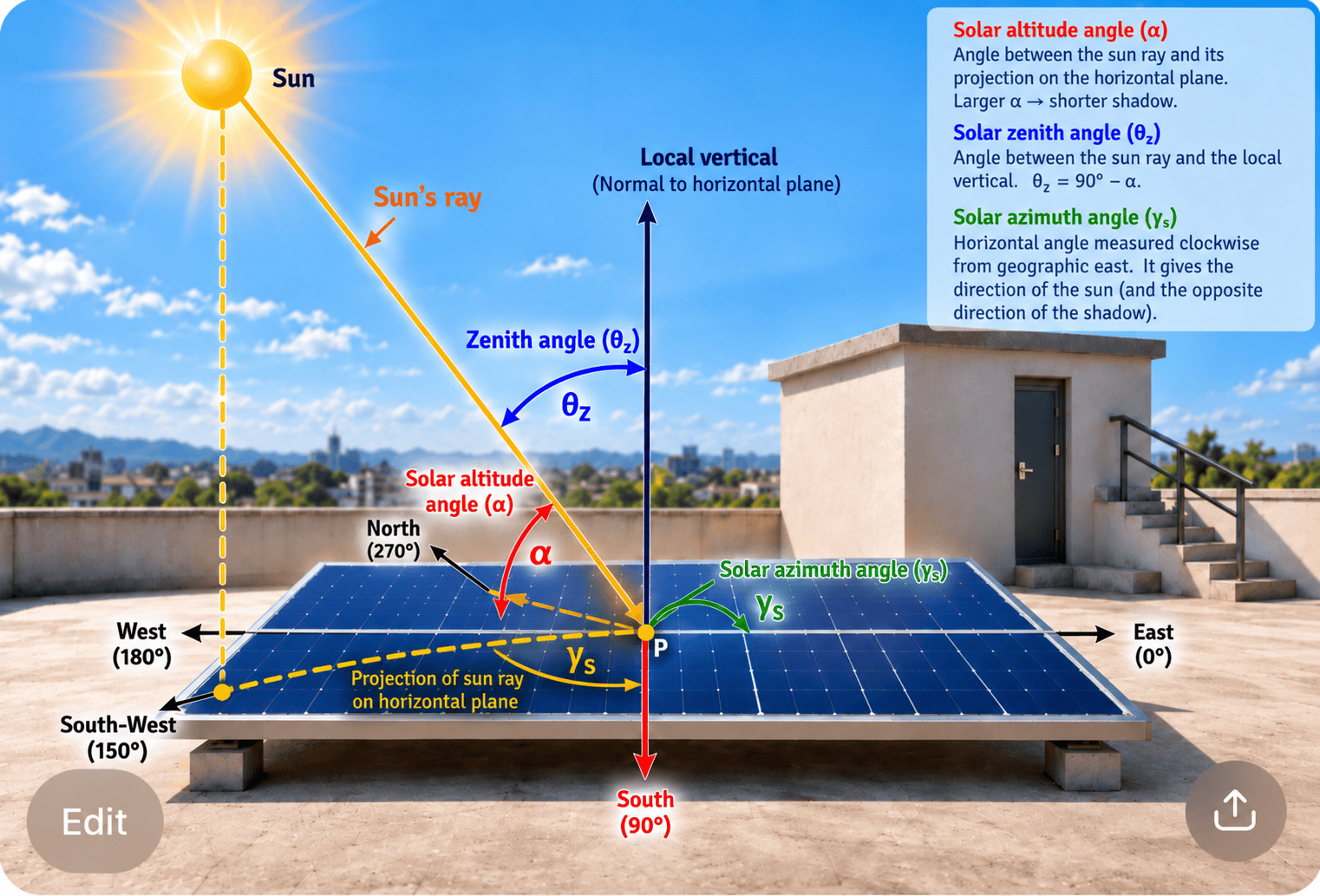
Have you ever wondered why the shadow of a building changes its length and direction throughout the day, or why solar panels installed at different locations are inclined at different angles? These everyday observations are governed by the geometry of the Sun’s apparent movement across the sky. Understanding this geometry is essential not only for explaining the behaviour of sunlight but also for designing rooftop solar photovoltaic (PV) systems that can capture solar energy efficiently.
In our previous discussions, we explored how the Sun’s apparent position changes throughout the day and across different seasons. We learned that solar declination, hour angle, latitude, and longitude play important roles in determining sunrise, sunset, daylight duration, and solar noon. We also learned why solar noon does not necessarily coincide with 12:00 on our clocks. These concepts provide the foundation for understanding two additional parameters: the solar zenith angle and solar azimuth angle, which describe the Sun’s position relative to an observer on Earth.
Consider a simple everyday experience. When sunlight falls on a horizontal surface, its intensity per unit area depends on the angle at which the rays strike that surface. When the Sun is nearly overhead, its rays fall more directly on the ground, concentrating the incoming solar energy over a smaller area. As the Sun approaches the horizon, the same beam of sunlight spreads over a larger area, reducing the radiation received per unit horizontal surface area. This geometric relationship explains why the Sun’s position is so important when estimating the solar energy available to a rooftop.
The position of the Sun above the horizon is described by the solar altitude or elevation angle (α). It is the angle between the direction of incoming sunlight and its projection onto the horizontal plane. When the Sun is at the horizon, the solar altitude angle is approximately 0°, whereas when the Sun is directly overhead, it reaches 90°. The complementary angle, known as the solar zenith angle (θz), is measured between the direction of the Sun and the local vertical. These two angles are related by the simple expression:
Thus, a higher solar altitude corresponds to a smaller zenith angle, indicating that sunlight strikes a horizontal surface more directly. Conversely, a larger zenith angle indicates more oblique illumination. The solar zenith angle is therefore a fundamental parameter for estimating the direct solar radiation incident on a horizontal surface.
These angles also help us understand the changing length of shadows. Imagine a vertical object of height H standing on level ground. When the Sun is high in the sky, its shadow is relatively short. As the solar altitude decreases, the shadow becomes progressively longer. The relationship between the object’s height, the solar altitude angle, and its shadow length (L) is expressed as:
Where:
- \(L\) = Shadow length (m)
- \(H\) = Height of the vertical obstruction (m)
- \(\alpha\) = Solar altitude angle
- \(\theta_z\) = Solar zenith angle
This equation demonstrates that shadow length depends on both the height of the obstruction and the Sun’s elevation. However, knowing the shadow length alone is insufficient for rooftop solar assessment. We must also determine the direction in which the shadow falls.
This brings us to another important parameter: the solar azimuth angle (γs). While solar altitude and zenith describe how high the Sun appears in the sky, solar azimuth describes its direction along the horizon. It is the horizontal angle between a reference direction and the projection of the Sun’s direction onto the horizontal plane. Using the clockwise-from-geographic-north convention, north corresponds to 0°, east to 90°, south to 180°, and west to 270°. Since a shadow extends in the direction opposite to the Sun, the solar azimuth angle allows us to determine where the shadow of an obstruction will fall.
The combined knowledge of solar altitude and azimuth is particularly valuable when assessing a rooftop for solar PV installation. Nearby buildings, trees, parapet walls, rooftop stairwell structures, and other elevated objects may cast shadows over the proposed panel area. Because the Sun’s apparent position changes throughout the day and across seasons, the extent and direction of these shadows also change. A rooftop that remains free from shading at noon may experience substantial shading during the morning or afternoon. Therefore, both shadow length and direction must be considered before selecting the location of PV modules.
Another important consideration is the orientation of the solar panels themselves. Owing to Earth’s axial tilt and revolution around the Sun, solar declination varies throughout the year between approximately +23.45° and −23.45°. Meanwhile, Earth’s rotation causes the Sun’s apparent position to change continuously throughout the day. Consequently, the angle at which sunlight strikes a fixed surface is constantly changing. Even at locations where the Sun can appear directly overhead on certain dates, this alignment does not persist throughout the year.
For locations outside the tropical region, the Sun never reaches the zenith. However, this does not mean that sunlight cannot strike an inclined solar panel perpendicularly. By appropriately orienting and tilting the panel, its surface can face the incoming solar rays more directly during selected periods. This explains why fixed solar PV modules and solar thermal collectors are generally installed at an inclination rather than being placed arbitrarily on a horizontal surface.
The inclination of a solar panel is represented by the tilt angle (β), measured between the panel surface and the horizontal plane. The objective is not simply to make the panel perpendicular to sunlight at one particular moment, but to select a suitable inclination that maximises the solar energy received over a desired period, such as a season or an entire year. Determining this inclination requires an understanding of solar declination, hour angle, latitude, solar zenith, solar azimuth, and the angle of incidence of sunlight on the inclined surface.
Through this series of articles, Sustainable Reflections aims to translate these scientific relationships into a practical rooftop solar assessment tool. Our objective is to develop a calculation-based application through which readers can estimate suitable panel inclination angles for different geographical locations and, eventually, evaluate the technical requirements of small rooftop PV installations.
In the next stage of our discussion, we will develop the mathematical relationships connecting solar geometry with the angle of incidence on an inclined surface. These relationships will provide the foundation for determining suitable panel orientations and estimating the solar radiation received by a PV module.
By understanding the science behind each calculation, readers will not only learn how solar panels should be positioned but also appreciate the principles on which our proposed software will operate. We welcome observations and constructive feedback from researchers, engineers, students, and solar energy enthusiasts as we gradually develop this educational initiative into a practical assessment tool.