
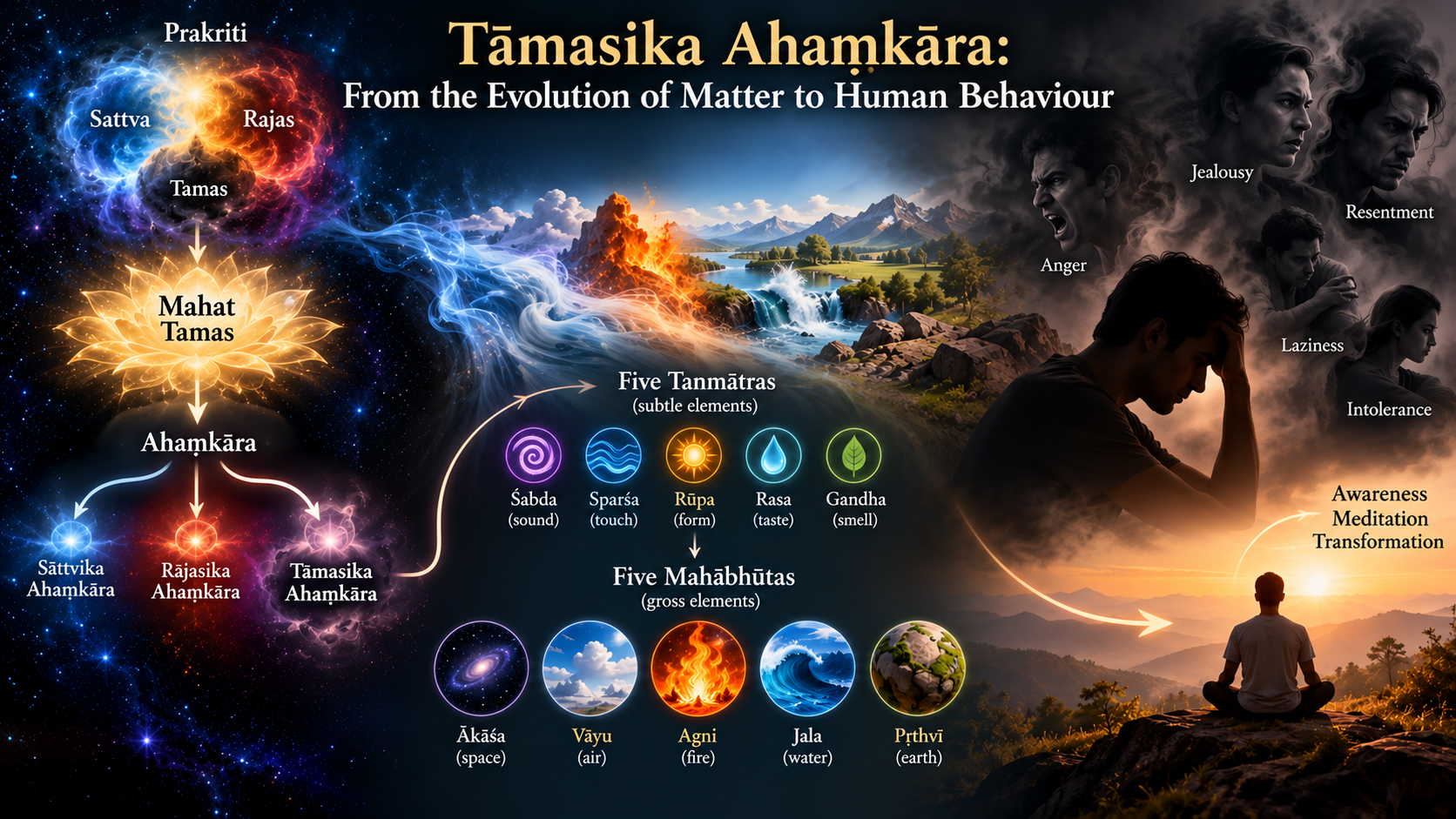
In our exploration of the evolution of Prakriti, we have seen how Ahaṃkāra emerges from Mahat and manifests in three forms—Sāttvika, Rājasika, and Tāmasika. Among these, Tāmasika Ahaṃkāra holds particular significance because it gives rise to the subtle principles that eventually form the foundation of the material world. But is the role of Tāmasika Ahaṃkāra limited to the creation of the universe, or can the influence of its qualities also be observed in our thoughts and behaviour? To explore this question, we must first understand the origin of the five Tanmātras and the five Mahābhūtas.
According to Sāṃkhya philosophy, Tamas predominates in Tāmasika Ahaṃkāra, although Sattva and Rajas also remain present. To understand this more easily, we may imagine a composition consisting of approximately 60% Tamas and the remaining 40% Sattva and Rajas combined. This proportion is not a fixed numerical calculation prescribed by Sāṃkhya philosophy but an illustration of the coexistence of the three Guṇas. Tamas represents inertia and obscuration, Rajas represents activity and movement, while Sattva represents illumination and knowledge. Their mutual interaction drives the evolutionary process of Prakriti.
From Tāmasika Ahaṃkāra, with the active assistance of Rajas, emerge the five Tanmātras—Śabda (sound), Sparśa (touch), Rūpa (form), Rasa (taste), and Gandha (smell). These are not physical substances but the subtle causes of perceptible qualities. From them gradually evolve the five Mahābhūtas—Ākāśa (space), Vāyu (air), Agni (fire), Jala (water), and Pṛthvī (earth). In the traditional Sāṃkhya explanation, Ākāśa possesses the characteristic of sound; Vāyu possesses sound and touch; Agni possesses sound, touch, and form; Jala possesses sound, touch, form, and taste; while Pṛthvī possesses all five qualities. Thus, all five sensory qualities are manifested in Pṛthvī. Here, the Mahābhūtas should not be understood as chemical elements in modern science; rather, they are philosophical principles used to explain the structure of creation.
The material world, constituted by the five Mahābhūtas, is therefore an extension of the threefold Guṇa structure of Prakriti. All material objects in the universe, including our physical bodies, belong to this framework. However, an important feature of Sāṃkhya philosophy is that it explains not only the origin of the external world but also considers the mind, intellect, and Ahaṃkāra as parts of the evolutionary process of Prakriti. Consequently, the influence of the three Guṇas is not confined to physical matter but is also reflected in our mental tendencies and behaviour.
We often encounter individuals whose behaviour is characterised by anger, jealousy, resentment, laziness, or intolerance towards others. These tendencies can be examined through the Triguṇa theory of Sāṃkhya. Tamas may obscure discrimination, while Rajas intensifies desire, excitement, and emotional reactions. Consequently, individuals may sometimes react impulsively rather than understand situations calmly. However, it would be inappropriate to attribute a person’s entire behaviour to a single Guṇa, since all three Guṇas remain continuously active.
An important question now arises—if Tamas predominates in a person’s behaviour, will that person remain the same throughout life? Inspired by the Triguṇa theory of Sāṃkhya, the answer may be found in the possibility of transformation. Just as our illustrative example contains 40% Sattva and Rajas alongside 60% Tamas, the predominance of Tamas does not imply the complete absence of the other Guṇas. The activity of Rajas may help overcome inertia, while an increase in Sattva encourages discrimination, balance, and clarity. Therefore, a person’s present tendencies should not be regarded as an unchangeable identity.
For example, a person may become angry upon hearing even minor criticism and respond with harsh words. Later, the person may regret such behaviour. However, by developing awareness and learning to recognise anger as it arises, the individual may gradually learn to pause before reacting. This awareness can progressively bring about changes in behaviour. Meditation, self-observation, and a disciplined lifestyle can support this process. Particularly in the Yoga tradition, which is closely associated with Sāṃkhya, meditation and concentration of the mind are regarded as important means of developing mental balance.
It is also necessary to understand the role of Ahaṃkāra in this context. In everyday language, Ahaṃkāra is commonly understood as pride or arrogance, whereas in Sāṃkhya philosophy, it is the principle responsible for generating the sense of ‘I’ and ‘mine’. When individuals begin to regard their mental tendencies as their permanent identity, they may say, ‘I am naturally short-tempered’ or ‘I cannot change.’ However, according to Sāṃkhya, the mind and its tendencies belong to the ever-changing Prakriti. Purusha, in contrast, is the principle of pure consciousness, distinct from these modifications. Discriminative knowledge of this distinction guides individuals towards freedom from unnecessary identification with their mental states.
Ultimately, the study of Tāmasika Ahaṃkāra introduces us to two important dimensions. First, it explains how the subtle principles of Prakriti provide the foundation for the manifestation of the gross material world. Second, the interaction of the three Guṇas offers a philosophical perspective for understanding our mental life. The predominance of Tamas does not eliminate the possibility of transformation. Through awareness, self-observation, and meditation, individuals can understand their reactions and gradually develop more balanced behaviour. This understanding encourages us to move beyond the evolution of the external universe and explore the nature of Prakriti within ourselves. In our next article, we will examine the roles of Manas (mind), Buddhi (intellect), and Citta, exploring how they influence our experiences, thoughts, and decisions.