
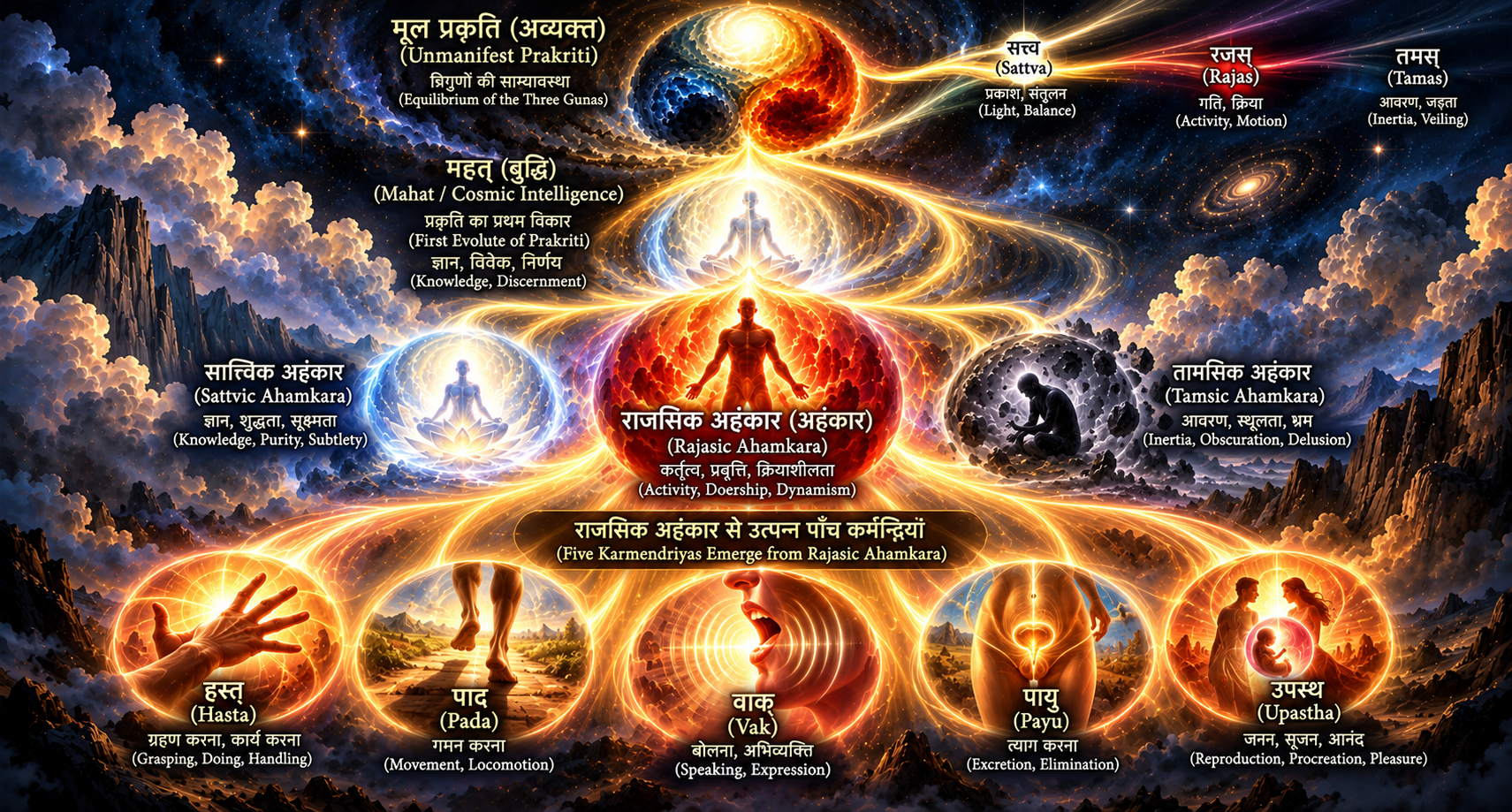
Why does one achievement rarely bring lasting satisfaction? Why does every success seem to awaken the desire for something greater? A student aspires to excel, a professional seeks recognition, and an entrepreneur strives for greater success. Although their goals differ, they share a common impulse—the desire to achieve, progress, and establish a distinct identity. But what drives this seemingly endless pursuit of accomplishment? In the context of Sankhya philosophy, this tendency can be understood through Rajasic Ahamkara, the aspect of Ahmakara associated with activity, ambition, and the sense of doership. It is through this interplay of desire, action, and achievement that individuals continuously strive to shape their identity and position in society.
The predominance of Rajasic Ahamkara is clearly visible in everyday social interactions. Under its influence, individuals engage in various activities and progress towards social and material achievements. The dynamic nature of Rajas becomes particularly evident when individuals strive tirelessly for economic advancement, social progress, or material prosperity, sometimes even sacrificing their personal comforts in pursuit of their goals. Yet, an important question arises: Is every action driven by personal ambition, or can the same energy be directed towards a higher purpose?
The Bhagavad Gita offers a profound illustration of this distinction. Standing on the battlefield of Kurukshetra, Arjuna is overwhelmed by grief and moral uncertainty at the prospect of fighting his own relatives, teachers, and loved ones.His determination weakens, and he becomes reluctant to fight. At this critical moment, Lord Krishna reminds him of his duty as a warrior and urges him to rise above attachment and emotional paralysis. In Chapter 2, Verse 38, Krishna advises Arjuna to regard happiness and sorrow, gain and loss, and victory and defeat with equanimity, and then perform his duty by engaging in battle. Through this teaching, Krishna does not seek to awaken personal pride, aggression, or the desire for victory in Arjuna; rather, he encourages action guided by righteousness, wisdom and sense of duty. The episode illustrates an important philosophical distinction: while Rajas provides the energy and motivation for action, wisdom and discernment determine its direction. Thus, the challenge is not to suppress the active nature of Rajas but to guide it beyond personal ambition and ego towards responsible and purposeful action.
From another perspective, the predominance of Rajasic tendencies can also be observed in modern corporate culture and social media. Many individuals are find themselves in continuous competition for social prestige, economic prosperity, position, recognition, and achievement. In such an environment, individuals seek appreciation and social acceptance through their skills, efficiency, and accomplishments. For example, the desire for promotion and prestige in the corporate world, along with the pursuit of appreciation and popularity on social media, may motivate individuals to continuously display their achievements. Some establish their identity through professional success, while others seek recognition through their contribution to society.
One of the behavioural tendencies associated with Rajasic Ahamkara is the inclination to compare oneself with others. Individuals begin comparing their achievements, abilities, and social standing with those of others. Such comparisons may give rise to a sense of superiority. Their satisfaction no longer depends solely on their own achievements but also becomes influenced by their position relative to others. Under the influence of this tendency, individuals may be unable to derive lasting satisfaction from their present achievements. What they possess may begin to seem insufficient after some time, prompting them to pursue new accomplishments. Thus, the satisfaction arising from achievements may gradually transform into new aspirations, leaving individuals continuously preoccupied with future possibilities.
The constructive influence of Rajas can also be understood in relation to the development of human civilisation. From one perspective, this active nature of Rajas has played an important role in the progress of human civilisation. From the Stone Age to the modern era, the development of human society, the formation of civilisations, scientific progress, and new inventions have been associated with human curiosity, industriousness, and the continuous desire to advance. While knowledge, wisdom and cooperation have shaped human progress, the activity and industriousness associated with Rajas may be understood as important motivating forces.
Yet the same drive for progress can become a source of dissatisfaction when it is dominated by ego, excessive ambition, and the desire for superiority. Individuals start considering their achievements as the very basis of their identity and may sometimes neglect their families, social relationships, and inner satisfaction. Consequently, despite material accomplishments, a sense of dissatisfaction may persist within them.
In the continuous pursuit of proving their superiority and achieving more than they presently possess, they begin to drift away from the true purpose of life and their inner balance. Instead of experiencing satisfaction with what they already have, they remain constantly engaged in seeking new achievements. Thus, Rajasic Ahamkara, which on the one hand provides motivation for action and progress, may, when left uncontrolled, entangle individuals in a cycle of dissatisfaction and endless aspirations.
Therefore, the objective is not to eliminate Rajasic tendencies but to guide their active nature through wisdom and balance. Actions and achievements can serve as instruments of progress in life, but when they become the sole basis of our identity and satisfaction, those very achievements may also become a source of bondage. Ultimately, we must ask ourselves: Are we enriching our lives through our achievements, or are we becoming slaves to our own accomplishments?