
Solar time is another important concept that is vital to understanding the performance of photovoltaic (PV) systems and should be understood by every student of solar energy, installer, and engineer working in this field. The time shown by a clock may not correspond to the actual time determined by the apparent position of the Sun in the sky relative to the observer’s location or the location where a solar PV plant is installed.
Solar time is significant because it represents the actual position of the Sun in the sky relative to a specific location. In solar PV systems, this information is used to calculate solar angles for module orientation, shading analysis and solar tracking. Trackers use the Sun’s zenith and azimuth angles to orient the modules and may employ backtracking to reduce row-to-row shading, particularly when the Sun is low in the morning and evening. Since solar noon does not necessarily occur at 12:00 clock time, accurate solar-time calculations are important for these applications.
The performance of a PV system ultimately depends on the angle at which solar radiation falls on the modules. Solar time therefore provides an essential link between time, the Sun’s position and PV performance. Solar noon occurs when the Sun crosses the observer’s local meridian.
This solar time should be distinguished from the standard civil time shown by our clocks. Standard time is referenced to the mean solar time of a designated standard meridian and therefore may not correspond to the Local Apparent Time (LAT) at a particular location. The difference arises from the location’s longitude and from variations in the Sun’s apparent motion caused mainly by the Earth’s elliptical orbit and axial tilt.
To determine the solar time at an observer’s location, two corrections are required. One accounts for the difference between the observer’s local meridian and the standard meridian of the time zone. The second accounts for the non-uniform apparent motion of the Sun during the year, arising mainly from the Earth’s elliptical orbit and axial tilt.
Solar time (ST) and Local Apparent Time (LAT) refer to the same solar-time concept when considered for a particular meridian. However, ST or LAT should not be confused with the clock time at the standard meridian. Clock time represents the standard time of a country or time zone, which is based on mean solar time at the designated standard meridian.
This distinction becomes important when calculating the solar hour angle. The hour angle is expressed as:
where LAT is the Local Apparent Time expressed in hours. If LAT = 12, then:
Thus, an hour angle of zero indicates solar noon, when the Sun crosses the local meridian. Therefore, the time used in the hour-angle equation is Local Apparent Time, not standard clock time..
The local solar time naturally differs from one place to another because the Sun’s apparent position depends on longitude. Since the Earth rotates through 360° in approximately 24 hours, a difference of 1° in longitude corresponds to a time difference of approximately 4 minutes. However, using a different clock time for every longitude would be impractical. Therefore, countries and time zones adopt a standard time, which is based on the mean solar time of a selected standard meridian. Consequently, the standard clock time at a particular location may differ from its Local Apparent Time (LAT).
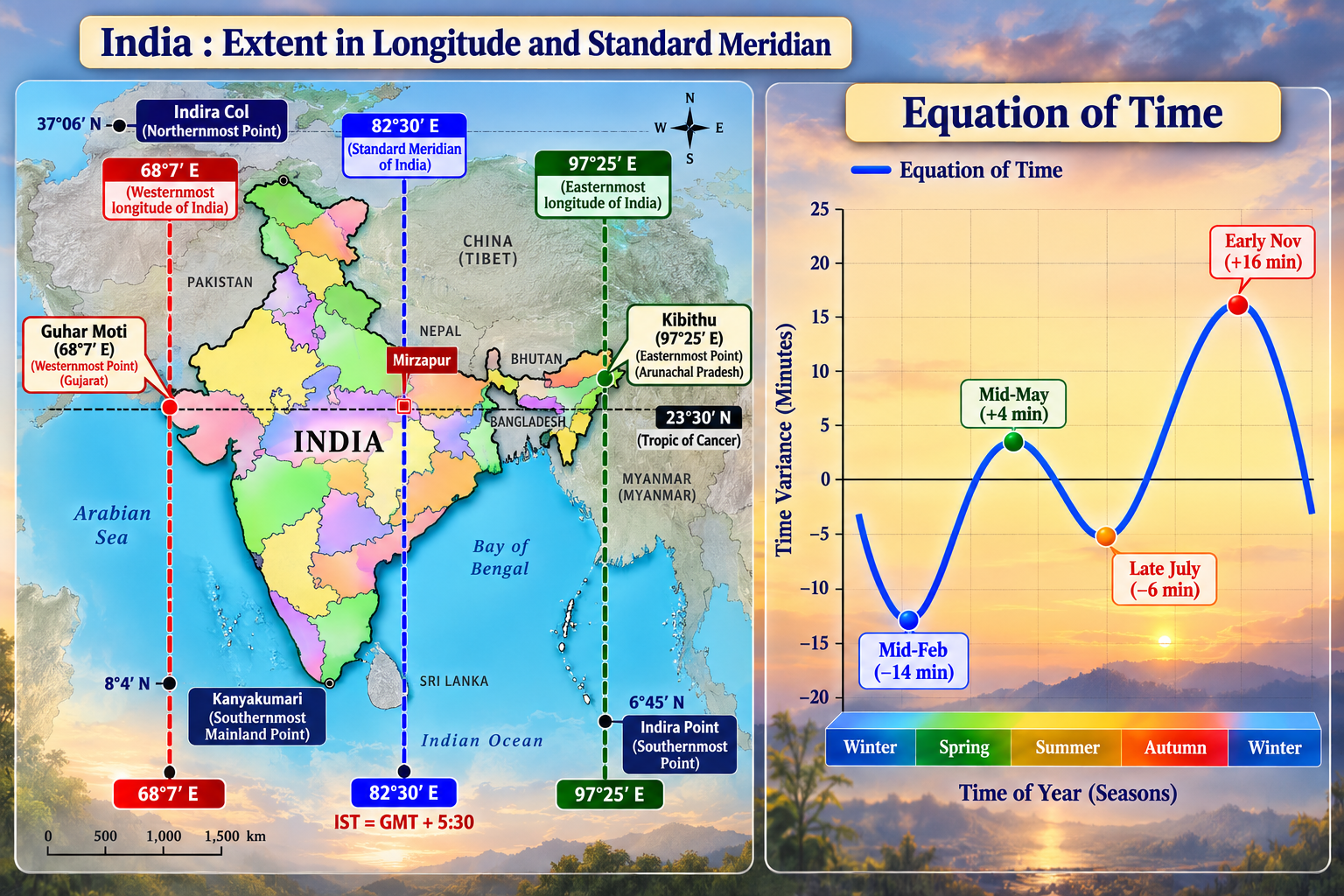
To understand this, consider the example of India. The Indian mainland extends approximately from 68°7′ E to 97°25′ E longitude. The easternmost region lies in Arunachal Pradesh, while the westernmost region lies in Gujarat. The longitudinal difference between these two regions is about 29°, corresponding to nearly two hours of solar-time difference. For administrative convenience, however, the entire country follows a single standard time. India has adopted 82°30′ E as its standard meridian, and Indian Standard Time (IST) is based on the mean solar time of this meridian. Therefore, irrespective of the local position of the Sun, clocks throughout India show the same time termed as Indian standard time (IST).
To determine Local Apparent Time (LAT) from standard clock time, two corrections are required: the longitude correction and the Equation of Time (E). For a location east of the standard meridian, the longitude correction is positive, while for a location west of it, the correction is negative. Thus, the relationship may be written as:
where the longitude difference is expressed in degrees and the factor 4 converts it into minutes. and E is also expressed in minutes.
For example, consider Delhi, located at approximately 77° 2′ E, while the Indian standard meridian is 82°30′ E. Therefore, when the clock shows 12:00 noon IST, the Local Apparent Time in Delhi will generally not be exactly 12:00 solar time. The longitude correction and the Equation of Time must first be applied to obtain the LAT.
The Equation of Time (E) provides the correction required because apparent solar time does not progress uniformly relative to mean solar time. It can be approximated by:
where:
and (n) represents the day number of the year. Since the value of (A) changes with the day of the year, the Equation of Time also varies throughout the year. The calculated value of (E), together with the longitude correction, is therefore applied to standard time to determine the Local Apparent Time.
Thus, the Equation of Time is essentially a correction that accounts for the difference between Mean Solar Time and Apparent Solar Time, while the longitude correction accounts for the difference between the location and the standard meridian.
Because of these two geometric realities, the actual length of an apparent solar day changes slightly from day to day, varying by up to about 30 seconds. Since it is impractical to adjust mechanical or digital clocks daily, scientists introduced the concept of the “Mean Sun,” which moves at a perfectly uniform rate. The cumulative difference between Mean Solar Time and Local Apparent Time is known as the Equation of Time, and it causes the two values to differ by up to about 16 minutes at certain times of the year.
Due to the effect of the Earth’s elliptical orbit, according to Kepler’s Laws of Planetary Motion, the Earth moves faster along its orbit when it is closest to the Sun (perihelion in January) and slower when it is farthest from the Sun (aphelion in July). Near perihelion, the Earth has to rotate slightly more on its axis each day for the Sun to return to the same position in the sky. This makes the apparent solar day longer than 24 hours. Near aphelion, the Earth does not have to rotate as much, making the apparent solar day shorter than 24 hours.
The obliquity of the ecliptic effect arises from the Earth’s axial tilt of roughly 23.5 degrees relative to the plane of its orbit around the Sun. Around the solstices (June and December), the Sun’s apparent motion is more nearly parallel to the celestial equator, so more of its motion contributes to an east-west shift, making the solar day longer than average. In contrast, around the equinoxes (March and September), the Sun moves at an angle to the celestial equator. Consequently, part of its apparent motion is directed north or south rather than east or west, making the solar day shorter than average.
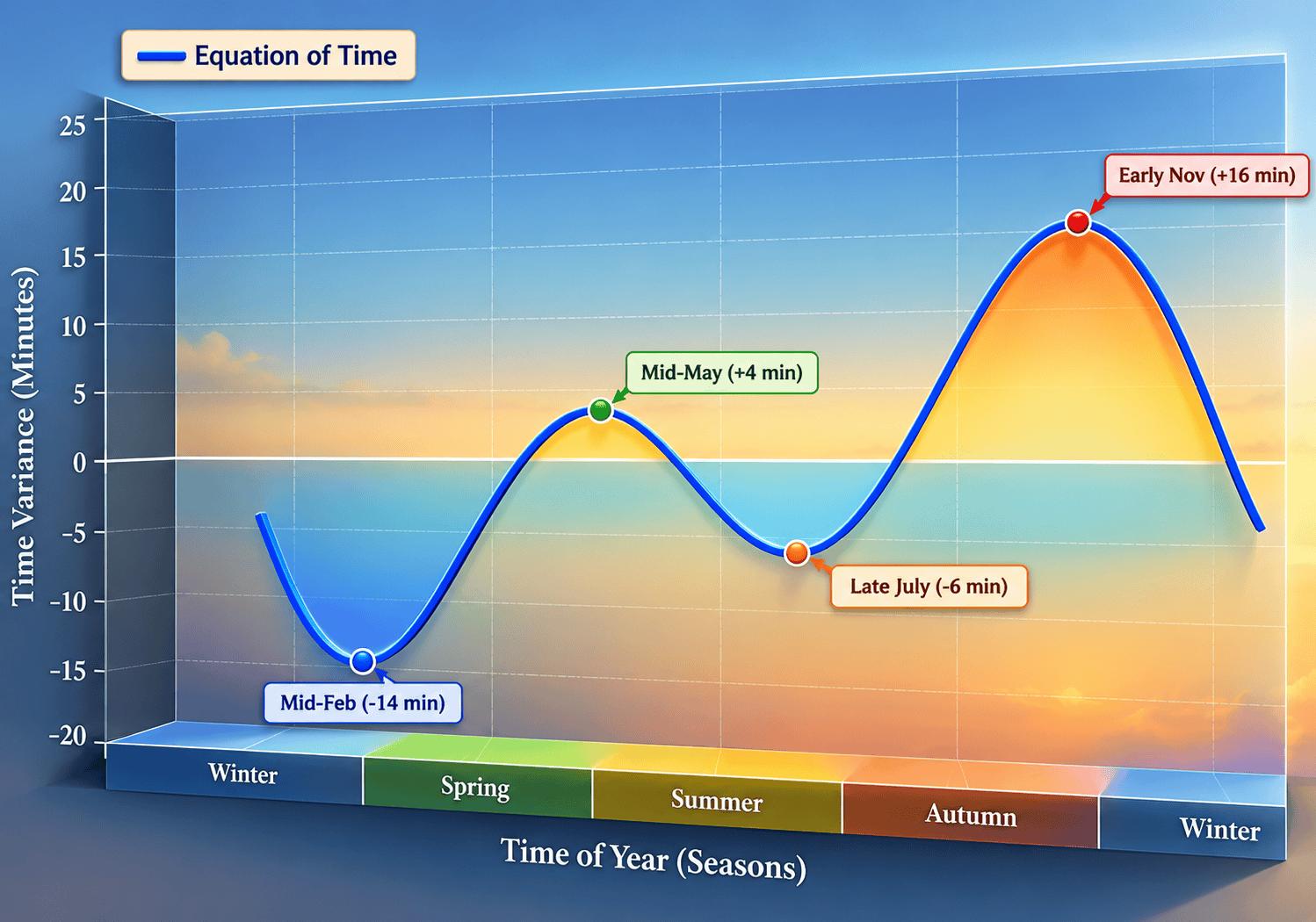
The Equation of Time graph shows how apparent solar time varies from mean solar time throughout the year due mainly to the elliptical orbit of the Earth around the Sun and the tilt of the Earth’s axis. When the curve lies below zero, apparent solar time is behind mean solar time; when it rises above zero, apparent solar time is ahead.
The difference varies through the year, reaching approximately 14 minutes behind in mid-February and 16 minutes ahead in early November, with smaller variations occurring in between. The curve crosses zero approximately four times—around mid-April, mid-June, early September and late December—when apparent and mean solar time are nearly the same. The graph therefore illustrates why the Sun does not maintain a perfectly uniform relationship with our clocks throughout the year.
Why is the Analemma Important in Solar PV?
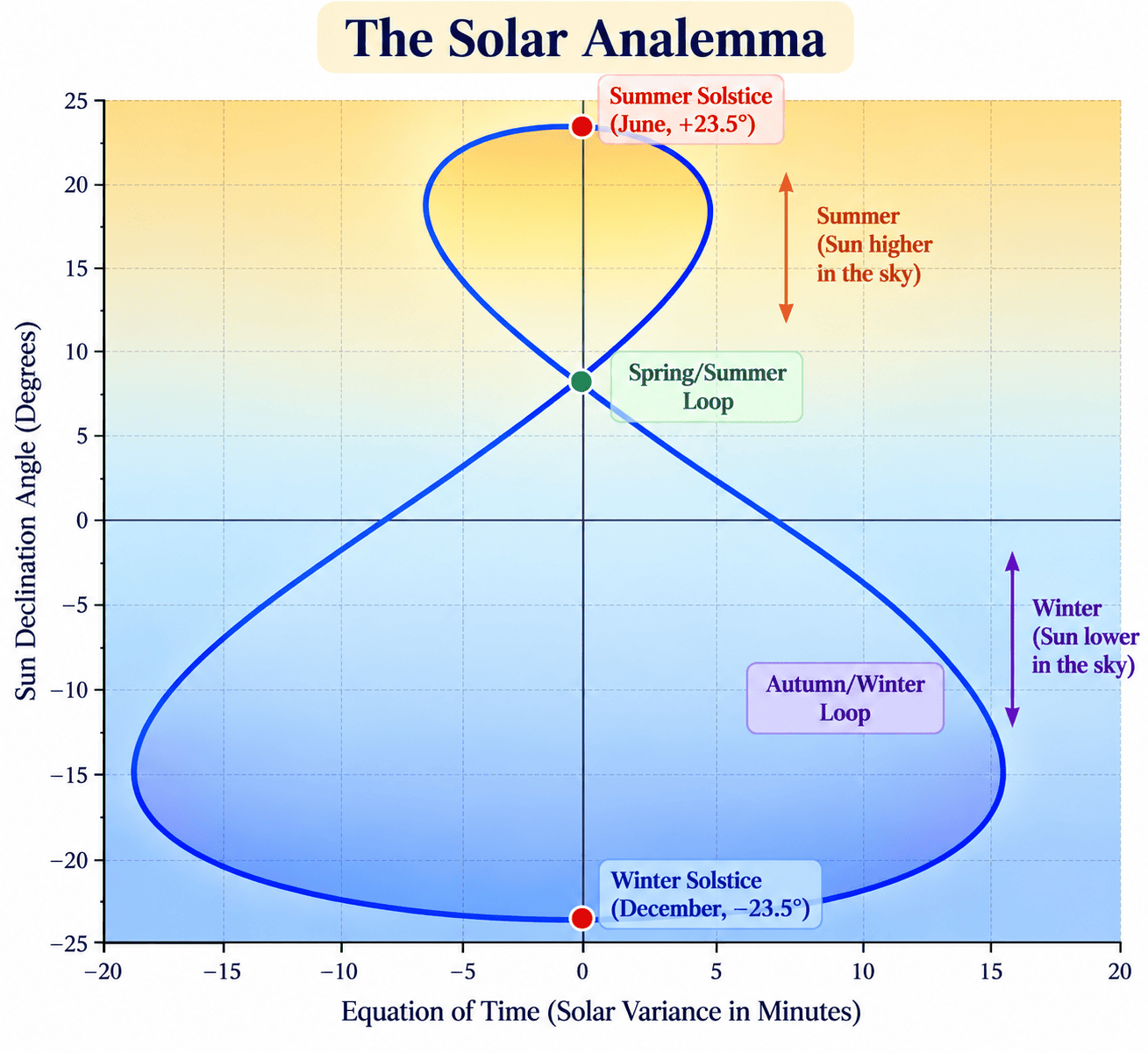
The analemma is much more than an interesting figure-eight pattern made by the Sun. It is a visual record of how the Sun’s apparent position changes throughout the year when observed from the same location at the same clock time every day. Its vertical movement represents the seasonal change in solar declination, while its horizontal movement represents the variation between apparent solar time and mean solar time, described by the Equation of Time. In this way, the analemma brings two important ideas—solar position and solar time—together in a single picture.
For a solar PV installer, this concept is useful because a PV module does not respond to the time shown on a clock; it responds to where the Sun actually is in the sky. For example, 12:00 noon on a clock does not necessarily mean that the Sun is exactly on the local meridian or at its highest position for that day. Depending on the location and time of year, solar noon may occur before or after 12:00 clock time. The analemma makes this difference easy to visualize.
Understanding this variation helps installers and engineers interpret solar-path and shading studies more accurately. A nearby tree, building, parapet, or other obstruction may cast a shadow on the PV array at different clock times during different seasons. Similarly, knowledge of the Sun’s changing position is important when determining module orientation, row spacing, shading periods, and the operation of tracking systems.
The analemma therefore does not directly tell an installer what tilt angle or panel capacity to select. Instead, it develops an important understanding: the Sun’s position at a given clock time is not fixed throughout the year. For anyone working with solar PV, this is the key significance of the analemma—it provides a simple visual bridge between our clock, the seasons, and the actual position of the Sun in the sky.