
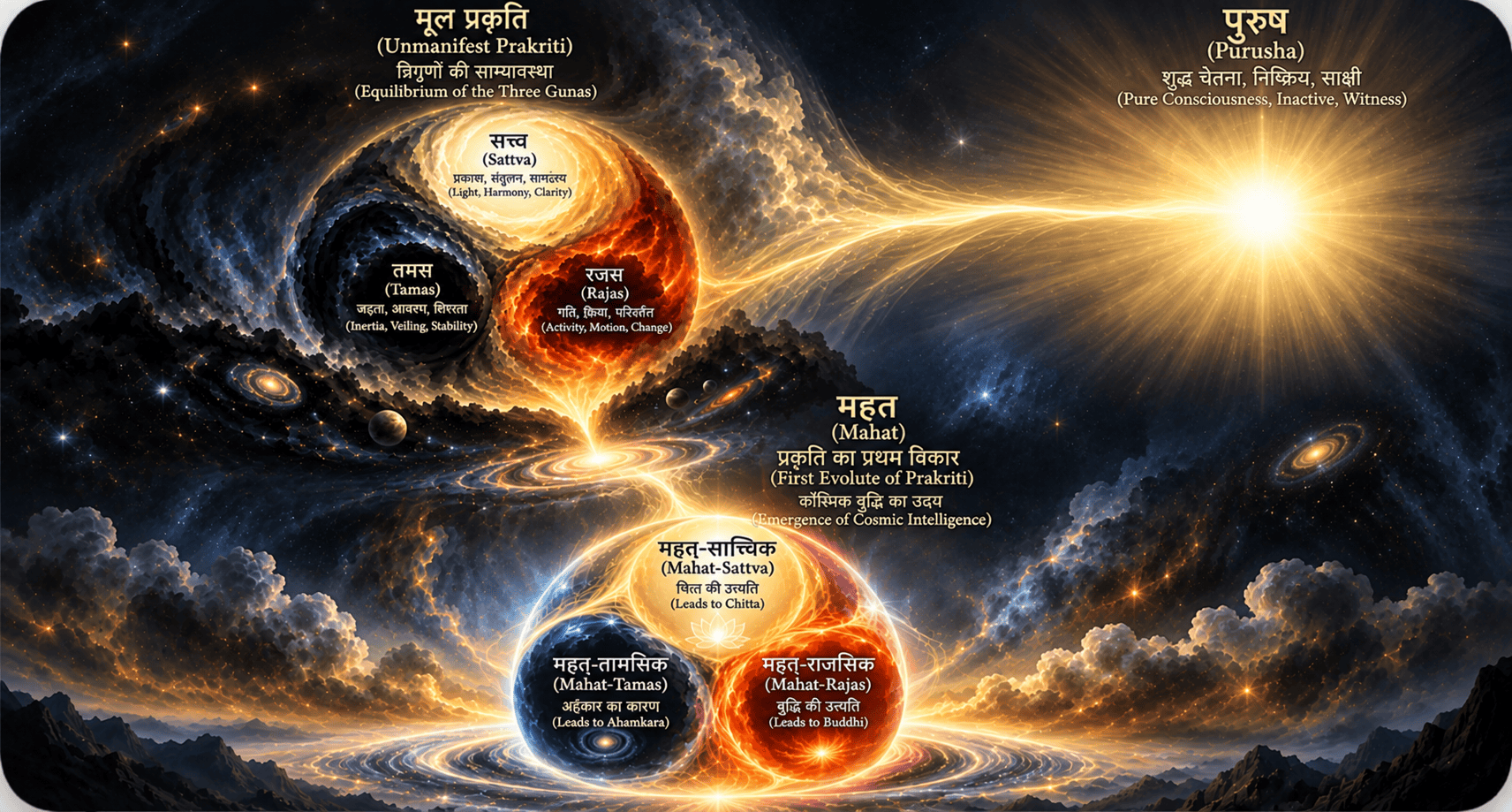
In our previous reflections on Sāṃkhya philosophy, we encountered Prakriti in its most primordial state—unmanifest, yet containing within itself the potential for the entire universe. In this state, its three fundamental Gunas—Sattva, Rajas, and Tamas—exist in perfect equilibrium. Nothing has yet differentiated; no distinct form has emerged. Yet all possibilities remain latent within Prakriti.
One may think of the three Gunas metaphorically as a kind of “cosmic DNA.” Just as a limited set of biological instructions can give rise to extraordinary diversity in living forms, the countless phenomena of existence may be understood, within this framework, as expressions of the three Gunas in different proportions and combinations.
But equilibrium is not the end of the story. Once the balance of the three Gunas is disturbed, possibility begins to move toward expression. Prakriti, until now unmanifest, enters the first stage of its evolutionary unfolding. This first manifestation is Mahat.
With the disturbance of the balance among Sattva, Rajas, and Tamas, Prakriti begins to evolve. What was previously unmanifest begins to manifest. This marks one of the most significant transitions in the Sāṃkhya account of cosmic evolution: the emergence of Mahat, the first evolute of Prakriti.
Mahat is therefore not something created independently of Prakriti. It is Prakriti itself in its first manifest state—the earliest and most subtle expression from which the subsequent stages of evolution unfold.
From Equilibrium to Mahat
Since Mahat arises directly from Prakriti, it necessarily carries within itself the same three Gunas—Sattva, Rajas, and Tamas. The crucial difference is that their original equilibrium has now been disturbed. Consequently, the Gunas begin to appear in different proportions and degrees of predominance.
This gives us a useful way of understanding Mahat through three modes of expression: Mahat-Sattva, Mahat-Rajas, and Mahat-Tamas. These should not be imagined as three entirely separate substances. Rather, each contains all three Gunas, but one or another becomes more prominent.
This distinction is important because the changing dominance of the Gunas gives rise to different functions. In the framework followed here, Mahat-Sattva is associated with the emergence of Chitta, while Mahat-Rajas is associated with Buddhi. Through these developments, the cosmic process begins to acquire a psychological dimension: the principles underlying the universe also become the basis through which experience, understanding and decision-making become possible.
This is one of the most fascinating features of Sāṃkhya: its cosmology gradually becomes a psychology. The unfolding of the universe and the emergence of our inner faculties are not treated as two unrelated stories.
The Three Gunas Within Mahat
In one interpretive framework, the relative predominance of the three Gunas within these expressions of Mahat is represented numerically. These proportions should be understood as an illustrative model rather than as a universally accepted formulation of classical Sāṃkhya.
In Mahat-Sattva, Sattva predominates at approximately 60%, accompanied by 36% Rajas and only 4% Tamas. Its strong Sattvic character is associated with the development of Chitta.
In Mahat-Rajas, the balance changes. Rajas constitutes approximately 50%, while Sattva remains close behind at 46%, with Tamas again at only 4%. This Rajasic predominance is associated with Buddhi. An interesting pattern becomes visible here. Although Mahat-Sattva and Mahat-Rajas differ in which Guna predominates, Tamas remains comparatively insignificant in both, at approximately 4%.
The picture changes considerably in Mahat-Tamas. Here, Tamas predominates at approximately 50%, followed by Rajas at 29% and Sattva at 21%. Within the framework presented in this article, Mahat-Tamas functions as the Upādāna Kāraṇa—the material cause—for the emergence of Ahamkara, the next important evolute.
These proportions illustrate an important philosophical point: the Gunas do not disappear as evolution proceeds; their relationships change. Diversity arises not necessarily because entirely new principles are continually introduced, but because the same fundamental Gunas manifest through different proportions and predominance.
From the Cosmic to the Inner World
At this stage, Sāṃkhya begins to turn from the architecture of the cosmos toward the architecture of experience. Chitta and Buddhi, together with Manas and Ahamkara, constitute what is collectively called the Antahkarana, or the inner instrument.
This transition is philosophically significant. We began with an unmanifest Prakriti in which the three Gunas rested in equilibrium. With the disturbance of that equilibrium, Mahat emerged. Within Mahat, variations in the predominance of the same three Gunas opened the way toward the faculties through which experience, cognition and individuality eventually become possible.
Thus, the journey from Prakriti to Mahat is more than merely the first step in a cosmological sequence. It marks the point at which potential begins to become expression, equilibrium becomes differentiation, and the unmanifest begins its journey toward the world of experience.
Yet an important question remains: how does this universal process eventually give rise to the sense of individuality—the feeling that “I am the thinker” and “I am the doer”? To answer this, Sāṃkhya takes us to the next stage of evolution: Ahamkara. That will be the subject of our next reflection.