There was a time when I lived in a small house on the outskirts of the city, where civilization slowly surrendered itself to nature. The house stood beside a vast stretch of woodland, embraced by towering trees whose branches formed a living canopy above the earth. Every season painted this place with a different emotion.
Winter mornings welcomed me with soft golden sunlight filtering gently through the leaves, while the summer afternoons remained surprisingly cool under the generous shade of ancient trees. Yet it was the rainy season that transformed the landscape into something almost magical.
On rainy days, my room became an orchestra hall designed by nature itself. The steady rhythm of raindrops striking countless leaves created a soothing melody that accompanied every page I read and every sentence I wrote. Occasionally, thunder rolled across the sky like the deep beat of a distant drum, reminding me of nature’s immense power. At times, the sound was so intense that it awakened an instinctive fear, as though some unseen creature from the forest might emerge from the darkness. Even then, the rain never disturbed the peace; it only deepened it.
As I write this story today, that same music still echoes in my memory.
One such rainy afternoon, I sat beside my window with a cup of tea, watching the world outside disappear beneath countless shades of green. The monsoon had awakened every dormant seed. Wild grasses, tiny shrubs, and creeping plants had covered the open field like a living carpet. The earth, softened by continuous rain, breathed with renewed life.
The monsoon brought abundance to the entire landscape. Fresh grass covered the open fields, and farmers often allowed their cattle to wander freely and graze. The animals grazed peacefully, while the forest quietly offered its generosity to all.
As my eyes wandered across the meadow, one particular scene captured my attention.
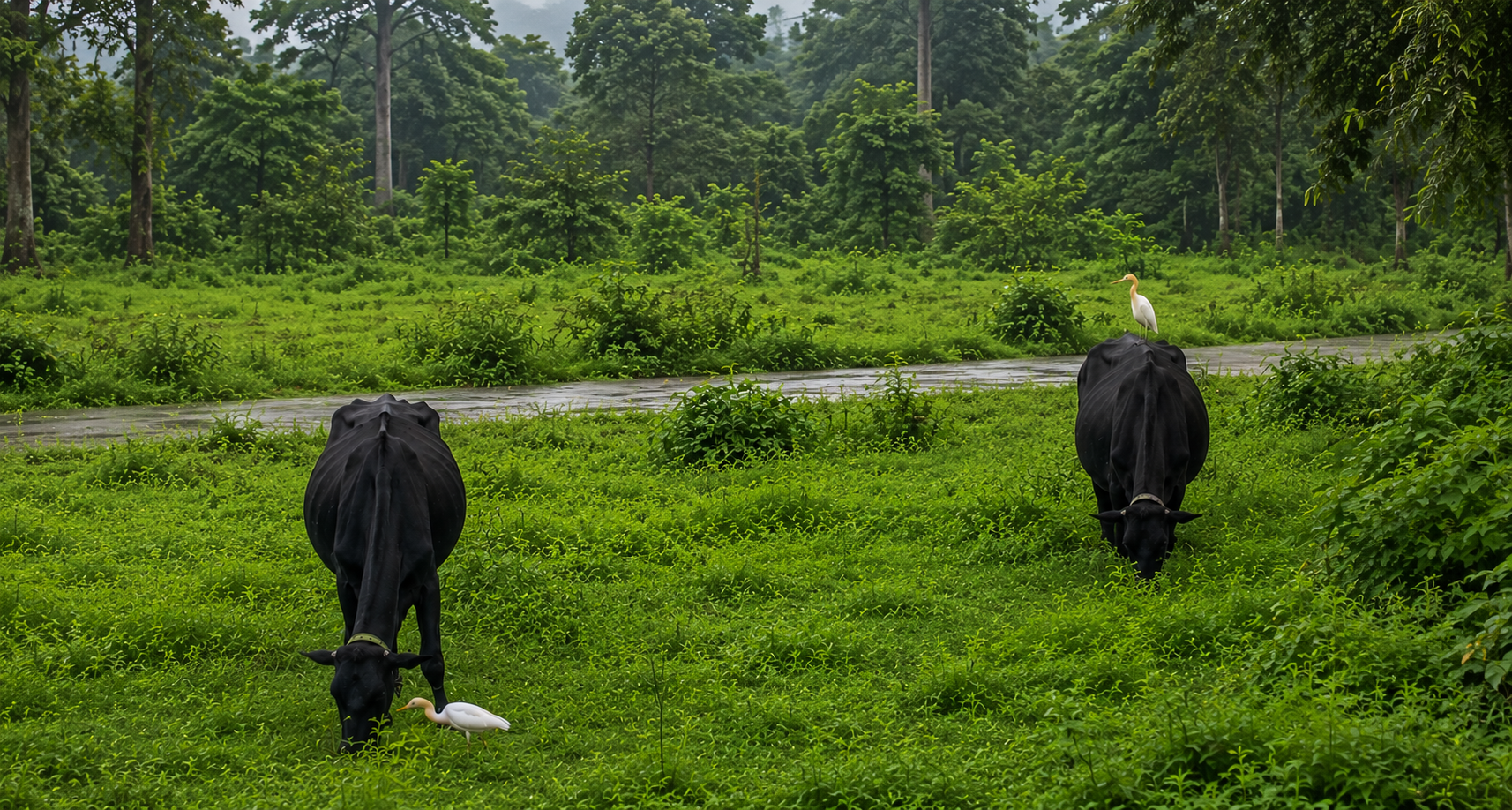
A lean black cow grazed patiently among the lush greenery. Behind her, at a respectful distance, stood the dark forest, silent and watchful, its towering trees disappearing into the mist of the monsoon. Nearby walked a solitary white egret. Its snowy feathers glowed against the emerald field like a tiny floating cloud that had descended to earth.
At first, the two seemed completely unrelated.
The cow lowered her head, tearing at the grass with slow, deliberate movements. The egret wandered independently, disappearing now and then into the tall vegetation before emerging once again. It searched carefully among the grasses, its long neck stretching forward with remarkable patience.
Curious, I continued to watch.
Gradually, I noticed the bird moving closer to the cow. Sometimes it walked beneath her belly. Sometimes it stood just beside her mouth as she grazed. For a brief moment, I smiled at my own imagination.
“Perhaps,” I thought, “the bird is observing the cow just as I am.”
“But nature had a wiser explanation.”
The cow pulled another mouthful of grass. Because the rain had loosened the soil, many plants came out with their roots still attached. In that very instant, tiny worms hidden beneath the roots were suddenly exposed to daylight.
Without hesitation, the egret darted forward.
Its sharp beak picked the worms one after another with astonishing precision before they could burrow back into the soil.
Then the mystery became beautifully clear.
The cow was not feeding the bird intentionally.
The bird was not helping the cow intentionally.
Yet one life was unknowingly creating an opportunity for another, simply by following its own nature.
The cow searched only for grass.
The egret searched only for worms.
“Neither competed. Neither disturbed the other. Neither demanded anything.”
For several minutes, I forgot the rain, the book beside me, and even the thunder rolling through the forest. What I had taken for an ordinary scene—a cow grazing and a bird searching for food—had quietly revealed something profound. Neither creature was trying to help the other, yet the simple act of one had created an opportunity for the other. No agreement had been made. Nothing had been demanded. Life was simply supporting life.
Looking at that quiet companionship between the grazing cow and the patient egret, I began to see harmony differently. It does not always require intention, agreement, or even similarity. Sometimes it emerges naturally when each being follows its own needs without unnecessarily disturbing the life around it.
Perhaps there is a lesson here for us as well. We often imagine survival as a struggle for more—more space, more resources, more control. Yet the forest seemed to suggest something quieter: life can also flourish through coexistence, where the ordinary existence of one being creates possibilities for another.
The future of humanity may not depend upon conquering nature.
It may depend upon rediscovering the quiet balance that nature has practiced for millions of years.
As the rain continued to fall, the cow moved slowly through the grass and the little white egret followed in silence. Neither knew that it was part of a lesson; neither needed to know. The forest stood behind them, ancient and still, as if it had been teaching this truth long before human beings learned to put wisdom into words.
Perhaps nature’s deepest dharma is not written anywhere. It is simply lived—quietly, continuously, one life making room for another.
And perhaps our task is not to teach nature how to survive, but to become quiet enough to learn from it.