
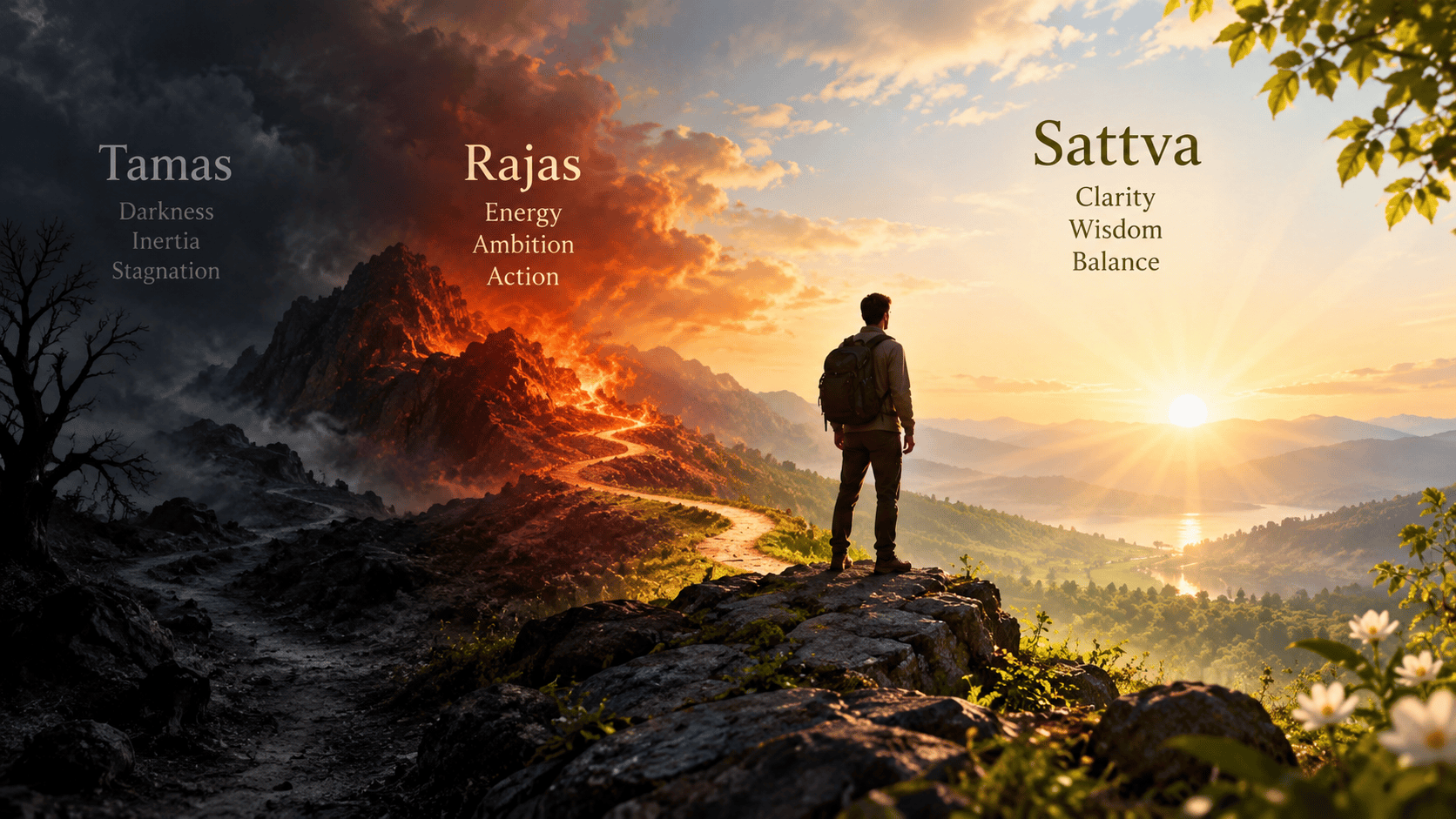
In Sankhya philosophy, Sattva represents purity, light, knowledge, and balance. It influences the way we think, understand, and act. If Tamas is understood as darkness and Rajas as fire, then Sattva is like the light that not only gives us the strength to move forward but also the wisdom to recognize the right direction.
We began our journey of understanding these three qualities of Prakriti with Tamas—a state of inertia, inactivity, and darkness. Tamas holds us back, keeps us still, and often creates a veil under which even the desire to move forward begins to fade. In contrast, Rajas brings movement to this stillness. It is like fire—it gives energy, awakens ambition, and creates the desire to do something, become something, and achieve something. If Tamas holds us back, Rajas pushes us forward. Perhaps it is this Rajas that led humans to explore, create, develop civilizations, and cross boundaries that once seemed impossible.
But fire has another side—if it is not given direction, the same fire that gives momentum to life can also become a cause of destruction. When this fire becomes uncontrolled and turns into a desire to acquire more than one’s rightful share, human judgment begins to blur. The desire for success can turn into greed, jealousy, and competition, and that same energy can ultimately become harmful to both the individual and society.
When “I want to achieve something” turns into “I want more at any cost,” Rajas begins to shift from ambition to greed, from competition to jealousy, and from action to attachment. In that state, a person may have great energy, but the wisdom that guides it in the right direction gradually begins to fade.
But the journey of fire does not end here. Imagine this same fire becoming more and more intense until it reaches a certain point where its very nature begins to change. Its purpose is no longer merely to burn or provide heat; it begins to give light.
The fire of Rajas → rising heat → emergence of light → awakening of wisdom.
Imagine a hot object. As its temperature rises, it mainly gives off heat, but beyond a certain point, the same object begins to emit light as well. Heat an iron rod. At first, we mainly feel its heat, but as the temperature continues to rise, a point comes when the rod begins to glow. As a metaphor, the fire of Rajas, refined through experience and self-realization, also moves towards the light of Sattva.
This metaphor can help us understand the relationship between Rajas and Sattva. When the fire of Rajas within a person crosses a certain threshold of experience and self-realization, the light of Sattva begins to emerge from that same energy. The intensity of action remains, but now wisdom begins to guide that energy in the right direction.
The fire of Rajas now begins to transform into the light of Sattva.
Recognizing Sattva does not require any extraordinary spiritual experience. It can be seen in our small everyday decisions—in thinking before reacting, maintaining ethics amid competition, and not wishing for someone else’s failure for our own success.
Suppose two people at a workplace are competing for the same promotion. Rajas motivates both to work hard, perform better, and move ahead. There is nothing wrong with this. But when the desire to get ahead becomes so strong that a person begins to wish for the other’s failure, take credit for their work, or use unfair means for personal gain, Rajas begins to cross its limits.
In contrast, a Sattvic person also wants the promotion, works hard, and strives to move forward to the best of their ability. The only difference is that they do not consider harming someone else necessary for their own success. For them, success is important, but the path to success is equally important.
Therefore, Sattva does not mean giving up desires. It means allowing the light of wisdom to guide our desires.
We work, earn, move forward, compete, and strive to fulfil our dreams—but one question remains alive within us:
“Is my progress good only for me, or is there also some space in its light for the people around me?”
Sattva helps us think clearly, make sound decisions, and grow spiritually. It does not force change but gently guides us towards the right path, like the soft light of morning. Sattva quietly enters the mind, clears confusion, and helps us understand that true knowledge does not come from outside but emerges from within—when the mind is calm and pure. By cultivating Sattva, a person can not only live a peaceful and meaningful life but also move towards the ultimate goal of life—Moksha.
From the Sankhya perspective, all three Gunas work together in Prakriti. Therefore, the purpose of life is not to completely eliminate Rajas or Tamas, but to keep them in a balanced state guided by wisdom. Rest is necessary, but it should not become laziness; ambition is necessary, but it should not become greed—this is where the role of Sattva emerges.
From the darkness of Tamas to the fire of Rajas, and from the fire of Rajas to the light of Sattva—this is not merely the story of the three Gunas.
It is the journey of the evolution of human consciousness.