
In the previous articles of our “Is Your Home Solar Ready?” series, we explored two fundamental questions: Does your rooftop have enough shadow-free space for solar panels? And how large should your solar PV system be based on your household electricity consumption?
Now imagine that you have completed both exercises. You know where the panels can be installed and approximately how much solar capacity your home needs. You may feel that you are finally ready to install your rooftop solar plant—but one important decision still remains.
What type of solar PV system should you choose?
Should your system operate independently of the electricity grid, remain connected to it, or include battery storage as an additional backup? Each option works differently and has its own advantages, limitations, and costs. Understanding these differences is essential before deciding which system is most suitable for your home.
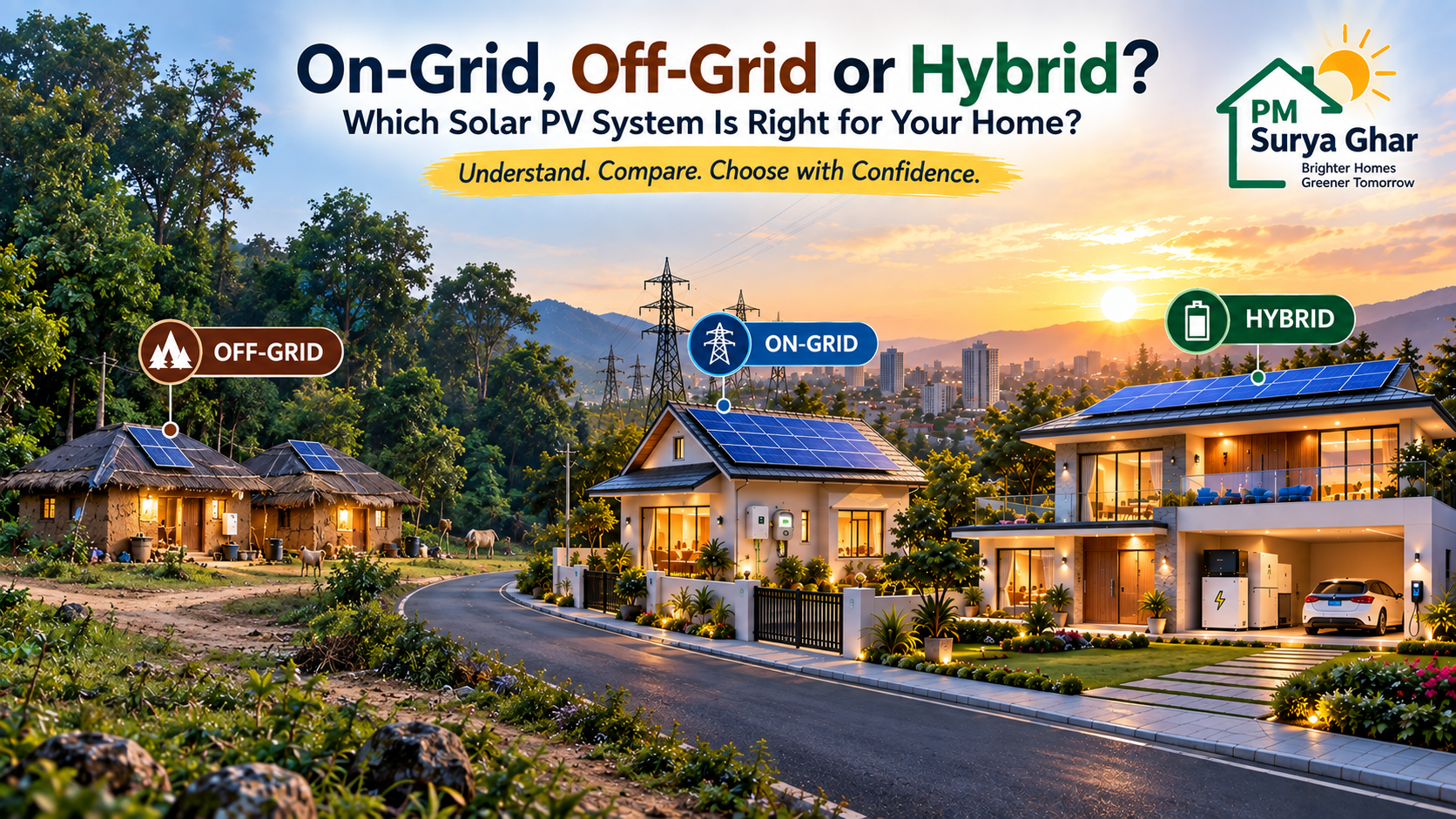
Broadly, residential solar PV systems can be classified into three categories: off-grid, on-grid, and hybrid systems. Let us begin with the off-grid system.
An off-grid, or standalone, solar PV system operates independently of the local electricity grid. Such systems are particularly useful in locations where a reliable grid connection is unavailable. Electricity generated by the solar panels is supplied through the inverter to the household electrical system, with appropriate switching and protection devices incorporated to ensure safe operation. Since there is no grid to support the house when solar generation is insufficient, energy storage is generally required if electricity is needed when adequate solar power is unavailable.
Now consider a very different situation. Your house is already connected to the electricity grid, but you also install a rooftop solar plant. This is where an on-grid solar PV system becomes interesting because your home can use electricity from two sources—the sun and the grid.
Imagine your home is consuming 6 kW at a particular moment, while your rooftop solar plant is generating only 2.5 kW. The solar electricity is utilized by the house, while the remaining 3.5 kW required to meet the load is drawn from the grid. From inside the house, you hardly notice this balancing act taking place—your appliances simply continue to operate.
But now imagine the opposite situation.
It is a bright weekday afternoon. The adults are away at work or business, the children are at school, and only a few appliances are operating. Your household load has fallen to just 1 kW, while the rooftop solar system is still producing 2.5 kW. The house can consume 1 kW of that solar generation, leaving 1.5 kW of surplus electricity. Under an applicable net-metering arrangement, that surplus can flow into the electricity grid, while a bidirectional/net meter keeps track of electricity imported from and exported to the grid.
And this is where an on-grid rooftop system becomes particularly interesting for a homeowner.
During periods when nobody is home and electricity consumption is very low, a substantial part of the solar electricity generated on the rooftop may be exported to the grid instead of going unused. At other times—during the evening, at night, or whenever household demand exceeds solar generation—the home draws the required electricity from the grid.
At the end of the billing period, the electricity imported from and exported to the grid is accounted for according to the net-metering or billing regulations applicable in your State or Union Territory. In favourable circumstances, sufficient solar generation can substantially reduce the household’s net electricity consumption from the grid and, depending on the applicable tariff and metering rules, may even result in a very low or zero energy charge.
So, an on-grid solar plant is not simply a collection of panels generating electricity on your rooftop. It creates a two-way relationship between your home and the electricity grid—drawing electricity when you need more and, where permitted, sending surplus solar electricity back when your rooftop produces more than you need.
But what if you want the benefits of a grid-connected system while also having electricity stored for emergencies? This brings us to the third option—the hybrid solar PV system, which combines the benefits of a grid-connected system with battery storage at home. During normal conditions, solar energy can meet the household load, while surplus electricity may be stored in batteries or exchanged with the grid according to the applicable metering arrangement. The stored energy therefore provides an additional layer of energy security, particularly during grid outages or periods when solar generation is insufficient to meet household demand.
However, this additional security comes at a cost. Batteries increase the initial investment, system complexity, and eventual replacement cost of a rooftop solar plant. Since prolonged grid failures and extreme weather conditions may not be frequent in many locations, homeowners with a reliable electricity supply may find a conventional grid-connected system more economical. The final choice should therefore depend on the reliability of the local grid, frequency of power outages, need for backup power, and the homeowner’s budget.
PM Surya Ghar: Government Support for Your Rooftop Solar
If you are considering a grid-connected rooftop solar system, there is another important reason to explore this option. The Government of India is supporting residential rooftop solar through the PM Surya Ghar: Muft Bijli Yojana. Approved on 29 February 2024, the scheme aims to promote rooftop solar installations in one crore households and help households access free or low-cost electricity through solar generation. The scheme is currently scheduled to be implemented until 31 March 2027.
An important point is that under the PM Surya Ghar: Muft Bijli Yojana, Central Financial Assistance (CFA) is primarily available for grid-connected residential rooftop solar systems. Certain battery-hybrid systems with battery storage that remain connected to the grid may also be eligible, subject to approval by the respective Electricity Regulatory Commission and compliance with DISCOM requirements. However, off-grid installations are not eligible for CFA under the scheme.
How Much Financial Assistance Can You Get?
Under the scheme, an eligible residential consumer can receive Central Financial Assistance (CFA) of ₹30,000 per kWp for the first 2 kWp and ₹18,000 for the additional 1 kWp, giving a maximum standard central assistance of ₹78,000 for a residential rooftop system of 3 kWp or above. No additional CFA is provided for capacity beyond 3 kWp. Special Category States and UTs have higher prescribed CFA rates.
The scheme also extends support to Group Housing Societies (GHS), Resident Welfare Associations (RWAs) and similar residential bodies for solar installations serving common facilities, including EV charging. CFA is available at ₹18,000 per kWp, subject to an eligible capacity of up to 500 kWp and a limit of 3 kWp per household.
So, Which Solar System Is Right for Your Home?
Choosing a rooftop solar system is not simply about deciding how many panels can fit on your roof. It is also about understanding how your home uses electricity, how reliable the local grid is, whether you need backup power, and how much you are willing to invest.
For homes with a reliable grid connection, an on-grid rooftop solar system can often provide a practical and economical solution. It allows your home to use solar electricity whenever it is available, draw additional electricity from the grid when required, and, under the applicable metering arrangement, export surplus solar generation to the grid. A hybrid system adds the security of battery storage, but this additional flexibility comes with higher initial and replacement costs. An off-grid system, on the other hand, is more relevant where access to a reliable electricity grid is limited or unavailable.
The PM Surya Ghar: Muft Bijli Yojana makes the grid-connected option even more attractive for eligible residential consumers by providing Central Financial Assistance for rooftop solar installations. It is the Government of India’s current programme providing CFA for eligible residential rooftop solar installations, including support for individual households and common facilities of RWAs and Group Housing Societies. The earlier Grid Connected Rooftop Solar Phase-II Programme has been subsumed into this scheme.
So, before asking an installer for a quotation, ask yourself one final question: Do I simply want to generate solar electricity, or do I also need to store it? Your answer, together with the reliability of your local grid and your household electricity pattern, will help determine whether an on-grid, hybrid, or off-grid system is the right choice for your home.
With this decision made, your home is one important step closer to being truly solar ready.