
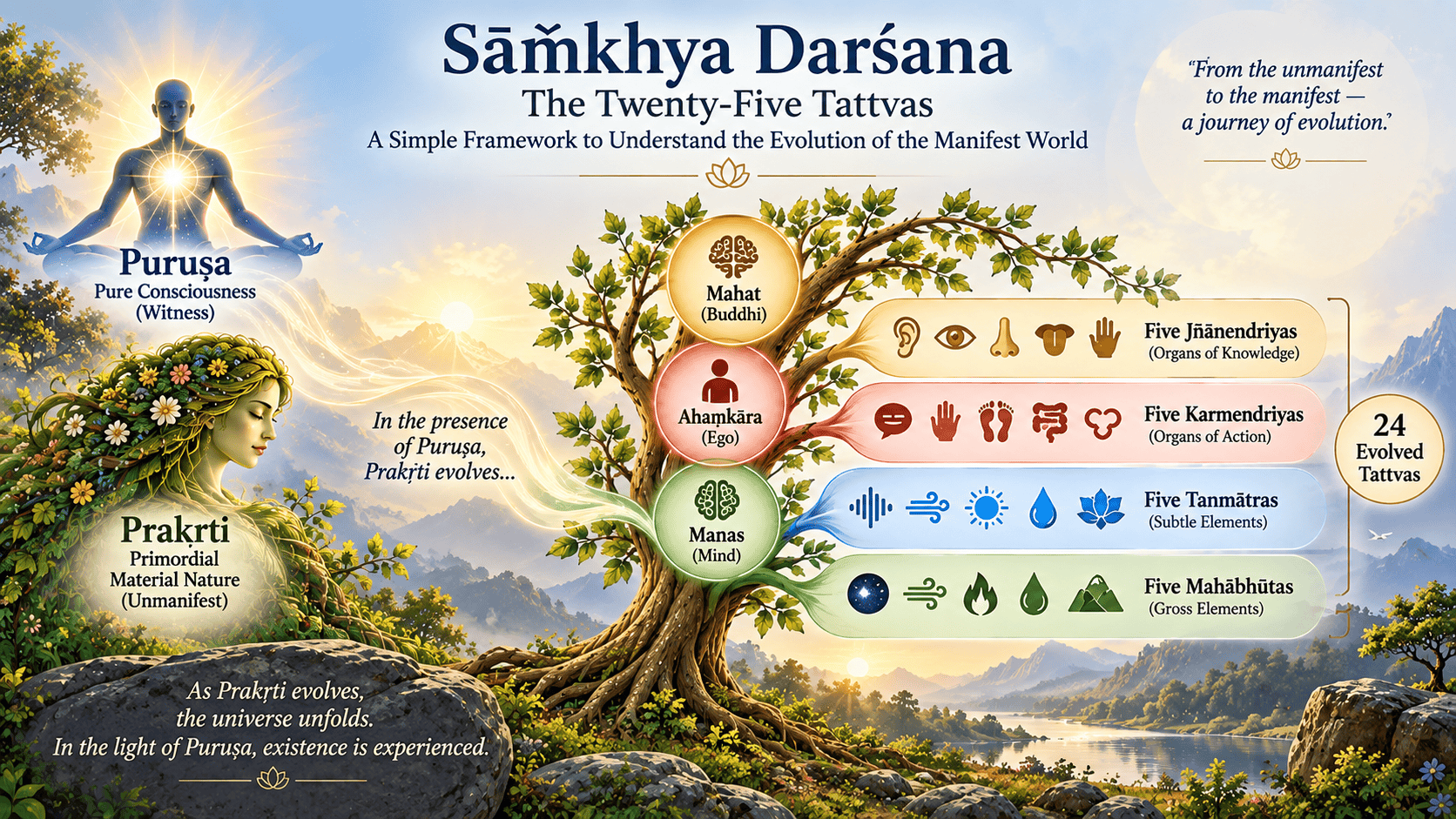
In the blogs so far, we have tried to understand some of the fundamental concepts associated with Sāṃkhya philosophy. Sāṃkhya is a highly systematic and analytical philosophy, but because it deals with profound subjects such as Prakṛti, consciousness, and the evolution of the manifest world, some of its concepts may initially appear complex. Therefore, before moving further, it would be useful to understand some of the principal tattvas and philosophical terminology used in Sāṃkhya through a simple framework.
In this article, we will try to understand the twenty-five tattvas of Sāṃkhya, the cause-and-effect relationships among them, and some important philosophical terms, so that it becomes easier to connect and understand the concepts that follow.
Sāṃkhya philosophy explains the universe through the relationship between two fundamental principles—Puruṣa and Prakṛti. Puruṣa represents pure consciousness, or the witnessing principle, while Prakṛti represents primordial material cause. But an interesting question arises here—if Puruṣa is merely the witness and Prakṛti is still in an unmanifest state, how does this diverse world that we see around us come into existence? Sāṃkhya answers this question through an ordered sequence of tattvas that evolve from Prakṛti.
According to Sāṃkhya, the entire world of our experience can be understood through twenty-five tattvas. These are—Puruṣa, Prakṛti, Mahat (Buddhi), Ahaṃkāra, Manas, the five Jñānendriyas (ears, skin, eyes, tongue, and nose), the five Karmendriyas (speech, hands, feet, excretion, and reproduction), the five Tanmātras (sound, touch, form, taste, and smell), and the five Mahābhūtas (ākāśa, air, fire, water, and earth).
Among these twenty-five tattvas, Puruṣa is the conscious principle and remains separate from the process of material evolution, while the remaining twenty-four tattvas are associated with Prakṛti and constitute the material or psycho-physical world. These tattvas evolve according to a systematic cause-and-effect relationship. Prakṛti is the fundamental material cause from which Mahat (Buddhi) arises; therefore, Prakṛti is the cause and Mahat is its effect. Subsequently, Mahat itself becomes the cause of Ahaṃkāra. Thus, Ahaṃkāra is, on the one hand, the effect of Mahat and, on the other, the cause of the tattvas that evolve further. From Ahaṃkāra, various tattvas develop, ultimately including Manas, the five Jñānendriyas, the five Karmendriyas, and the five Tanmātras. From the Tanmātras, as subtle elements, arise the five Mahābhūtas—ākāśa, air, fire, water, and earth—from which the gross material world manifests.
Thus, in Sāṃkhya philosophy, the evolution of Prakṛti can be understood as a continuous chain of cause and effect, in which an effect produced at one stage becomes the material cause for the next stage. In this sequence, Prakṛti occupies a unique position because it is the fundamental cause but is not itself the effect of any preceding tattva. In contrast, the intermediate evolved tattvas perform both roles—they are effects of their preceding tattvas and causes of those that follow them. At the final stage of this evolutionary chain are the five Mahābhūtas, which are only effects and do not give rise to any further tattva. Puruṣa, in contrast, is neither produced from Prakṛti nor does it produce any other tattva; it remains separate from the entire process of material evolution as pure consciousness and witness.
Thus, In Sāṃkhya, the manifest world does not appear suddenly; it unfolds through a gradual process of evolution in which each stage becomes the effect of the preceding tattva and the cause of the next. In brief, it can be understood as follows:
Prakṛti (fundamental cause) → Mahat (Buddhi) → Ahaṃkāra → various subtle, mental, and sensory tattvas
Tanmātras → Five Mahābhūtas (the final gross elements)
Puruṣa, meanwhile, remains separate from this entire cause-and-effect chain as pure consciousness.
Along with the twenty-five tattvas, it is also useful to understand certain philosophical terms such as Upādāna Kāraṇa, Sahakārī Kāraṇa, and Nimitta Kāraṇa in order to understand the cause-and-effect relationship. In Sāṃkhya philosophy, Prakṛti is regarded as the material cause of the universe. In philosophical terminology, it is called the Upādāna Kāraṇa because it provides the material from which all objects and forms evolves. From a philosophical perspective, this distinction is explained through three types of causes:
Upādāna Kāraṇa is the material from which an object is made.
Sahakārī Kāraṇa refers to the supporting factors that assist in the process of construction or creation.
Nimitta Kāraṇa is the cause whose role makes the performance or evolution of an action possible, while it is not itself the material substance of that action.
This can be understood through a simple example. Suppose a building is being constructed. The bricks of the building are the Upādāna Kāraṇa because without them the building cannot exist. The labourers, craftsmen, and masons are the Sahakārī Kāraṇa because they assist in constructing the building. But the architect or engineer, who plans the building and determines its form, is the Nimitta Kāraṇa.
Now, keeping this example in mind, let us return to Sāṃkhya. Here, the role of Prakṛti is distinctive.
Since Prakṛti is regarded as the primordial or fundamental cause of material evolution, it is not itself the effect of any preceding cause. In this sense, Prakṛti may be regarded as the fundamental material principle from which the process of the evolution of the manifest world begins. Puruṣa, on the other hand, represents pure consciousness and remains separate from the entire process of material evolution. It neither undergoes any evolution or transformation itself nor directly participates in the transformation of Prakṛti. According to Sāṃkhya, in the presence of Puruṣa, the equilibrium of the three guṇas of Prakṛti is disturbed, and the process of its evolution begins, resulting in the manifestation of the phenomenal world.
Thus, Sāṃkhya philosophy accepts two independent and fundamental realities—Puruṣa, the conscious principle, and Prakṛti, the material principle. Since Sāṃkhya explains existence and the manifest world on the basis of these two distinct and fundamental principles, Sāṃkhya philosophy is generally classified as a dualistic philosophy.
Sāṃkhya philosophy, propounded by Maharṣi Kapila, presents a systematic metaphysical structure of twenty-five tattvas, including the evolution from Mahat to Ahaṃkāra, the Manas , Karmendriyas, Tanmātras, and the five Mahābhūtas. All these tattvas are connected to one another in an ordered sequence and explain the process of the evolution of the manifest world. This metaphysical structure also provides a basis for understanding the relationship between the individual and the wider world. This arrangement of subtle and gross tattvas indicates that human beings and the world they experience are related to the same fundamental principles of Prakṛti.
Thus, Sāṃkhya philosophy provides us with a perspective through which evolution can be understood not merely as a list of different tattvas, but as a systematic cause-and-effect process. Prakṛti is the fundamental material cause of this evolutionary sequence, while Puruṣa, as pure consciousness, remains a separate witness to the entire process. The tattvas evolving from Prakṛti gradually manifest the world from the subtle to the gross, ultimately reaching the five Mahābhūtas. Thus, on the one hand, Sāṃkhya accepts two independent fundamental realities in the form of Puruṣa and Prakṛti, while on the other, it explains the structure of the manifest world through the tattvas that evolve from Prakṛti. Once we become familiar with these fundamental concepts and philosophical terms, it becomes much easier to understand the deeper topics of Sāṃkhya philosophy that follow.