
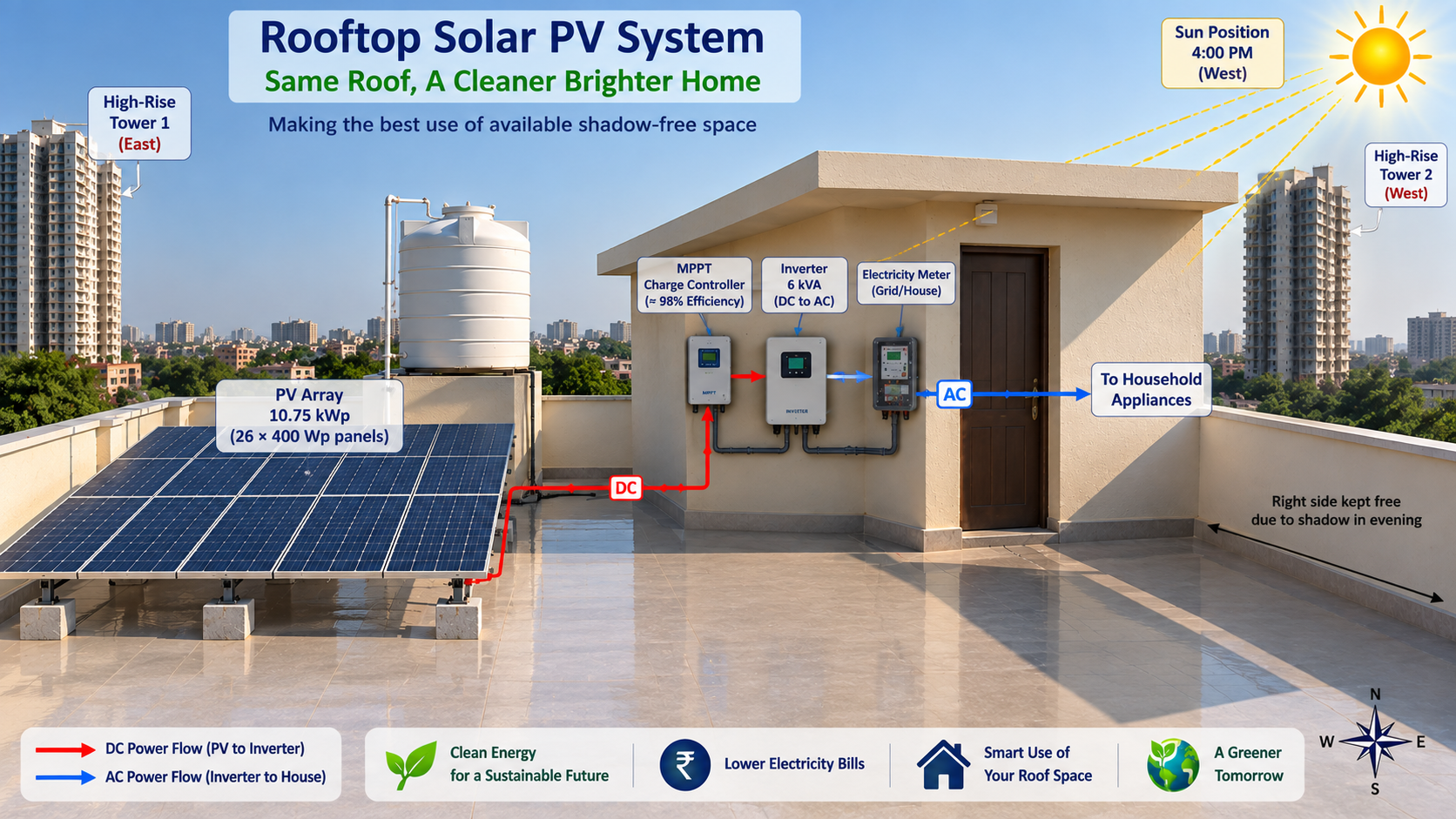
In the previous article, you learned how to identify the available shadow-free area on your rooftop. Now that you have mapped your rooftop and know how much usable space is available for solar panels, the next important step is to understand your home’s electricity consumption pattern. Only after estimating your household’s electricity demand can you determine the appropriate capacity of the solar PV system required to meet your daily energy needs. Correct system sizing is crucial. An undersized solar PV system may fail to meet your expectations and leave a significant portion of your electricity demand dependent on the grid, while an unnecessarily oversized system may increase the initial investment without providing proportional benefits. A solar PV system primarily comprises PV panels that generate DC power, a charge controller that regulates and transfers this power to the inverter, and an inverter that converts DC power into AC power for use by household appliances through the electrical distribution system and energy meter.
The first and most important step in sizing a solar PV system is to understand how much electricity your home actually needs. Fortunately, you do not need any sophisticated equipment to make a reasonable estimate. Simply walk through your house and list the electrical appliances you commonly use—lights, fans, television, refrigerator, washing machine, air conditioner, computer, water pump, and so on. Note the power rating in watts (W) written on each appliance or its nameplate, count how many such appliances you have, and estimate how many hours each operates in a typical day. The daily energy consumption of each appliance can then be calculated as Number of appliances × Power rating (W) × Hours of use per day. Add the consumption of all appliances to obtain your household’s total daily energy requirement in watt-hours (Wh/day); divide by 1,000 to express it in kilowatt-hours (kWh/day), or units of electricity. This simple exercise turns your everyday household routine into a useful energy profile—and provides the starting point for deciding how large your solar PV system should be.
However, another simple and more realistic way to estimate your household’s energy requirement is to use your electricity bills—they already contain the answer. Collect the electricity bills for the last 12 months, note the units (kWh) consumed in each billing period, add them together, and divide the total by 12 to obtain the average monthly electricity consumption. Using a full year is important because household electricity demand changes considerably with the seasons: air conditioners may dominate consumption in summer, while heaters, geysers, or longer lighting hours may increase demand in winter. The annual-bill method naturally captures these seasonal variations and avoids errors caused by incorrectly identifying appliance ratings or guessing how many hours each appliance operates every day. The average monthly consumption can then be divided by approximately 30 days to estimate the average daily energy requirement in kWh/day, providing a simple and practical starting point for sizing your rooftop solar PV system.
Once the daily energy requirement is known, the next step is to determine the inverter size. In this particular case, the daily energy consumption of the house is 38,300 Wh/day or 38.3 kWh/day, which means that the inverter should have an output capacity of 38.3 kWh. Suppose the inverter has an efficiency of 95%; therefore, to provide an output of 38.3 kWh, it must receive an input of around 40.3 kWh from the charge controller. However, commercially available inverters have their capacity specified in kVA rather than kWh.
Therefore, to size the inverter based on the appliances used in the house, first determine its operating load by calculating the total load of all the appliances as Number of appliances × Power rating (W), using the following relation:
Inverter operating load = Σ [No. of appliances × Power rating (W)] = 6050 W
Power Rating of Inverter = 6050 W or 6050 VA = 6.05 kVA
In this case, the required inverter capacity comes out to be 6.05 kVA. Therefore, a commercially available inverter of approximately 6.0 kVA capacity can be selected.
Once the inverter capacity is determined, the next question is: how much current will the inverter actually supply to your household load? This can be estimated easily from the operating load and inverter output voltage. For a household load of 6050 W at 230 V, the current flowing from the inverter to the AC load is Current = Operating Load / Inverter Voltage = 6050 W / 230 V ≈ 26.3 A. Thus, the inverter should be capable of continuously supplying approximately 6.05 kW of load and 26.3 A of current at 230 V. This simple calculation helps ensure that the selected inverter can safely handle the expected household load. Now, moving one step backward towards the solar array, if the charge controller operates at 98% efficiency, it must receive approximately 41.2 kWh/day of energy from the PV array to deliver the required energy to the inverter.
Now comes the most practical question: how many solar panels will your home actually need? The answer mainly depends on two things—your household’s daily energy requirement and the amount of sunlight available at your location. In our example, the PV array needs to supply about 41.2 kWh of energy per day to the charge controller. If your location receives about 4 peak-sun-hours per day, the required solar PV capacity would be around 10.3 kWp (41.2 ÷ 4). However, at a sunnier location receiving about 6 peak-sun-hours per day, the required capacity drops to approximately 6.86 kWp (41.2 ÷ 6). So, the idea is quite simple: the more useful sunlight your rooftop receives, the smaller the PV array required to produce the same amount of daily energy.
Finally, we arrive at the question every homeowner wants answered: how many solar panels will my rooftop actually need? Once the required PV array capacity is known, the calculation becomes quite simple—divide the required array capacity by the rated power of one solar panel and round the result up to the next whole number. For example, with 400 Wp solar panels, a 10.3 kWp system would require 10.3 × 1000 ÷ 400 = 25.75, or approximately 26 panels, at a location receiving about 4 kWh/m²/day of solar radiation. Similarly, an 6.86 kWp system would require about 6.86 × 1000 ÷ 400 = 17.15, or approximately 18 panels, at a location receiving about 6 kWh/m²/day. The number will naturally change if you choose panels of a different wattage. And that completes your basic solar-sizing exercise: starting with your household electricity consumption, you can work your way through the inverter requirement, local solar availability, PV array capacity, and finally arrive at the number of solar panels your own home may need. In other words, the right rooftop solar system is not decided by guesswork—it is shaped by how much electricity your home uses, how much sunshine your location receives, and the capacity of the solar panels you choose.

Very nicely explained about the PV system calculation and one can find the approximate cost of the cost of the plant for his home
Mathematical calculation done in the article is very clear and understandable