
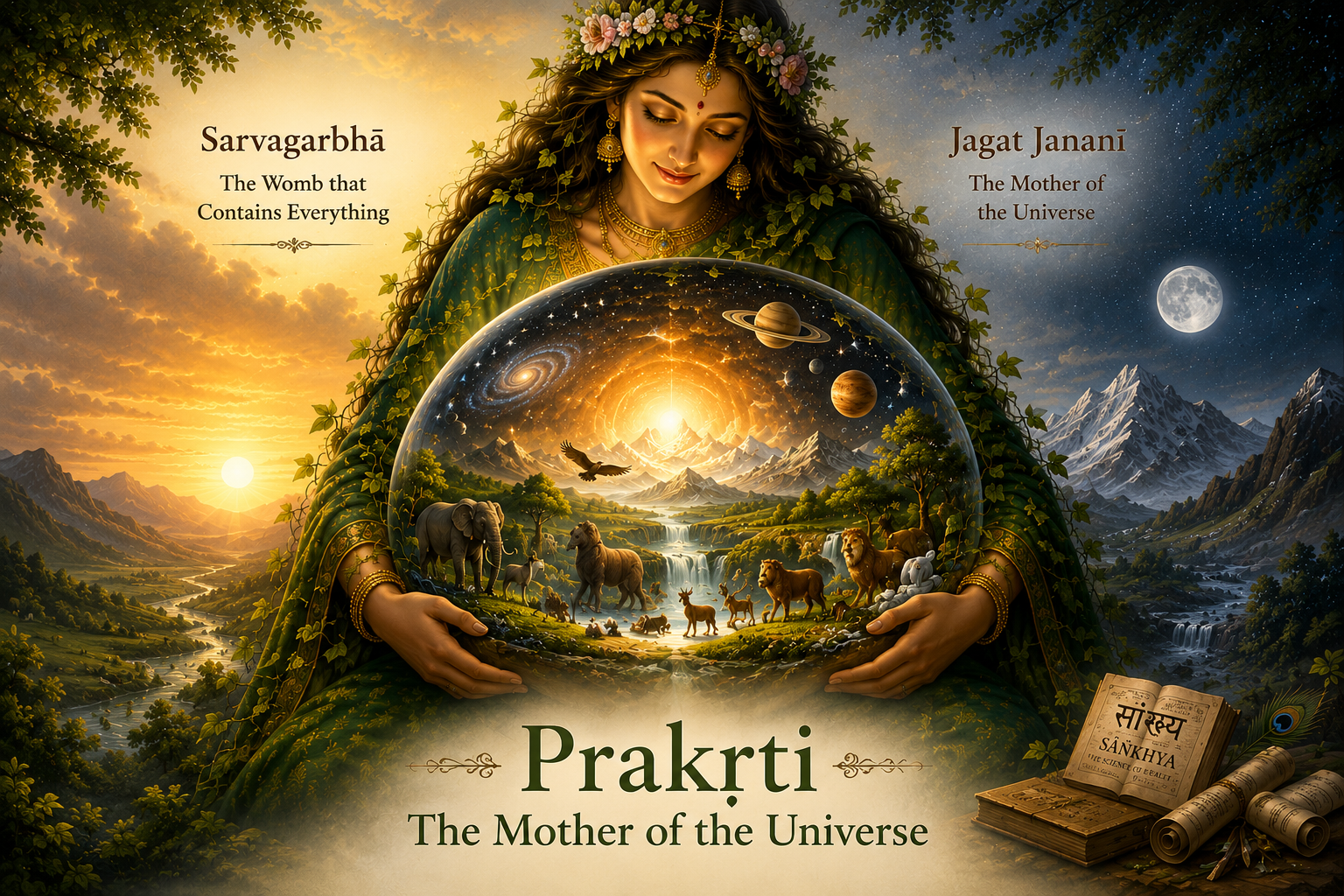
In the previous article, we explored Satkāryavāda, a foundational principle of Sāṃkhya philosophy, which holds that every effect (kārya) already exists in potential within its material cause (upādāna kāraṇa). Nothing emerges from nothing; what appears as creation is essentially the manifestation of what already exists in an unmanifest form.
From this principle emerges Sāṃkhya’s profound conception of Prakṛti—the primordial material cause of the universe, carrying within itself the potential for the countless forms of existence. From the vastness of the cosmos to the subtlest dimensions of material and psychophysical nature, all are understood as manifestations of Prakṛti.
Perhaps this limitless potential is best captured in the ancient names Sarvagarbhā—“the womb that contains everything” and Jagat Jananī—“the mother of the universe.”
But one profound question remains: How can one Prakṛti unfold into such an astonishingly diverse universe?
If the universe arises from one primordial Prakṛti, how does one source give rise to such extraordinary diversity?
This raises the central question: How can one Prakṛti give rise to the extraordinary diversity of the universe? Sāṃkhya approaches this question by looking beyond the apparent differences among things and identifying the fundamental characteristics common to all manifestations of nature.
According to Sāṃkhya, every manifestation of Prakṛti—whether physical, biological, sensory, mental, or emotional—exhibits, in varying degrees, three fundamental tendencies: illumination and harmony, activity and transformation, and resistance and stability. These universal tendencies are termed Sattva, Rajas, and Tamas, respectively. Since no manifestation of Prakṛti is considered entirely independent of these three tendencies, Sāṃkhya proposes that Prakṛti itself is constituted by these three inseparable Guṇas. Their proportions and predominance may vary, but all three remain inherently present.
Here, Guṇa should not be understood merely as a “quality” added to Prakṛti; rather, the three Guṇas are its fundamental constituents or modes of operation.
Sattva — Illumination and Harmony: Sattva expresses itself through clarity, knowledge, lightness, balance, tranquillity, and harmony. It accounts for the illuminating and ordering tendency through which clarity and understanding become possible.
Rajas — Activity and Transformation: Rajas represents motion, energy, stimulation, desire, effort, and change. It provides the dynamic tendency necessary for activity, interaction, transformation, and continuous change within manifested nature.
Tamas — Resistance and Stability: Tamas represents heaviness, inertia, resistance, obscuration, and stability. Although associated psychologically with ignorance or dullness, its stabilising and restraining tendency is equally essential for persistence and relative stability.
Thus, the three Guṇas should not be viewed as competing moral categories of “good” and “bad.” They constitute a complementary framework: Sattva illuminates, Rajas activates, and Tamas stabilises. Their continuously varying interplay enables one Prakṛti to manifest as the immense diversity of the universe.
When the Three Guṇas Are in Equilibrium
Before manifestation, Sattva, Rajas, and Tamas exist in perfect equilibrium, forming the unmanifest state of Prakṛti. Nothing is absent; the entire potential for manifestation remains latent within it. This connects the three Guṇas with Satkāryavāda, according to which effects pre-exist within their cause. When the equilibrium among the Guṇas is disturbed, their varying interactions initiate differentiation, and from this differentiation begins the process of cosmic evolution and manifestation.
From One Prakṛti to an Infinitely Diverse Universe
The three-Guṇa doctrine explains how immense diversity can emerge from one Prakṛti. Sattva, Rajas, and Tamas are not separate substances but inseparable constituents of Prakṛti, present in varying proportions in every manifestation. Their changing predominance and interaction produce the diversity observed throughout nature. Thus, Sāṃkhya explains how unity becomes multiplicity and potential becomes manifestation, without equating the Guṇas with particles, forces, or other concepts of modern physics.
The Universe Outside—and the Nature Within
Sāṃkhya does not restrict the three Guṇas to the external universe; they also explain our mind, emotions, behaviour, and actions. When clarity, compassion, and tranquillity prevail, Sattva is prominent; desire, ambition, anxiety, and anger reflect Rajas; while heaviness, inactivity, confusion, and ignorance indicate Tamas. Thus, the doctrine of the Guṇas connects cosmology with human experience. Both the universe outside and our psychophysical nature belong to Prakṛtiand operate through these three Guṇas. This raises a profound question: How do Sattva, Rajas, and Tamas shape our thoughts, choices, behaviour, and ultimately our way of life?