
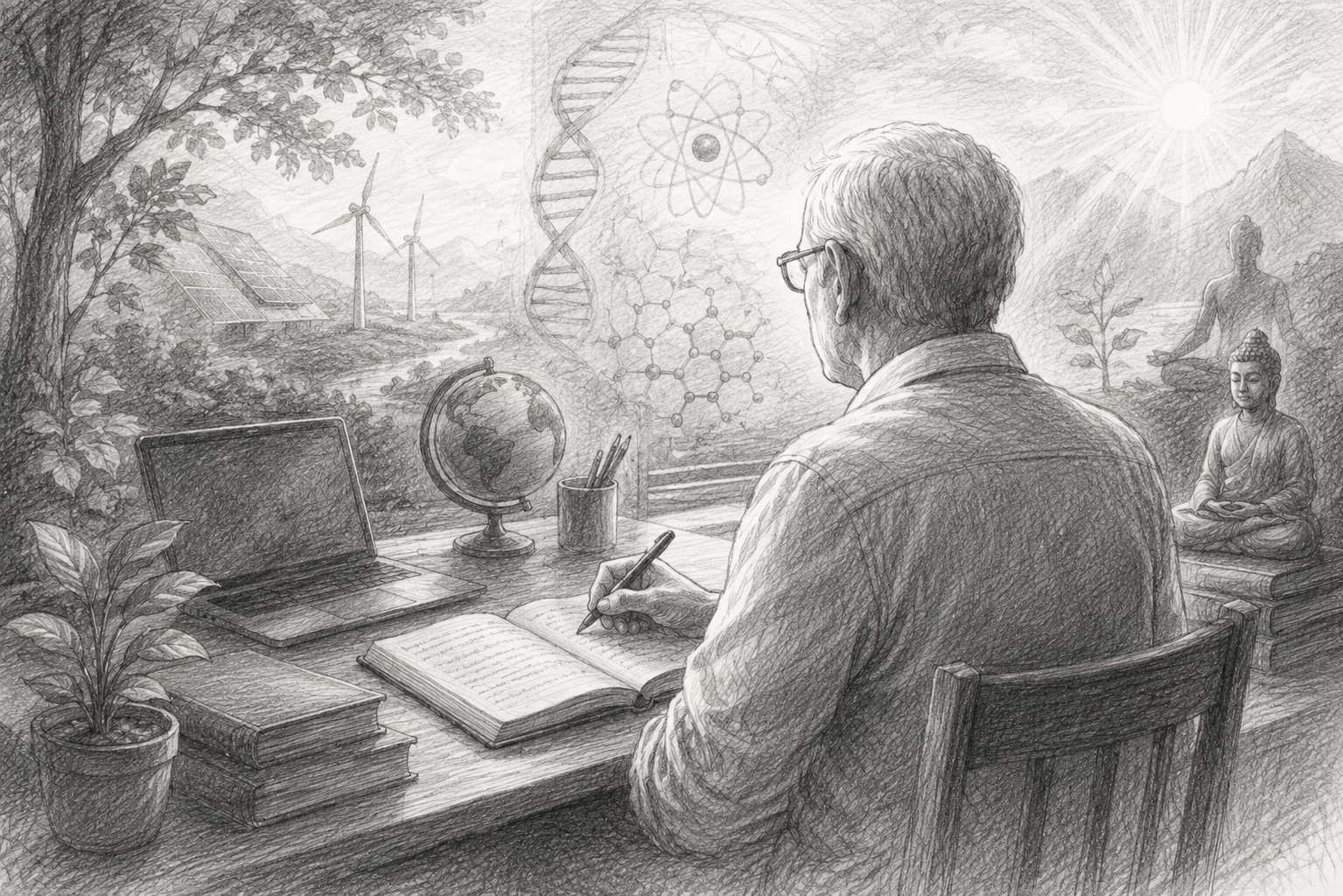
When I began writing this blog, I had planned to publish one article every Monday. Those writings were meant to focus mainly on science—topics such as renewable energy, the environment, and sustainability. These subjects belong to the world of scientific research, yet my intention has always been to connect them with everyday life so that even a common reader can see how science quietly shapes the world around us.
From the very beginning, I also made an important decision about language. Knowledge should never remain confined within the walls of a single language. Therefore, I chose to write my blogs in both English and Hindi. Sometimes a thought carries a deeper emotion in one language than the other, and expressing ideas in both helps the message travel farther and reach more minds and hearts.
After some time, I felt that writing only once a week might not allow a continuous conversation with readers. So I decided to write two blogs every week. Monday will remain dedicated to science, environment, energy, and sustainability. But every Thursday, I will write about spirituality.
However, the spirituality I wish to explore here is not merely about repeating religious beliefs or traditions. For me, spirituality is a journey of inquiry. It is an attempt to understand life with both reason and inner reflection. Swami Vivekananda once said that our beliefs should be respected, but they must also stand the test of rational thinking and constructive discussion. Inspired by that idea, I wish to look at spirituality with the same curiosity that science uses to study nature.
Modern science studies reality at extremely small scales—atoms, quantum particles, neural signals in the brain, and microscopic life that our eyes cannot see. In a similar spirit, spirituality explores another subtle dimension: consciousness, inner awareness, intuition, and the experience of being alive. These aspects are difficult to measure with instruments, yet they can be explored through disciplined observation of the mind.
Throughout history, many sages and philosophers followed this path. They observed the workings of the mind, the nature of existence, and the relationship between consciousness and matter. One of the earliest and most systematic attempts to understand this was the Sankhya philosophy, taught by the sage (Mahrishi) Kapila. According to the Bhagavata Purana, Kapila explained this philosophy to his mother with great clarity. Sankhya describes the universe as the interaction of two fundamental principles—Purusha, the pure consciousness, and Prakriti, the dynamic force of nature. From this interaction arise the mind, matter, and the entire cosmos.
Interestingly, echoes of similar philosophical questions appeared in other parts of the world as well. The great intellectual center of Alexandria, founded by Alexander the Great, became a meeting ground of ideas from many cultures. Later philosophical and spiritual movements such as Gnosticism also explored questions about the nature of reality, knowledge, and consciousness. While these traditions developed in their own ways, they show how humanity everywhere has been searching for answers to the same deep mysteries.
Science helps us understand the outer universe, while spirituality helps us observe the inner universe. When both journeys move together, perhaps we come a little closer to understanding the beautiful mystery of existence.
Through the Thursday blogs, my humble effort will be to explore spirituality in this spirit—not as blind belief, but as thoughtful inquiry. I hope that young and curious minds will find something new here: ideas that are logical, reflective, and inspiring.