
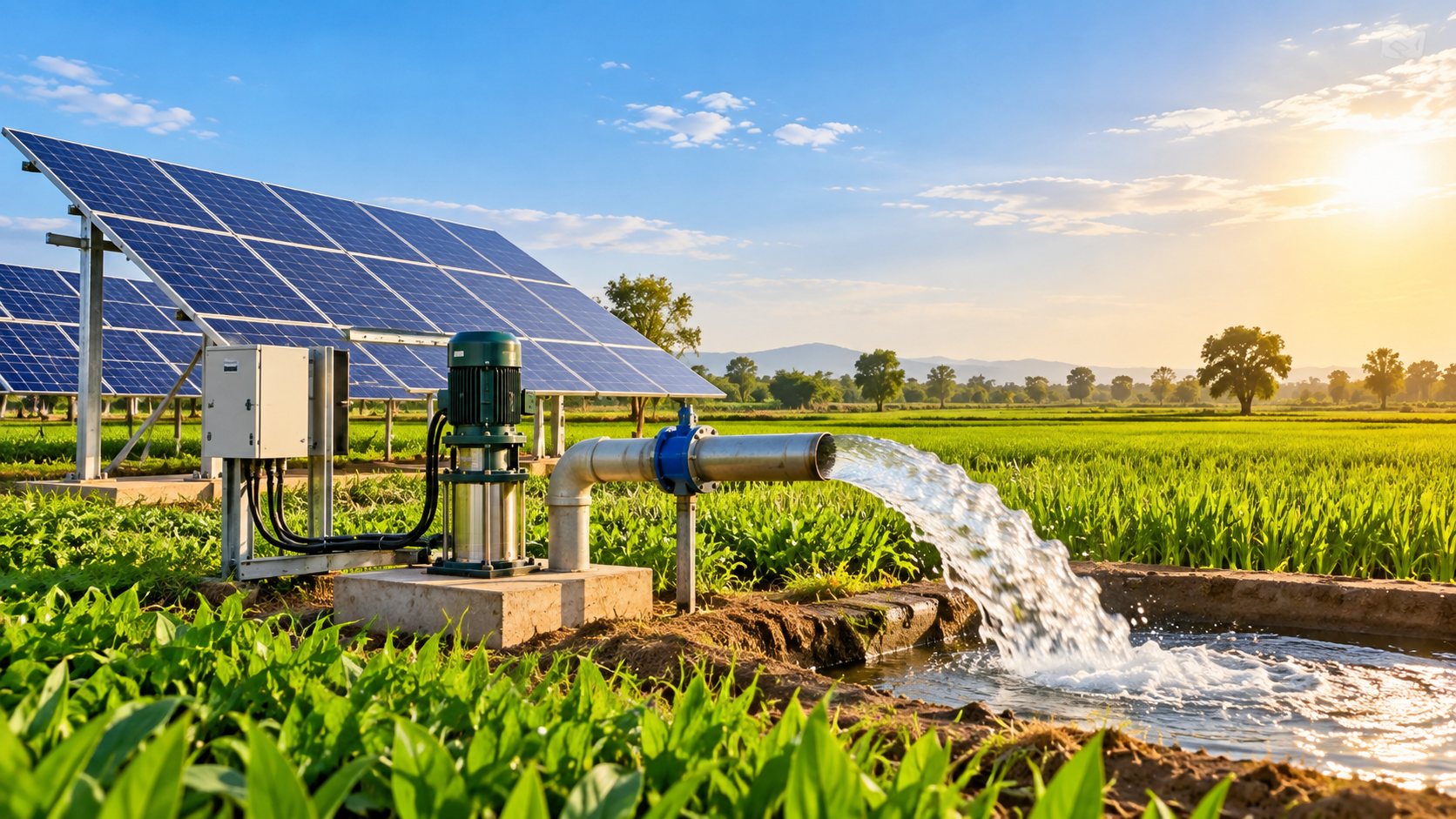
Sunlight has always essential to Indian agriculture, but could it also help farmers reduce irrigation costs and earn additional income? Across India, farmers depend on diesel and electricity to pump water into their fields, often facing rising expenses and unreliable power supplies. What if the same sunlight that nourishes their crops could also power irrigation pumps and generate electricity for sale? This possibility lies at the heart of the Pradhan Mantri Kisan Urja Suraksha evam Utthaan Mahabhiyan (PM-KUSUM), a Government of India initiative connecting agriculture with clean energy.
Why Was PM-KUSUM Introduced, and Who Can Benefit?
Launched in 2019 by the Government of India under the Ministry of New and Renewable Energy (MNRE), PM-KUSUM aims to address the challenges of unreliable electricity supply, rising diesel costs and dependence on conventional energy for agricultural irrigation. The scheme promotes reliable daytime solar power, reduces irrigation expenses and carbon emissions, and creates opportunities for farmers to earn additional income through solar electricity generation. It primarily benefits farmers using diesel-operated pumps in off-grid areas, those dependent on grid-connected irrigation pumps, and landowners interested in generating solar electricity or leasing suitable land for solar projects. Eligible participants include individual farmers, farmer groups, agricultural cooperatives, Farmer Producer Organisations (FPOs), Water User Associations (WUAs), Panchayats and other eligible rural institutions, subject to component-specific conditions. The scheme seeks to improve agricultural energy security while creating new economic opportunities in rural areas. However, financial assistance depends on state-wise allocations, eligibility criteria and the availability of approved projects and funds.
What Exactly Does PM-KUSUM Offer?
PM-KUSUM integrates solar energy into agriculture through three components, each addressing different irrigation and energy needs.
Component A – Solar Power Generation: This component enables eligible farmers, farmer groups, cooperatives and Farmer Producer Organisations (FPOs) to establish decentralised, grid-connected solar power plants of 500 kW to 2 MW. Electricity generated from these plants can be sold to distribution companies (DISCOMs) under approved power purchase arrangements, providing an opportunity for additional income. Farmers may also lease suitable land to developers. Unlike other components, it does not provide a standard 60% capital subsidy to farmers.
Component B – Standalone Solar Pumps: This component supports solar irrigation pumps, generally up to 7.5 HP, particularly in areas without grid electricity. Under the standard arrangement, the Central Government provides a 30% subsidy, the State Government at least 30%, and farmers contribute the remaining 40%. Subject to loan approval, bank financing may allow farmers to pay approximately 10% of the eligible cost initially, with the finance amount repaid over time..
Component C – Solarisation of Existing Pumps: This component covers grid-connected agricultural pumps through two approaches. Under Individual Pump Solarisation (C-I), farmers install solar systems for irrigation and may sell surplus electricity to DISCOMs, subject to applicable arrangements. Under Feeder-Level Solarisation (C-II), DISCOMs solarise entire agricultural feeders, supplying daytime solar electricity to multiple farmers. Thus, while C-I directly solarises an individual farmer’s pump, C-II provides solar electricity to multiple farmers through a common agricultural feeder. Financial assistance varies according to the applicable guidelines and implementation model.
PM-KUSUM: Which Component Is Suitable for You?
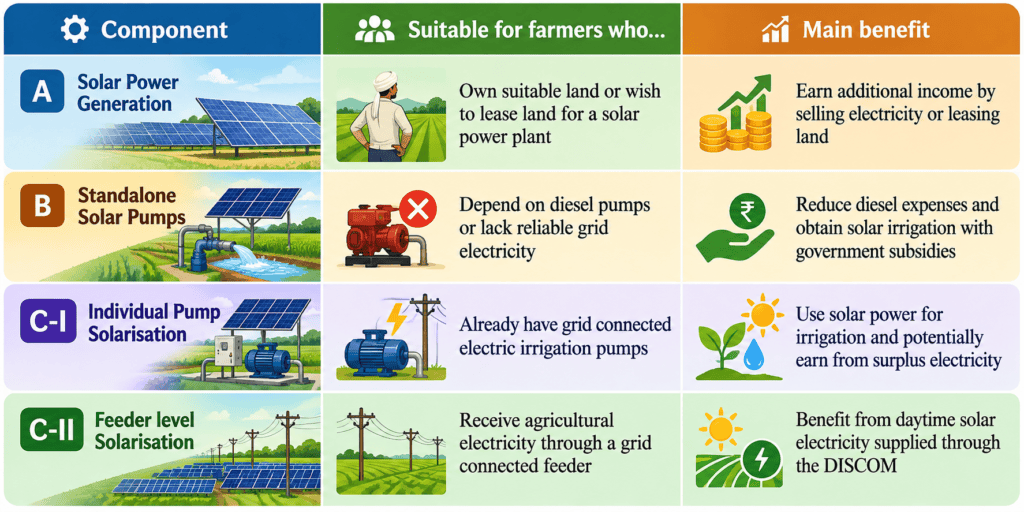
In simple terms: If you have suitable land and want additional income, explore Component A. If you depend on diesel for irrigation, consider Component B. If you already have an electric irrigation pump, Component C may be more relevant. Actual eligibility and benefits depend on state specific implementation and available allocations.
Financial Assistance and Current Progress of PM-KUSUM
PM-KUSUM envisages ₹34,422 crore in central financial support and a solar capacity addition of 34,800 MW. Under Component A, farmers can earn income through electricity sales or land leasing, while DISCOMs receive specified incentives. Component B generally provides a 30% central subsidy and at least 30% state subsidy for solar pumps. Component C offers financial assistance for individual pump and feeder-level solarisation, subject to applicable guidelines.
Beyond its financial provisions, the scheme’s progress can also be assessed through the solar capacity installed and the number of irrigation pump solarised.
As of 31 August 2026, approximately 2,193 MW of solar capacity had been installed under Component A, 11.80 lakh standalone pumps under Component B, and 16,469 individual pumps and 16.78 lakh feeder-connected pumpssolarised under Component C. Government records reported 21.77 lakh farmers had benefited as of December 2025. Although the original scheme period ended on 31 March 2026, implementation timelines extend into 2026–27. Applicants should verify current eligibility and application availability through the official PM-KUSUM portal.
How to Apply for PM-KUSUM: Documents and Procedure
Farmers interested in PM-KUSUM should first identify the components suitable for their irrigation or energy needs and check whether applications are open in their state. Farmers can apply through their designated State Renewable Energy Agency or DISCOM, subject to application availability. Commonly required documents include Aadhaar, land records, bank details, photographs and existing pump or electricity connection details, where applicable. Applicants should identify the suitable component, verify eligibility and apply through the authorised state portal. Following approval and payment of the prescribed contribution, an approved vendor completes installation.
Eligibility, subsidy amounts, required documents and application procedures may vary across states. Beneficiaries can find their respective state implementing agency and official application links through the National PM-KUSUM Portal or consult the MNRE scheme guidelines.
Financial Assistance, Loans and Reliable Information
Before applying for financial assistance, farmers should verify applicable subsidies, eligibility, bank loan terms and approved vendors through their respective state implementing agencies. Official information is available on the MNRE website, the National PM-KUSUM Portal and its Frequently Asked Questions. Farmers may also seek guidance through the MNRE helpline (1800-180-3333). Since subsidy provisions and application procedure vary across the states, beneficiaries should rely exclusively on authorised government channels for registration, payments and vendor selection, avoiding fraudulent websites and unauthorised agents.
For generations, Indian farmers have harvested crops with the help of sunlight. PM-KUSUM offers them an opportunity to harvest something more-clean energy, that can power irrigation, reduce expenses and create additional income. Yet the scheme’s true potential extends beyond financial subsidies and solar installations. its success depends on effective implementation, affordable financing and responsible groundwater management, ensuring that energy savings do not come at the cost of precious water resources.
Ultimately, the real achievement of PM-KUSUM’s success will not be measured merely by the number of solar pumps installed or megawatts of electricity generated, but by the difference it makes to farmers’ livelihoods and the environment. If implemented effectively, the scheme could help transform Indian agriculture from consumer of conventional energy into producer of clean energy- allowing farmers to cultivate not only their fields, but also a more sustainable future.