
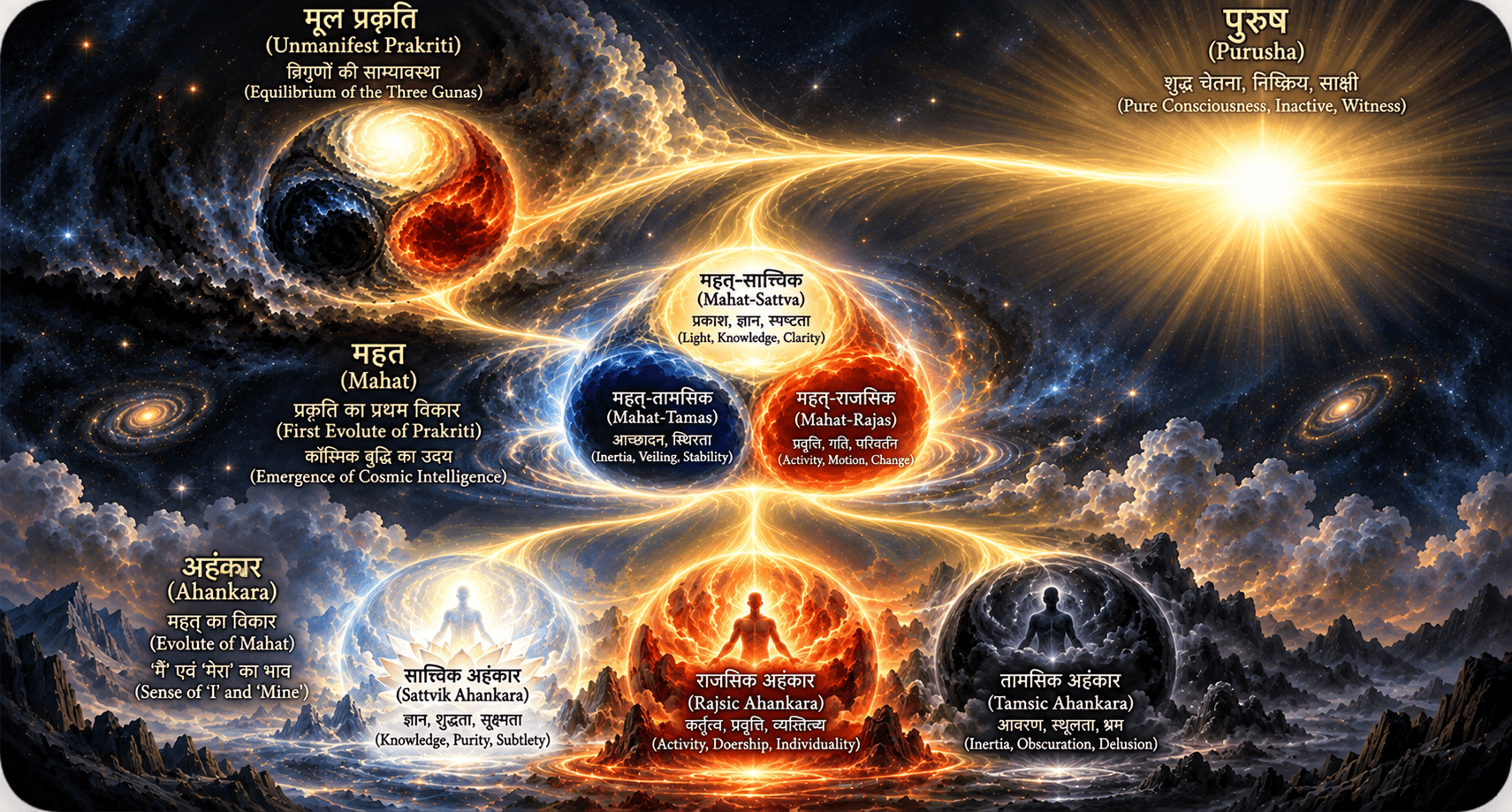
In the previous exploration of Sankhya philosophy, we discovered how Prakriti, in the presence of Purusha, begins its evolutionary journey through the manifestation of Mahat. Mahat emerges when the equilibrium of the three cosmic elements, or Gunas—Sattva, Rajas, and Tamas is disturbed and give rise to Mahat Sattva, Mahat Rajas, and Mahat Tamas, each containing these three Gunas in different proportions. But the evolution of Prakriti does not end with Mahat. What emerges next, and how does it contribute to the development of individual identity and material world? The answer leads us to second evolute of Prakrirti- Ahankara.
In the evolutionary process of Prakriti, Mahat becomes the material cause of the next evolute, Ahankara. Here, it is important to clarify that readers should not be confused by terms such as Mahat and Ahankara. These terms represent different evolutes of Prakriti, which manifest successively during its evolution. Although these terms may appear unfamiliar compared with those commonly used in modern science, they reflect the distinctive philosophical language developed by ancient thinkers to express their understanding of existence and its evolution.
To understand Ahankara , we must first distinguish its philosophical meaning from its everyday interpretation. Although commonly translated as ego, pride, or arrogance, Ahankara in Sankhya philosophy represents a material principle in the evolution process of prakiriti. Its association with individual identity becomes clearer when we examine the human tendency to identify experiences and possessions through the notion of ‘I’ and ‘mine’.
Among the three forms of Mahat, Mahat Sattva and Mahat Rajas, in which Sattva and Rajas respectively predominate, are responsible for the formation of Chit and Buddhi. The third form, Mahat Tamas, in which Tamas predominates, becomes the material cause of Ahankara. Although Mahat Tamas serves as the material cause of Ahankara, the three Gunas continue to exists in varying proportion. Consequently, Ahankara manifests in three distinct forms, each characterised by a different relative composition of Sattva, Rajas and Tamas. variations in the proportions of the three Gunas within Mahat Tamas lead to the manifestation of three forms of Ahankara: Sattvik Ahankara, Rajasik Ahankara, and Tamasik Ahankara.
Sattvik Ahankara contains a comparatively higher proportion of Sattva, Rajasik Ahankara contains a comparatively higher proportion of Rajas, and Tamasik Ahankara contains the highest proportion of Tamas. According to the proposed proportions, Sattvik Ahankara consists of 26.6% Mahat Sattva, 30% Mahat Rajas, and 43.3% Mahat Tamas. Rajasik Ahankara consists of 20% Mahat Sattva, 33.3% Mahat Rajas, and 46.6% Mahat Tamas, whereas Tamasik Ahankara consists of 16.6% Mahat Sattva, 23.3% Mahat Rajas, and 60% Mahat Tamas.
These differences in the proportions of the three Gunas are reflected in the distinct roles performed by the three forms of Ahankara during subsequent evolution of Prakiriti.
The five Tanmatras are the products of Tamasik Ahankara. Due to the predominance of Tamas they remain characterised by inertia. This tamas dominated Ahankara subsequently becomes the cause of the manifestation of five subtle & gross elements (Aakash, vayu, Aganni, Jal and Prithivi). It also veils Buddhi and Chitta, suppressing knowledge and detachment while strengthening inertia. Consequently, it keeps human beings bound to a worldly attachments, and its cessation becomes a means of attaining liberation (Moksha)
Rajasic Ahankara is predominatinantly governed by Rajas Guna and serves as the material cause of the organ of action (Karamendriyas). It reinforces the tendencies towards action and worldly enjoyment. Its influence is prominent in administrative and social activities. Through the Rajasic Ahankara, human beings strengthen their worldly relationships and social connections.
The material causes of Satvik Ahankara are the three substances: Mahat Satva, Mahat Rajas, and Mahat Tamas. Among these, Mahat Tamas is predominat, while the other two act as auxiliary causes. Satvik Ahankara primarily serve as the material cause of the organs of knowledge (Janendriyas) and together with Rajasik and Tamasik Ahankara give rise to Manas (the mind).
Thus Ahankara represents an important stage in the evolutionary journey of Prakiriti. Through its three forms-Satvik, rajasic and Tamasik- it becomes the material cause of the organs of knowledge (Jnanendriyas), the organ of action (Karmendriyas) and the subtle elements (Aakash, vayu, Aganni, Jal and Prithivi), while collectively contributing to the manifestations of Manas. What began as a disturbance in the equilibrium of the three Gunas continues to unfold into increasingly differentiated .