
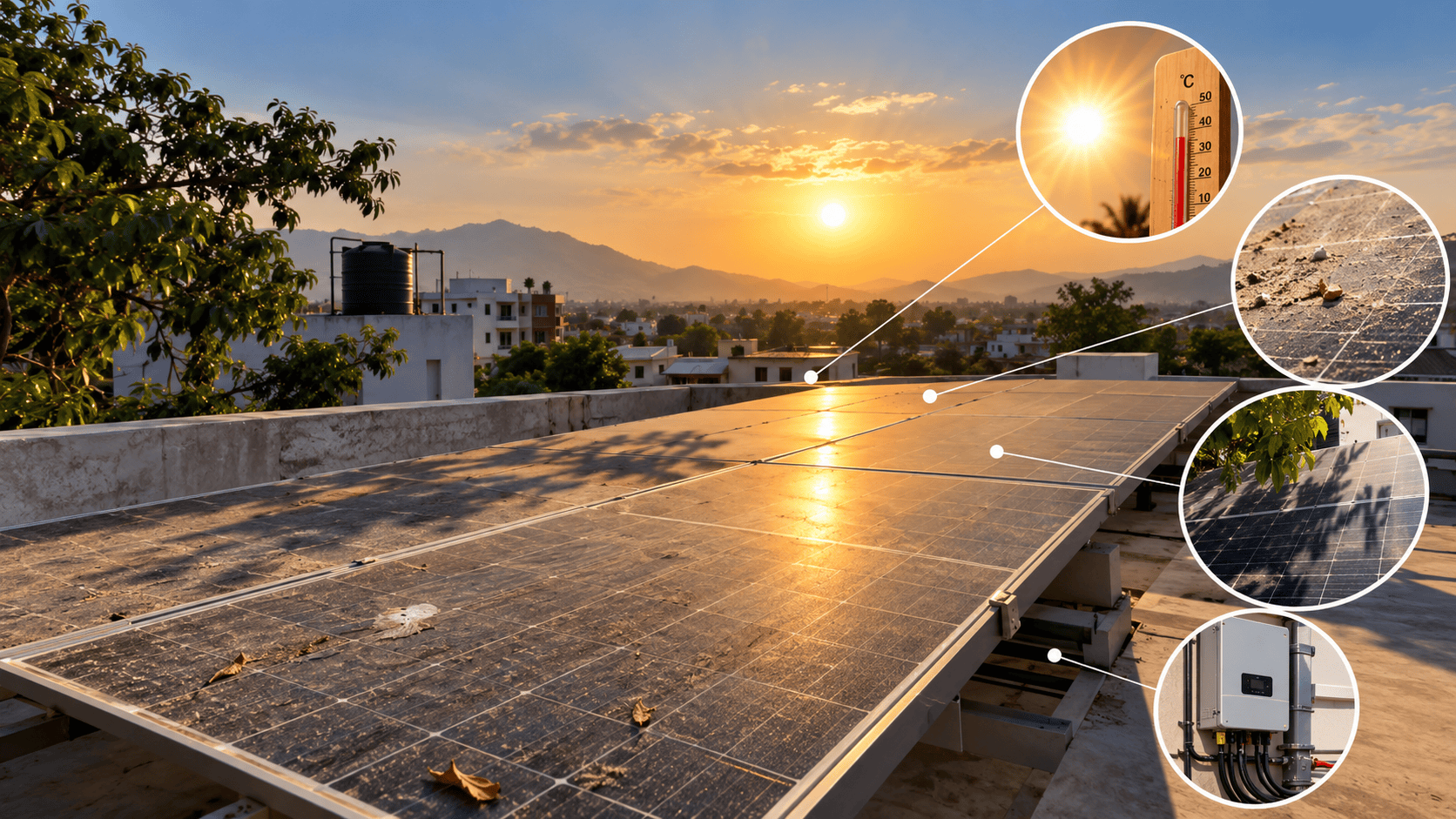
A solar power plant may look deceptively simple. Sunlight falls on photovoltaic modules, the modules convert it into electricity, and an inverter makes that electricity usable. With abundant sunshine and a sufficiently large solar array, good energy production may seem almost guaranteed. But is it?”
In practice, the story is more complicated.
Two solar plants with the same installed capacity, operating under similar sunlight conditions, may deliver noticeably different amounts of energy. Even the same plant may produce less electricity as months and years pass. The reason is that installed capacity tells us how large a solar plant is; it does not tell us how effectively that plant will perform in the real world.
Between the sunlight arriving at a PV module and the electrical energy finally delivered by the system lies a chain of environmental, electrical, mechanical and operational factors. Each can take away a small part of the expected energy—and sometimes several of them act simultaneously.
Understanding these losses is therefore essential before asking a seemingly simple question: Why is my solar plant producing less than expected?
From Available Sunlight to Actual Energy
At its simplest, the energy produced by a PV system depends primarily on three things: the size of the PV array, the amount of solar irradiation available and the overall efficiency with which the system converts that solar energy into useful electrical energy.
The first two are relatively easy to understand. A larger array has greater generating capacity, while greater solar irradiation provides more energy for conversion. The third factor—overall system efficiency—is where things become interesting.
A PV plant does not operate under laboratory conditions. Its modules sit outdoors through heat, dust, rain, wind and changing seasons. Cables carry current over physical distances. Inverters convert DC electricity into AC. Modules may not receive identical sunlight, and individual components do not always behave exactly alike.
Consequently, some of the solar energy that appears available on paper never reaches the final output.
These losses can broadly be understood as environmental losses, design and electrical losses, equipment-related losses, installation and operational losses, and long-term degradation.
Environmental conditions can significantly influence PV system performance through soiling, shading, and temperature effects. Soiling from dust, pollution, bird droppings, and other deposits reduces the solar irradiance reaching the cells. Partial shading from trees, buildings, parapets, or adjacent module rows can disproportionately reduce array output because electrically interconnected cells and modules affect one another. Temperature also plays a critical role: although high solar irradiance favours generation, increasing cell temperature reduces the voltage of crystalline-silicon modules and consequently lowers their power output. Thus, favourable sunlight alone does not guarantee optimum PV performance.
But environmental conditions are only part of the story.
The orientation and tilt angle of PV modules significantly influence plant performance by determining how effectively solar radiation is intercepted by the module surface. The module azimuth defines its directional orientation, while the tilt angle, together with the Sun’s zenith and azimuth angles, determines the angle of incidence of solar radiation. Improper orientation or tilt reduces the effective irradiance received by the array and consequently lowers energy yield, even under otherwise favourable solar conditions.
A Good Module Cannot Correct a Poorly Designed System
Even with abundant sunlight, high-quality modules and an efficient inverter, a PV plant may underperform if the system is poorly designed. Undersized cables increase electrical losses, improper string configuration affects inverter operation, incorrect inverter sizing can cause clipping or efficiency losses, and module mismatch can reduce overall array output. Excessive voltage drops further decrease the energy delivered to the load or grid. Therefore, PV design is not simply about selecting good components; modules, strings, cables, protection devices and inverters must be properly sized and coordinated to operate as an integrated system.
Installation Quality Matters as Much as Equipment Quality
Even a well-designed PV system can underperform if it is poorly installed. Loose connections, improper cable termination, inadequate mounting or earthing, incorrect module spacing, and weak component integration can introduce energy losses and reliability problems. This explains why two plants using similar equipment may perform differently after commissioning. Moreover, good installation must be supported by effective operation and maintenance (O&M), as neglected cleaning, deteriorating connections and undetected component faults can progressively reduce energy yield. Thus, good engineering must extend from design and installation to continuous monitoring and maintenance throughout the plant’s operating life.
As a PV plant continues to operate year after year, another less visible performance loss gradually emerges—degradation. Unlike temporary losses from dust or shading, degradation results from the long-term effects of environmental exposure, material ageing and electrical stresses on PV modules. Field studies report a median degradation rate of about 0.5% per year, which may appear small but becomes significant over decades of operation. Ageing may manifest as delamination, cell cracks, glass breakage, discoloration, defective interconnections, junction-box or cable failures, burn marks and internal circuit faults. Potential-induced degradation (PID) can further reduce output under certain voltage and environmental conditions. Thus, a solar module does not simply grow old; its materials and electrical characteristics gradually change, slowly widening the gap between its original rated power and the energy it can actually deliver.
Not every performance loss originates within the PV plant itself. A grid-connected PV system must operate within the voltage and frequency limits of the utility network. Grid instability, excessive voltage, frequency disturbances or outages may force the inverter to curtail generation or disconnect from the grid for protection. Consequently, even when solar irradiation is abundant and the PV modules are capable of generating at their full potential, the plant may be unable to deliver all the available energy. This highlights an important principle: PV energy yield depends on the performance and stability of the entire system, including the grid—not merely on the solar modules.
In practice, PV performance loss is rarely caused by a single factor; it is usually the cumulative effect of several small losses. Imagine a rooftop system on a clear summer afternoon: solar irradiation may be excellent, yet dust reduces the radiation reaching the cells, elevated module temperature lowers conversion efficiency, partial shading affects a string, cable resistance introduces electrical losses, and the inverter adds conversion losses. Years of gradual module degradation may further reduce output. Individually, each loss may appear modest, but together they create a noticeable gap between the energy theoretically expected and the energy actually delivered by the PV plant.
A Solar Plant Must Be Designed for the Real World
A solar plant is not built for perfect laboratory conditions—it must face the real world, where shadows move, dust settles, temperatures rise, components age, electrical losses occur and the grid does not always behave as expected. Good PV engineering, therefore, is not about eliminating every loss—an impossible task—but about identifying, quantifying and minimising the losses that can be controlled.
Thoughtful site assessment limits shading; proper orientation and tilt capture more useful sunlight; sound electrical design reduces mismatch and voltage losses; quality equipment and skilled installation improve reliability; and regular maintenance and continuous monitoring prevent small problems from quietly becoming large energy losses. Equally important is recognising that a PV plant must perform not only on the day it is commissioned, but year after year throughout its operating life.
So perhaps the real question is not, “How many kilowatts of solar panels have we installed?” The more revealing question is, “How much of the sunlight falling on this site can the entire system successfully convert into useful energy—today, tomorrow and twenty-five years from now?”
Between sunlight falling on a module and electricity reaching the user lies the entire science of PV performance and in the next part of our solar journey, we will look upward—to the position of the Sun itself—and see how zenith, azimuth and tilt determine how effectively a PV module captures its energy.”