
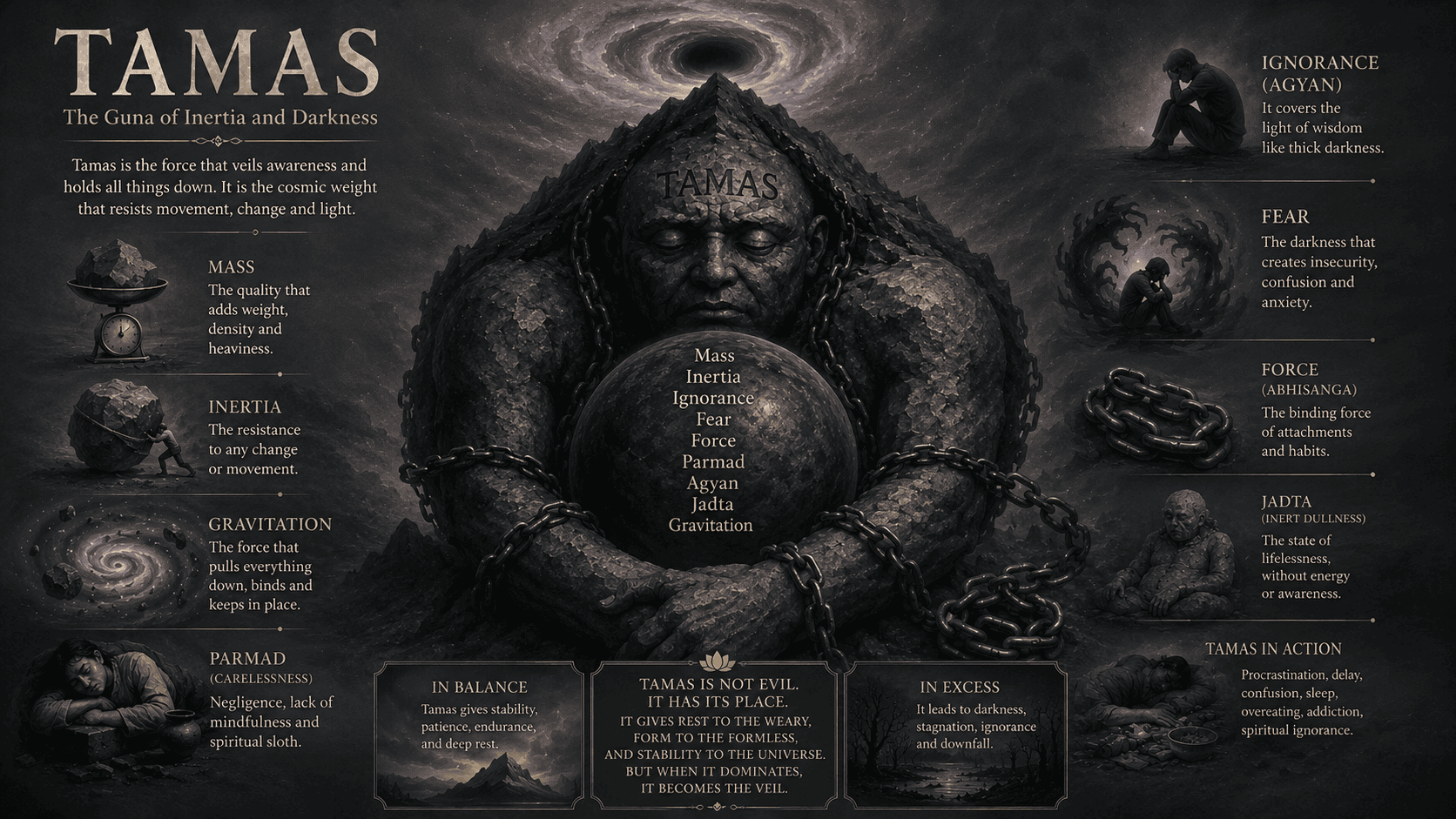
There are moments in life when a person feels trapped in a strange and invisible bondage — waking up without purpose, endlessly postponing important tasks, losing interest in self-growth, and sinking into laziness, confusion, distractions, and endless desires. Ancient Indian philosophy does not view these conditions merely as bad habits or emotional weaknesses; rather, it describes them as the influence of a profound cosmic force known as Tamas. According to Sāṃkhya philosophy and the Bhagavad Gītā, the entire universe operates through three fundamental qualities, or gunas — Sattva (purity and harmony), Rajas (activity and motion), and Tamas (darkness and inertia).
Scriptures describe the existence of 8.4 million life forms, excluding human beings and celestial beings from this classification. Humans and devas are considered distinct because, under the influence of higher consciousness and intelligence, they possess the ability to discriminate between right and wrong and reflect upon their actions. While ordinary beings merely undergo the consequences of their past karmas, humans have the unique capacity to refine their actions, elevate their consciousness, and even attain liberation (moksha). Yet, despite this privilege, most beings — including humans — remain deeply influenced by Tamas. Only rare sages, yogis, enlightened souls, and spiritually awakened individuals rise above its influence and free themselves from the endless cycle of birth and death. The rest of the world continues to live beneath the invisible veil of Tamas, unknowingly driven by attachment, ignorance, fear, and sensory pleasures.
Tamas is not merely physical darkness like the darkness seen after sunset; it is a state of consciousness. It weakens human discernment, dulls the power of judgment, weakens willpower, and binds the soul to worldly limitations. Wherever Tamas becomes dominant, inertia, excessive sleep, confusion, carelessness, attachment to pleasures, and destructive tendencies begin to emerge. Gradually, it diminishes human potential. The most dangerous aspect of Tamas is that a person often does not even realize that they are declining spiritually or mentally, because Tamas first attacks awareness itself.
In Chapter 18, Verse 28 of the Bhagavad Gītā, Lord Krishna describes a tamasic individual as undisciplined, stubborn, deceitful, lazy, sorrowful, and constantly procrastinating. Such a person loses enthusiasm for noble actions and becomes trapped in despair and inactivity. Similarly, Chapter 14, Verse 13 explains that when Tamas predominates, ignorance, delusion, negligence, and inactivity arise. The intellect becomes incapable of distinguishing truth from illusion, or right from wrong. The mind becomes immersed in selfishness, attachment, anxiety, and worldly delusions.
However, Tamas does not simply mean inactivity. It also refers to deriving pleasure from actions that are harmful to oneself and society. Under its influence, a person becomes negligent and gradually drifts away from higher goals. A common example is a student who, during examinations, feels more attracted to games, distractions, or sleep instead of study. Such tendencies reflect the growing influence of Tamas. It discourages disciplined effort and slowly distances a person from an ideal and elevated life. This is why the Bhagavad Gītā portrays Tamas as a downward-pulling force that binds consciousness and traps the soul in cycles of suffering, attachment, and confusion.
Yet it would be incorrect to conclude that Tamas is entirely negative. Even sleep itself exists because of the influence of Tamas. Imagine the condition of human health if people were unable to sleep. During illness, it is common to hear doctors and loved ones say that deep sleep helps the body recover faster. Everyone has also experienced that the most suitable environment for sleep is one where darkness prevails or where light remains soft and subdued. Excessive brightness stimulates alertness and reduces laziness, making sleep difficult. This is why birds return to their nests at sunset and awaken joyfully before sunrise. Darkness symbolizes Tamas — bringing stillness, heaviness, and rest — while light symbolizes Sattva, bringing energy, clarity, and enthusiasm.
When viewed scientifically, Tamas also performs many essential functions, just like other cosmic principles. One of its most significant qualities is inertia, which provides stability, resistance, and continuity. According to Newton’s principle of inertia, an object remains at rest or continues in motion unless acted upon by an external force. Without inertia, no structure in the universe could remain stable even for a moment. Mountains, planets, biological systems, and even the human body continue to exist in an organized manner because of this tamasic stability and resistance.
Similarly, the principle of gravity reflects qualities analogous to Tamas because it provides stability, mass, and structural cohesion within the cosmos. Without gravitational force, living beings would not remain grounded on Earth, and celestial bodies would fail to maintain their orderly positions in the universe. Solidity and structural resistance in the material world are also expressions of tamasic qualities, because without them physical forms would lack endurance and stability.
At times, when the body begins to feel heavy, rigid, or lethargic, it may be understood as an excessive influence of Tamas. This is why traditional practices such as yoga, physical exercise, and morning walks are highly recommended in Indian traditions. These practices help reduce excessive tamasic influence and restore balance, flexibility, and vitality within the body and mind. Greater flexibility in the body and joints is often seen as a sign of harmony and reduced stagnation, supporting both physical health and mental alertness.
The profound teachings of Indian philosophy remind us that every principle of nature possesses both constructive and destructive aspects, and Tamas is no exception. The moment a person becomes aware that procrastination, laziness, confusion, or inertia are dominating life, that very awareness becomes the first stage of awakening. Through self-awareness, disciplined living, higher knowledge, devotion, contemplation, and mindful action, one can gradually reduce the dominance of Tamas and move toward the illuminating balance of Sattva.
In the end, the struggle against Tamas is not merely a philosophical idea. It is a universal inner battle taking place silently within every human being — a battle that ultimately shapes the direction of life and the evolution of the soul.