
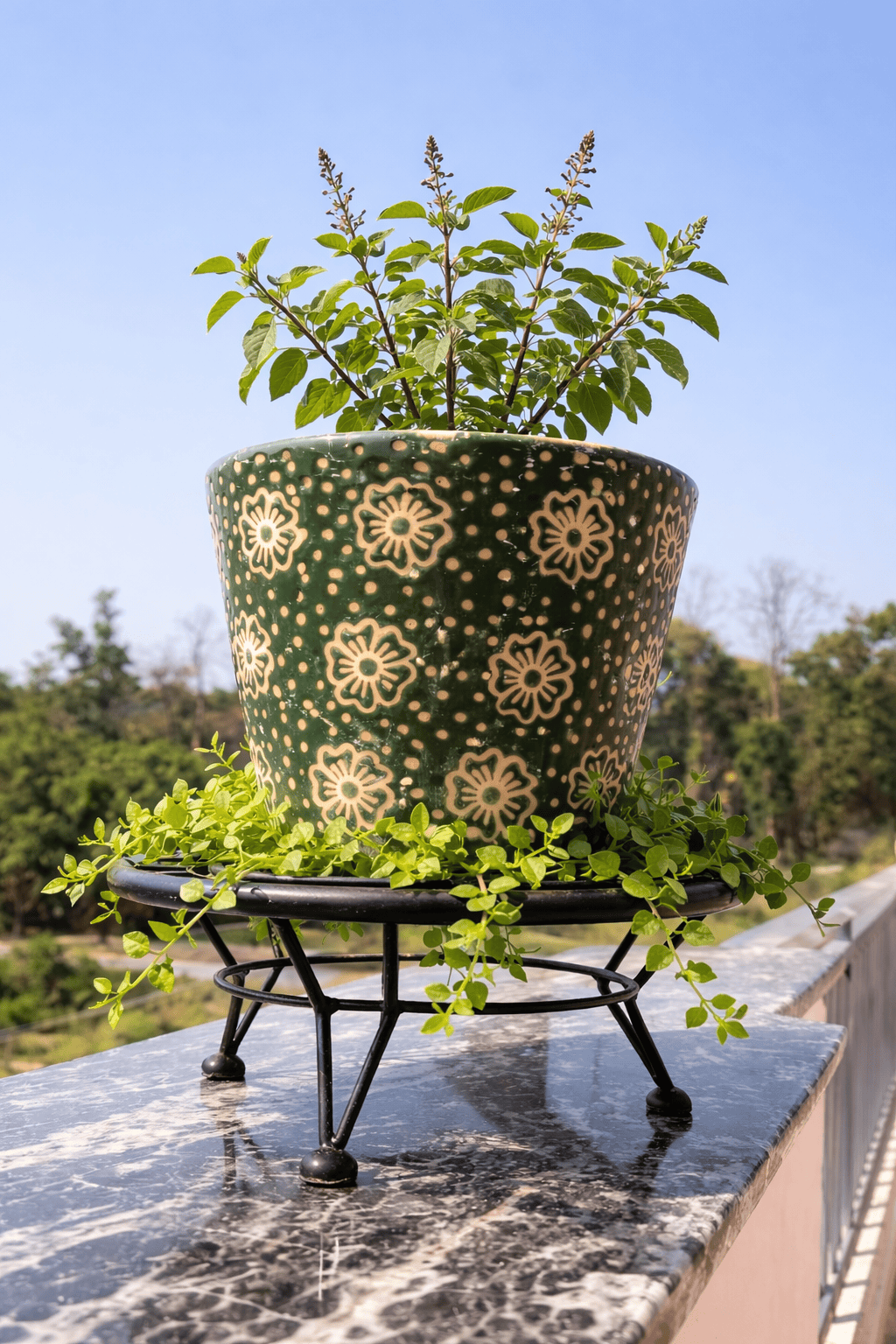
On my balcony, under an endless blue sky, there stood a green pot painted with delicate white flowers. In it grew my Tulsi— sacred in tradition, medicinal in science, and deeply meaningful to me. In Sanatan Dharma, Tulsi is not just a plant; it is a symbol of divinity and is worshipped with devotion. Many people even believe that offering water to Tulsi on Sundays or consuming its leaves on that day is not considered auspicious. From a scientific point of view, it is Ocimum sanctum, a powerful medicinal herb whose leaves, when boiled in tea, help relieve a cold and bring calm to the body. For me, it represented both discipline and dedication, so I cared for it with all my heart.
Every morning, I watered it carefully. I loosened the soil, removed unwanted weeds, added manure, and made sure the small drainage hole at the bottom of the pot allowed extra water to flow out — because too much care, without balance, can also cause harm. Balance is the foundation of life.
One day, I noticed a thin creeper peeping out from that very drainage hole — an unwanted guest. I ignored it. I thought, “It will not survive.” After all, it was growing in darkness. It received no direct water, no proper air, and no special care. My entire focus remained on the Tulsi.
But to my surprise, the creeper began to grow quickly. It became stronger and started spreading confidently around the stand, as if full of determination. Despite unfavourable conditions, it looked more vigorous and aggressive, while the Tulsi — which I was nurturing with devotion — grew slowly, calmly, and patiently.
The sight shook me deeply. How could something unwanted and neglected grow so strongly, while something sacred and carefully nurtured grew quietly? Then a powerful realization dawned on me: goodness requires effort, commitment, and consistent care, but negativity needs no encouragement. Qualities like discipline, compassion, and humility must be practiced every day. But ego, anger, jealousy, and laziness grow on their own. They do not wait for perfect conditions. They flourish even in darkness. They need nothing but our neglect.
From that day onward, the Tulsi in my balcony became a symbol of conscious growth, and the creeper became a reminder to stay alert within. I understood that each of us carries a Tulsi inside — our kindness, humility, discipline, and wisdom — which must be watered through mindful actions. But we also carry a hidden creeper — pride, greed, anger, and jealousy — which can spread through the smallest crack in our character. And often, it grows faster than our virtues.
That day, my balcony became my teacher. I removed the creeper from the drainage hole of the pot not with anger, but with awareness. I realized that building good habits is a continuous journey that requires consistency, while inner weaknesses grow naturally if we do not control them.
The message of this story is clear: our life is a garden. Within us lives a sacred Tulsi and a hidden weed (creeper). If we want our virtues to bloom, “we must nurture them daily with intention and care — because the weeds of our character need no effort to grow, only our carelessness”.