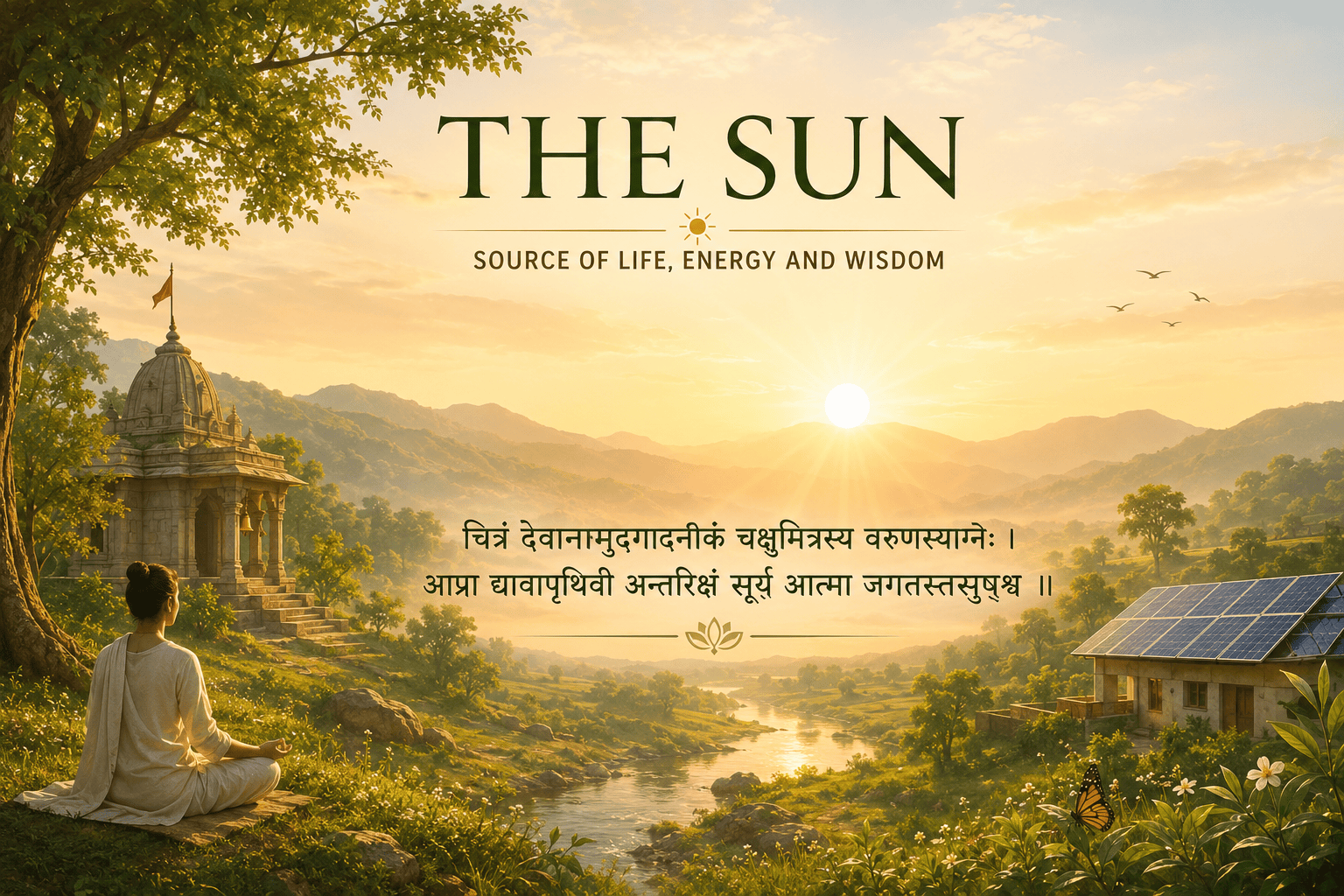
As the first ray of dawn spread across the sky, life quietly awakens. Some people step out for a refreshing morning walk, others practise yoga or meditation, while many make their way to nearby temples, where the gentle ringing of bells fills the cool morning air with peace. At the same time, newspaper hawkers move silently through the streets, delivering the day’s news to waiting doorsteps.
Now imagine that, one morning, all these familiar activities suddenly came to a halt. The streets would be empty, the temples would fall silent, and the world would seem to pause. Yet one thing would remain unchanged—the Sun would rise at its appointed time. Our clocks may change with the seasons and differ from one place to another, but nature’s clock never loses its rhythm. Every day, with remarkable discipline, the Sun rises and sets without fail. Human routines may pause, but the Sun never interrupts its eternal journey.
Thousands of years ago, the Sages of the RIGVEDA looked upon this same rising Sun with wonder and tried to express their experience through sacred verses. One such hymn declares:
चित्रं देवानामुदगादनीकं चक्षुर्मित्रस्य वरुणस्याग्नेः ।
आप्रा द्यावापृथिवी अन्तरिक्षं सूर्य आत्मा जगतस्तस्थुषश्च ॥
Its meaning is profound:
“The radiant Sun rises as the shining face of the Divine. It is the eye of Mitra, Varuna, and Agni. It fills the heavens, the earth, and the space between them. The Sun is the very soul of everything that moves and everything that stands still.”
From Ancient Wisdom to Scientific Understanding
At first glance, some may see this hymn as nothing more than a religious prayer. Yet its message reaches far beyond devotion. During our school days, we all learned a simple scientific fact: The Sun Gives Us Heat And Light. Without the Sun, life on Earth would simply not exist. Modern science fully agrees with this ancient understanding.
Science tells us that the Sun is a star located about 150 million kilometres from Earth. Deep within its core, hydrogen atoms continuously fuse to form helium in a process called nuclear fusion. This reaction releases an enormous amount of energy. Every second, the Sun radiates about 3.8 × 10²⁶ watts of power into space. By the time this energy reaches Earth’s orbit, around 1,361 watts of solar energy fall on every square metre of earth surface, facing the Sun. Since Earth is round and constantly rotating, the average energy received across the entire planet—day and night combined—is about 340 watts per square metre.Not all of this energy is absorbed. Nearly 30 percent is reflected back into space by clouds, snow, ice, and bright surfaces. The remaining 70 percent, about 240 watts per square metre, is absorbed by Earth’s land, oceans, and atmosphere. When this average is multiplied by Earth’s total surface area, the result is astonishing. Every second, our planet absorbs nearly 1.2 × 10¹⁷ watts of solar energy—about 120,000 trillion watts.
An Ocean of Energy Waiting Above Us
Now compare this with humanity’s total energy consumption. Our industries, transportation systems, agriculture, homes, and digital networks together consume only about 19 trillion watts (1.9 × 10¹³ watts) of power. In other words, humanity currently uses only about 0.016% of the solar energy that reaches Earth’s surface. This simple comparison reveals an extraordinary fact: the Sun provides nearly 6,000 times more energy than our present global energy demand. Clearly, the challenge before us is not a shortage of energy. Rather, the real challenge lies in learning how to efficiently harness solar energy, store it effectively, distribute it reliably, and use it wisely and sustainably.
The Promise of Solar Energy
Even more remarkable is the relatively small amount of land required to harness solar energy for meeting our present energy needs. Utility-scale solar power plants typically generate an average of 12–15 watts per square metre over the course of a year. Based on current global energy consumption of approximately 19 terawatts, the world would require nearly 1.5 million square kilometres of solar installations to satisfy its entire energy demand. At first glance, this figure may appear substantial. However, when viewed in perspective against Earth’s total land area of nearly 149 million square kilometres, it represents only about one percent of the planet’s land surface. In principle, dedicating such a small fraction of land to solar energy could provide sufficient power for the whole of human civilization.
The outlook is equally encouraging for India. Meeting the country’s total energy demand entirely through solar power would require approximately 96,000 square kilometres of land, which is only about 3 percent of India’s geographical area. If the focus is limited to electricity generation alone, the required land decreases dramatically to nearly 16,000 square kilometres, or roughly 0.5 percent of the nation’s land area.
An even more promising opportunity lies above our heads. The combined rooftop area of residential, commercial, industrial, and public buildings across India is estimated to be nearly 1,000 square kilometres. Utilizing this otherwise unused space for rooftop solar installations could generate close to 100 gigawatts of electricity. Such an approach would significantly strengthen urban energy systems while minimizing the need for additional land, preserving agricultural fields, and making the transition to clean energy both practical and sustainable.
The Sun Beyond Energy
The significance of the Sun extends far beyond its role as a source of electricity. It is the primary driver of Earth’s climate system, regulates atmospheric circulation, powers ocean currents, and sustains the global water cycle through continuous evaporation and precipitation. More importantly, solar radiation enables photosynthesis, the fundamental biological process through which plants convert sunlight into chemical energy, producing the food and oxygen upon which nearly all life depends. Every grain of rice or wheat, every leaf of vegetation, and every breath of oxygen consumed by living organisms can ultimately be traced back to the energy of the Sun. In addition to its ecological significance, controlled exposure to sunlight plays an essential role in human health by stimulating vitamin D synthesis, supporting hormonal balance, regulating circadian rhythms, and reducing the risk of several physical and psychological disorders.
The influence of solar energy also extends to the fuels that have powered human civilization for centuries. Fossil fuels such as coal, petroleum, and natural gas are, in essence, reservoirs of ancient solar energy captured by plants and microorganisms through photosynthesis millions of years ago and subsequently transformed through geological processes. Consequently, almost every major source of energy utilized by humanity—whether direct or indirect—originates from the Sun.
Whether viewed from a spiritual perspective as a symbol of divine benevolence or from a scientific perspective as a self-sustaining nuclear fusion reactor governed by the laws of physics, the conclusion remains fundamentally unchanged: the existence and progress of human civilization depend upon the continuous flow of solar energy.
The challenge before humanity, therefore, is not the availability of energy but the manner in which it is utilized. Society must decide whether to continue relying primarily on fossil fuels—finite reserves of ancient solar energy whose combustion contributes significantly to climate change—or to increasingly harness the clean, renewable, and virtually inexhaustible solar energy that reaches Earth every day.
The study of the Sun is therefore not confined to astronomy, environmental science, or spirituality alone. It represents the foundation of human civilization and offers a compelling narrative of abundance, responsibility, and sustainable development. Every sunrise serves as a reminder that nature consistently provides energy on a scale far exceeding human requirements. If any scarcity exists, it is not a scarcity of sunlight but of the wisdom and commitment required to utilize this resource efficiently. The ancient Vedic sages described the Sun as “the soul of the universe,” while modern science, through observation, experimentation, and quantitative analysis, demonstrates that without solar radiation Earth would be a frozen, lifeless planet. It is the Sun that provides light, heat, food, atmospheric balance, freshwater, ecological stability, and the conditions necessary for life itself.
The convergence of ancient philosophical insight and contemporary scientific understanding presents a unified perspective on the Sun’s role in sustaining life. Recognizing this shared truth encourages humanity not only to appreciate the Sun as the ultimate source of life and energy but also to adopt technologies and policies that ensure its responsible and sustainable utilization. Such an approach is essential for safeguarding the well-being of present and future generations while preserving the ecological balance of our planet.