
Imagine that you are standing on the shore of a vast ocean and reflecting on some of life’s deepest questions—Who am I?Why do we experience happiness and sorrow? How did this universe come into existence? What is the true purpose of life? Thousands of years ago, the ancient sages of India contemplated these very questions. Their search for truth gave rise to one of the oldest and richest philosophical traditions in the world.
These sages deeply studied the knowledge contained in the four Vedas—the Ṛgveda, Yajurveda, Sāmaveda, and Atharvaveda. As a result of this contemplation, the six major schools of Indian philosophy developed, which are collectively known as the Ṣaḍdarśanas. These are Nyāya, Vaiśeṣika, Sāṃkhya, Yoga, Pūrva Mīmāṃsā, and Vedānta (Uttara Mīmāṃsā). Although each philosophy has its own distinct method and perspective, the ultimate goal of all of them is to guide human beings towards Self-realization and Moksha. For this purpose, the Indian tradition describes three principal paths of spiritual practice—Bhakti (the path of love and devotion to God), Karma (the path of selfless action and the faithful performance of duty), and Jñāna (the path of intellectual and spiritual realization of Truth).
The Bhagavad Gītā presents a wonderful harmony between these three paths. Lord Śrī Kṛiṣṇa explains that if any one of these paths is followed with faith and dedication, it can lead the seeker to Self-realization and spiritual liberation.
Among these six systems of philosophy, Sāṃkhya holds a very special place. It is one of the oldest and most influential traditions of Indian philosophy. Its greatest distinguishing feature is that it explains life and the universe not based on miracles or divine intervention, but through logical reasoning, and systematic observation.
According to Sāṃkhya, the entire universe is founded upon two eternal and independent realities—Prakṛti, which is the source of all matter, nature, and physical transformation; and Puruṣa, which is pure consciousness and the eternal, unchanging witness present within every living being.
The influence of Sāṃkhya philosophy can be seen throughout Indian spiritual and philosophical literature. Its principles are described directly or indirectly in the Mahābhārata, the Bhagavad Gītā, many Upaniṣads, and various Purāṇas.
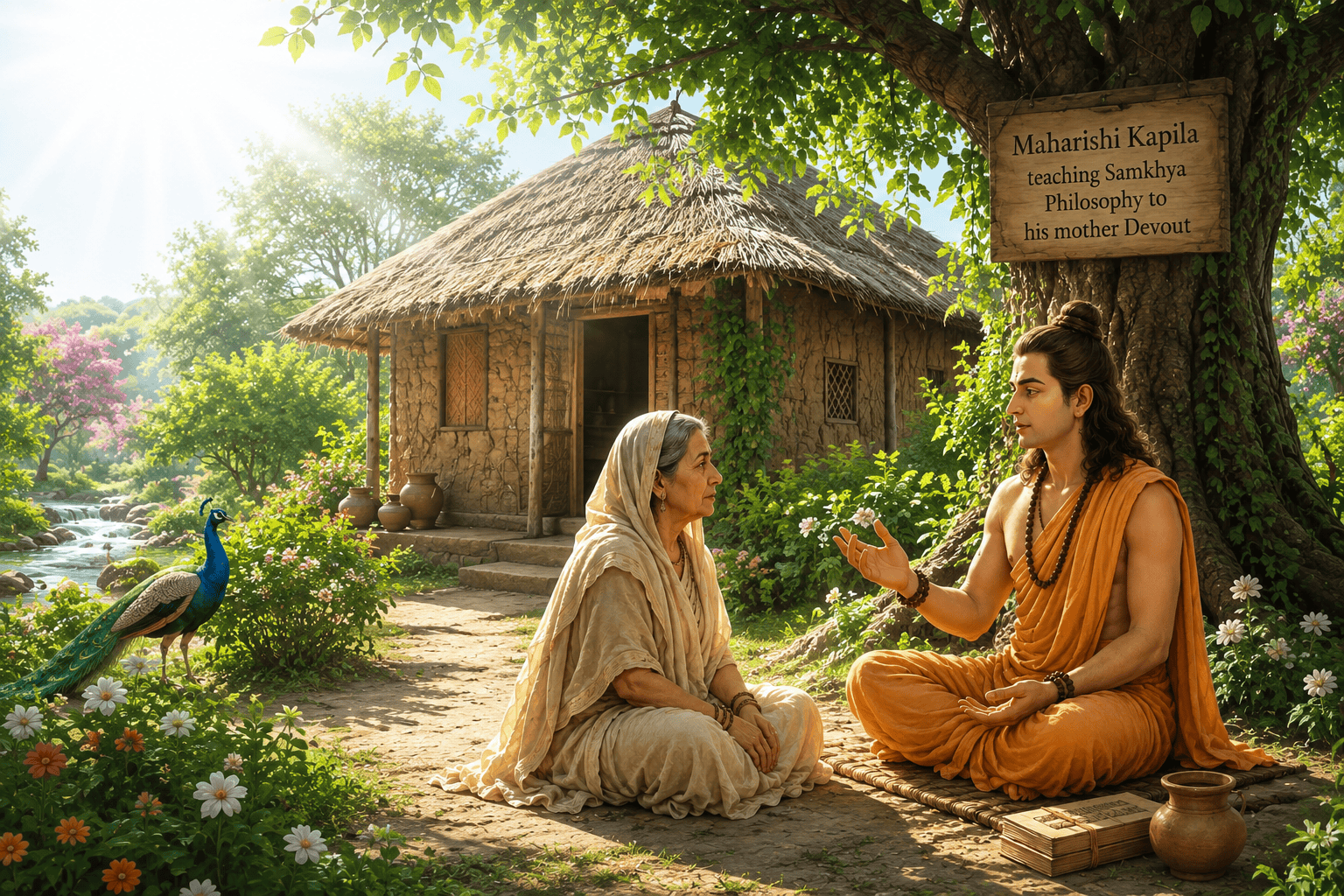
The founder of Sāṃkhya philosophy is regarded as Maharishi Kapila, who holds a place among the greatest sages of ancient India. According to the Śrīmad Bhāgavata Mahāpurāṇa, he was an incarnation of Lord Viṣṇu and the son of Sage Kardama and Mother Devahūti. Maharishi Kapila first imparted the teachings of Sāṃkhya philosophy to his mother, Devahūti. Their dialogue is regarded as one of the earliest philosophical teachings available in the history of Indian philosophy.
It is believed that around 2300 BCE, Maharishi Kapila compiled his teachings in a text known as the Sāṃkhya Pravachana Sūtra or Kapila Sūtra. Although the original work was lost over time, his teachings were preserved through the Guru–Śiṣya (teacher–disciple) tradition.
Maharishi Kapila transmitted this knowledge to his disciple Sage Āsuri. Āsuri then passed it on to Ācārya Pañcaśikha. It is believed that Pañcaśikha composed an important Sāṃkhya text called the Ṣaṣṭitantra, which played a significant role in preserving and propagating this philosophy.
Many centuries later, the philosopher Īśvarakṛṣṇa composed the Sāṃkhya/ Īśvarakṛṣṇa Kārikā. Written in approximately seventy kārikās (verses), this text presents the fundamental principles of Sāṃkhya philosophy in a highly systematic and concise manner. Īśvarakṛṣṇa also mentioned the lineage of Kapila, Āsuri, and Pañcaśikha, thereby preserving the historical continuity of this philosophical tradition.
Today, the Sāṃkhya Kārikā is regarded as the oldest complete extant text of Classical Sāṃkhya philosophy and is considered the most authoritative source for the study of Sāṃkhya philosophy. The chapter 10 of the Bhagavad Gītā is also known as Vibhūti Yoga because, in this chapter, Lord Śrī Kṛṣṇa describes his divine manifestations (दिव्य विभूतियों) and says in Verse 10.26:
अश्वत्थः सर्ववृक्षाणां देवर्षीणां च नारदः।
गन्धर्वाणां चित्ररथः सिद्धानां कपिलो मुनिः॥10.26॥
It means “Among all trees I am the Aśvattha (Peepal); among the divine sages I am Nārada; among the Gandharvas I am Citraratha; and among the perfected beings (Siddhas) I am Sage Kapila.”
This verse of Vibhūti Yoga, Lord Śrī Kṛṣṇa while describing his various divine manifestations, declares, “सिद्धानां कपिलोमुनिः (Among the Siddhas, I am Sage Kapila),’ Lord Śrī Kṛṣṇa identifies Maharishi Kapila as his own manifestation among the perfected beings.. This, statement itself, testify the ancient lineage of this philosophical tradition and reflects the exceptionally high position that its founder, Maharishi Kapila, holds in Indian philosophy.