
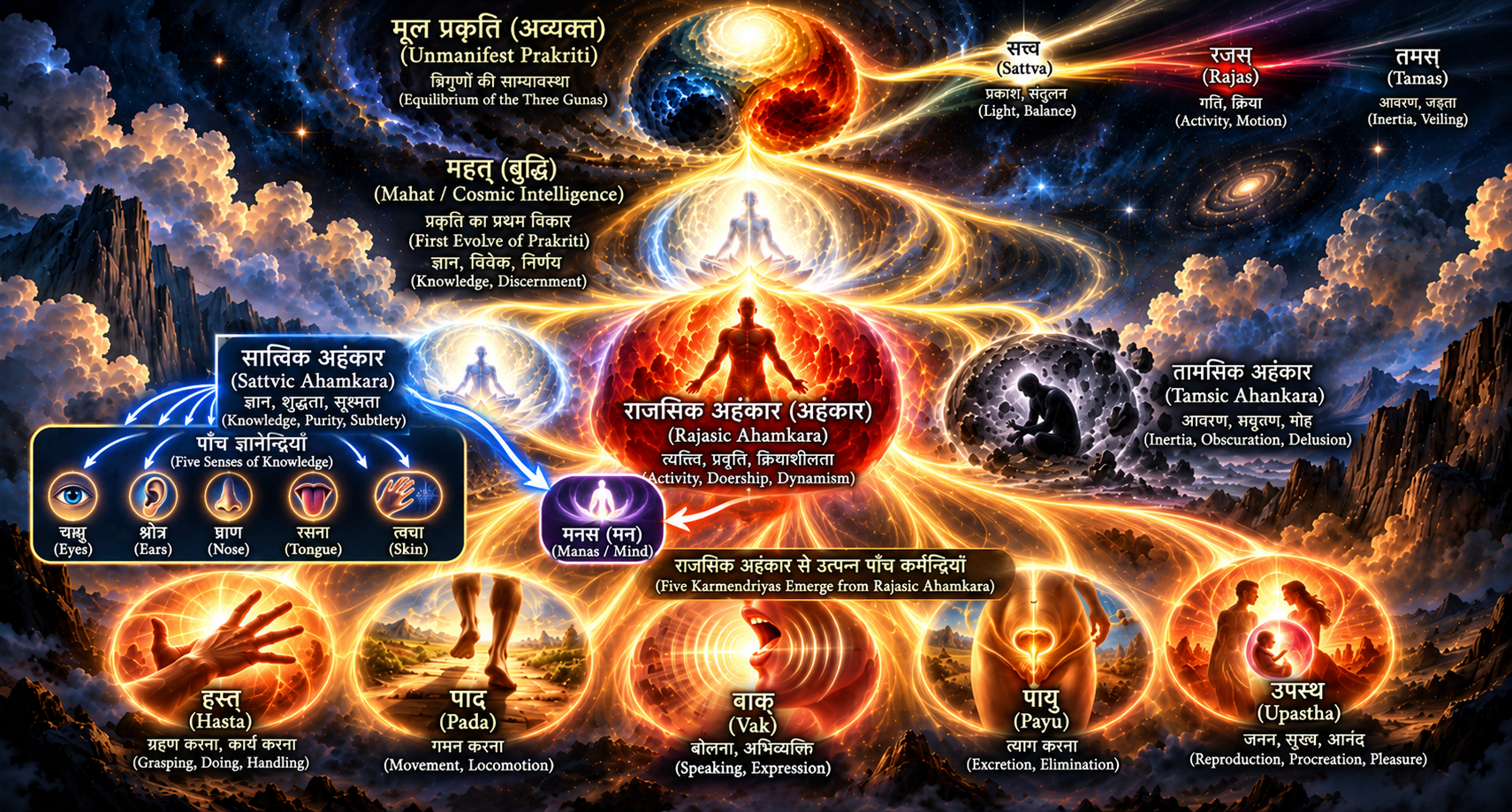
In Samkhya philosophy, three forms of Ahamkara (ego) are described—Sattvic, Rajasic, and Tamasic. Sattvic Ahamkara, also known as Vaikrita Ahamkara, is associated with the predominance of Sattva and is considered the source of the mind and ten senses. In everyday life, ego is generally associated with pride, wealth, power, or social status. However, a sense of superiority may also arise from knowledge, virtuous conduct, service, and spiritual accomplishments. Unlike the obvious expressions of pride, this feeling can develop so naturally that individuals may remain unaware of its presence.
To understand this subtle aspect of ego, it is necessary to examine the nature of Sattva. In Samkhya philosophy, Sattva is associated with illumination, knowledge, clarity, and happiness. Its predominance encourages discernment, peacefulness, self-restraint, and virtuous conduct. A Sattva-oriented individual generally seeks knowledge, maintains balance in thoughts and actions, and contributes to the welfare of others. However, when these qualities become the foundation of personal identity or superiority, a subtle sense of ego may emerge. The person may gradually begin to consider themselves more knowledgeable, morally upright, or spiritually advanced than others.
The distinction between Sattvic and Rajasic expressions of ego lies primarily in what individuals associate with their superiority. Rajasic tendencies may encourage pride in wealth, power, social recognition, and material achievements. In contrast, superiority associated with Sattvic qualities may arise from attachment to knowledge, morality, sacrifice, service, or spiritual experiences. Although the sources of satisfaction differ, both can reinforce the belief that one’s qualities or accomplishments make one exceptional. Thus, the underlying identification with “I” and “my achievements” may persist even when outward ambitions are replaced by apparently noble pursuits.
Consider someone who dedicates time and resources to social welfare, helping disadvantaged people and contributing to community development. Such activities are valuable expressions of compassion and responsibility. However, if the person gradually begins to believe that their contribution is greater or more meaningful than that of others, service may become intertwined with personal pride. Their charitable work, initially directed toward the welfare of others, may also become a means of establishing a special identity. The problem lies not in the act of service itself, but in the superiority that may become associated with it.
This tendency may become visible through expectations of recognition. A person who considers themselves humble and selfless may nevertheless expect appreciation for their knowledge, service, or ethical conduct. When their contributions go unnoticed or their opinions receive insufficient attention, they may experience disappointment or resentment. Such reactions do not necessarily invalidate their good intentions, but they can reveal how closely personal identity has become connected with external approval. Recognizing these expectations provides an opportunity to examine whether service remains an expression of goodwill or has also become a source of self-importance.
A similar situation can arise in spiritual life. Meditation, scriptural study, and disciplined spiritual practices may encourage inner peace, self-restraint, reflection, and greater understanding. Yet spiritual progress can become another basis for comparison when individuals begin to consider themselves closer to truth or more spiritually developed than others. They may attach special importance to their experiences and regard them as evidence of personal superiority. Consequently, practices intended to deepen self-understanding may also strengthen identification with spiritual accomplishments. This illustrates how the pursuit of freedom from ego can sometimes give rise to another, less obvious expression of it.
The difficulty in recognizing this tendency arises from its association with qualities that are generally considered desirable. Rajasic expressions of ego may be more apparent through competition, ambition, or the pursuit of recognition. By contrast, superiority connected with knowledge and virtuous conduct can remain concealed behind ethical behaviour and personal satisfaction. When individuals become convinced that their understanding or actions are unquestionably correct, they may overlook their limitations and become less receptive to alternative perspectives.
For example, a knowledgeable person may sincerely attempt to help others by offering advice and guidance. Their experience may be valuable, and their intentions may be constructive. However, if they begin treating their understanding as the final authority, they may dismiss the experiences and opinions of others. Instead of listening openly, they assume that their judgment is necessarily more reliable. Knowledge, which could have encouraged humility, discernment, and a broader perspective, then becomes a basis for intellectual superiority. This example demonstrates that the value of knowledge depends not only on its possession but also on the attitude with which it is applied.
Another important dimension of Sattvic ego is the sense of doership. Individuals acquire knowledge through effort, progress through spiritual discipline, and earn respect through ethical conduct and service. These accomplishments deserve recognition, yet problems may arise when individuals regard themselves as their sole creators. They may overlook the influence of circumstances, the support of others, and the functioning of the gunas of Prakriti. The repeated identification with statements such as “I accomplished this” or “this achievement belongs entirely to me” can strengthen personal attachment to otherwise constructive activities.
Samkhya philosophy offers a deeper explanation of this identification. According to its framework, Buddhi (intellect), Manas (mind), and Ahamkara (ego) are evolutes of Prakriti, while Purusha represents pure consciousness, distinct from these principles. The three gunas—Sattva, Rajas, and Tamas—participate in the functioning of mental and physical activities. When the activities of the intellect and ego are mistakenly identified with Purusha, the notion of personal doership arises. Samkhya regards Purusha as a non-doer and locates all activity within Prakriti. Therefore, even knowledge and virtuous conduct associated with Sattva may become objects of attachment when individuals mistake these accomplishments for their essential identity.
Does this mean that knowledge, morality, service, and spiritual practice should be abandoned because they may encourage subtle ego? Certainly not. These qualities and activities contribute to personal development, social welfare, and a balanced life. Samkhya itself recognizes the importance of Sattva in promoting knowledge and clarity. The essential distinction is between cultivating beneficial qualities and becoming attached to the superiority they appear to confer. Rather than rejecting worthwhile activities, individuals can examine their motivations and gradually reduce the expectations and personal identification associated with their accomplishments.
Such awareness also encourages a more balanced understanding of success. A person may recognize that achievements arise through personal effort alongside favourable circumstances, the contributions of others, and the interaction of the gunas. This perspective does not diminish individual responsibility or the value of disciplined work. Instead, it discourages the assumption that every accomplishment establishes personal superiority. By acknowledging the wider conditions contributing to their development, individuals may approach knowledge, service, and ethical conduct with greater humility and discernment.
Self-reflection provides a practical means of examining these tendencies. Individuals can periodically question the intentions underlying their thoughts and actions. Do they help others primarily for their welfare, or do they also seek recognition as generous and noble individuals? Do they pursue knowledge to deepen their understanding, or to demonstrate intellectual superiority? Is their spiritual practice directed toward self-realization, or has it become a means of establishing a special identity? These questions are not intended to undermine good intentions. Rather, they encourage individuals to recognize expectations, attachments, and motivations that may otherwise remain unnoticed.
The broader lesson is that ego does not depend exclusively on material possessions, authority, or social prestige. It may also become associated with qualities that society rightly values, including knowledge, compassion, ethical conduct, and spiritual discipline. Developing Sattvic qualities is therefore meaningful, but their cultivation alone does not establish complete freedom from ego. Greater awareness requires recognizing the attachment to “I” and “my achievements” that may accompany even the most admirable actions. Such recognition can encourage humility while preserving the value of knowledge and service.
Ultimately, Samkhya philosophy directs attention beyond the cultivation of Sattvic qualities toward discriminative knowledge of Purusha and Prakriti. Although Sattva supports clarity and discernment, it remains a constituent of Prakriti. Buddhi, Ahamkara, and Manas likewise belong to Prakriti, whereas Purusha is pure consciousness, distinct from them and free from agency. When the fundamental distinction between Purusha and Prakriti is realized, the mistaken identification of consciousness with the activities of nature is overcome. Samkhya regards this discriminative knowledge as the foundation of Kaivalya—the complete liberation of Purusha from Prakriti.