- July 22, 2026
- by awakeningsoul24@gmail.com
- 0
- 2:58 pm

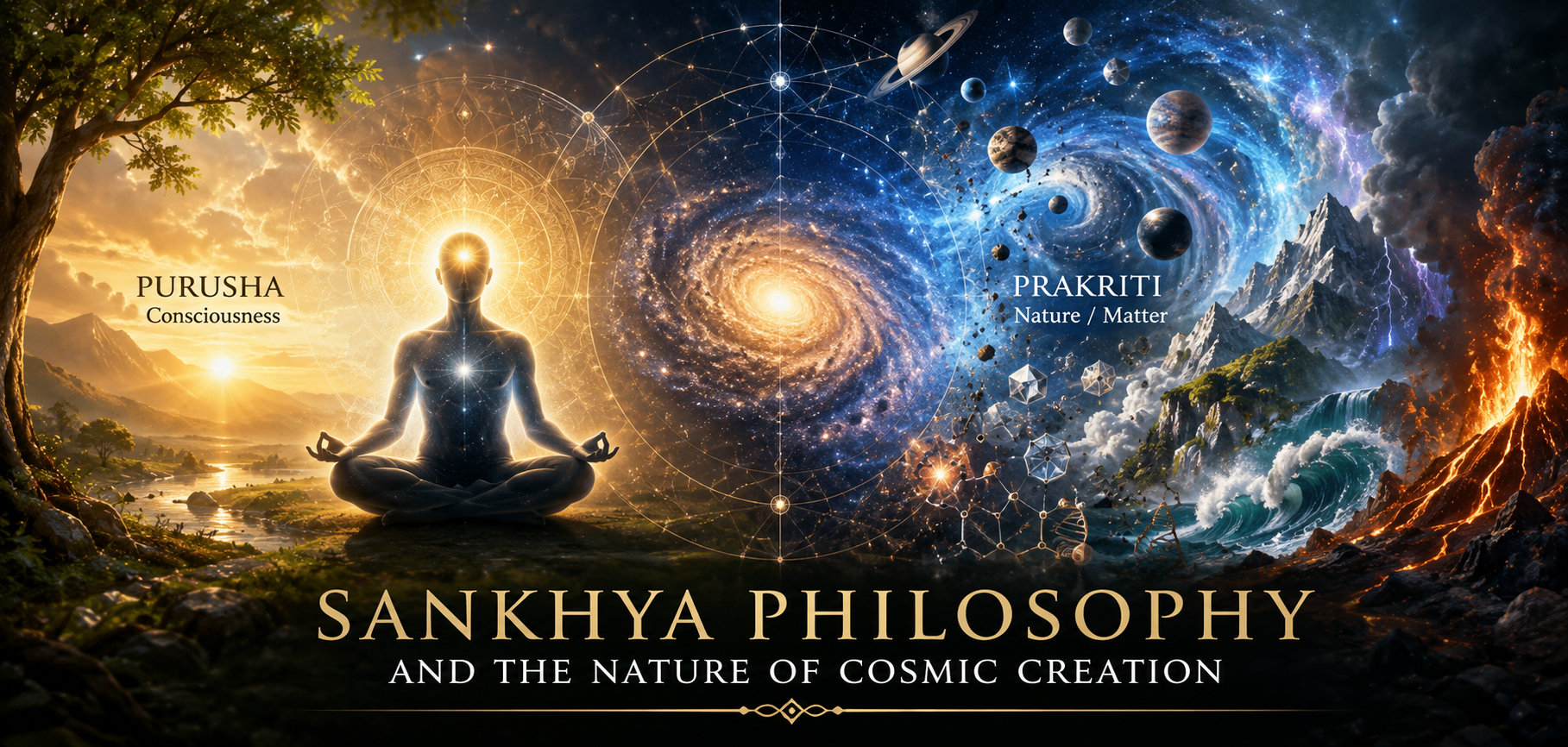
When human beings contemplate the vastness of the universe, an inevitable question arises: What is the origin of this immense cosmic order? The mind naturally assumes that such a complex and structured universe must have a creator. Equally, it appears reasonable to assume that some form of material must have been used in the process of creation, since nothing can come into existence without an underlying substance.
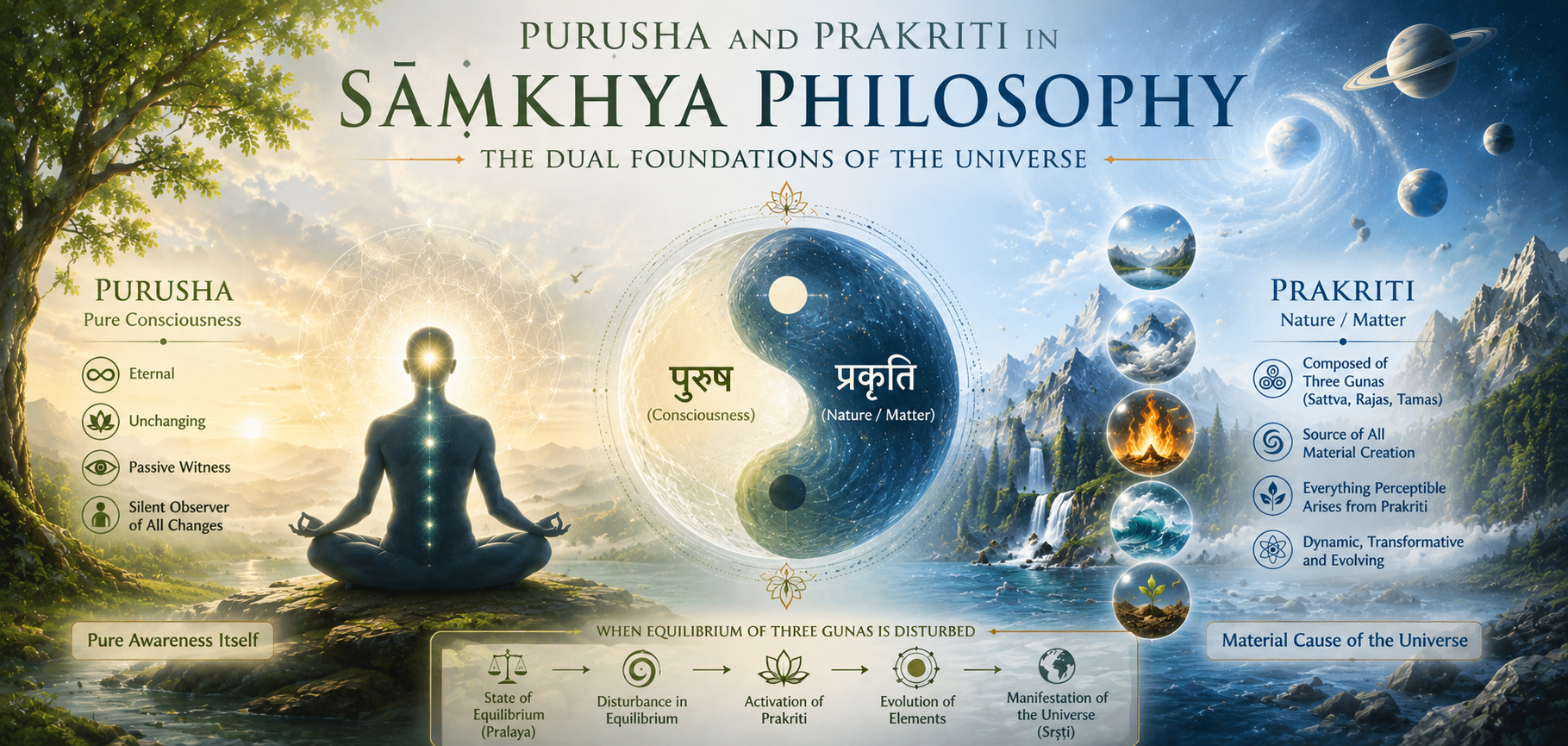
The philosophical system of Sankhya offers an explanation for these questions. Sankhya Yoga is a classical Indian philosophical tradition grounded in the study of fundamental principles (tattva-jnana). According to Sankhya philosophy, the entire universe is constituted by the interaction of two fundamental realities: Purusha and Prakriti.
Purusha represents the principle of consciousness. It is the sentient, living aspect of existence—the essence of awareness itself. In various spiritual and philosophical texts, this conscious principle is referred to by different names, such as Ishwar, Bhagwan, Paramatma, or the Supreme Self. These terms represent the universal consciousness that permeates all existence.
In contrast, Prakriti represents the principle of matter or nature. It is insentient and lifeless, yet it serves as the material foundation of the entire universe. All observable phenomena—whether the Earth, stars, planets, the Sun, or the Moon—are manifestations of Prakriti. Everything that can be perceived through the senses originates from this fundamental material principle.
Within Sankhya philosophy, Prakriti is considered the material cause of the universe. In philosophical terminology, it is referred to as the “Upādāna Kāraṇa”, or material cause, because it provides the substance from which all objects and forms emerge. The various elements and materials studied in modern science can also be understood as transformations of this primordial nature.
However, the existence of material alone does not explain creation. For this reason, Sankhya also recognizes the role of Purusha as the conscious principle associated with creation. The conscious reality is described as subtle beyond comprehension and immeasurable in its vastness. It is this conscious presence that allows the universe to come into being.
Philosophically, this distinction can be clarified through the concepts of material cause (“Upādāna Kāraṇa”), auxiliary causes “Sahakari Kāraṇa”, and efficient cause “Nimit Kāraṇa”. The material cause provides the substance from which something is made, while auxiliary causes support the process of creation. The efficient cause, however, is the guiding intelligence that initiates and directs the process.
A simple example illustrates this principle. Consider the construction of a building. The bricks constitute the material cause because the building cannot exist without them. The workers, masons, and laborers represent auxiliary causes, as they assist in the construction process. The architect or engineer, however, who designs the structure and determines its form, serves as the efficient cause.
Similarly, in the cosmic order, Prakriti provides the material basis, while the conscious principle associated with Purusha functions as the guiding cause of creation.
Both Purusha and Prakriti are believed to exist in subtle forms, even during periods of cosmic dissolution. When the universe undergoes dissolution, all manifest forms disappear, yet these two fundamental realities remain. Consciousness, however, is considered even subtler than Prakriti.
Matter, by itself, cannot expand or evolve without the presence of consciousness. It is only through the permeation of the conscious principle that Prakriti becomes capable of transformation and expansion. Thus, both during cosmic dissolution and during the phase of creation, consciousness remains present within Prakriti.
Because of this conscious presence, Prakriti becomes active and dynamic, giving rise to the processes of transformation that generate the universe. Within Prakriti reside three inherent principles: state (sthiti), activity (kriya), and knowledge (jnana). The interaction of these elements makes cosmic evolution possible.
Some may raise a philosophical objection: if consciousness remains present within Prakriti even during cosmic dissolution, why does creation not continue indefinitely? Why does Prakriti remain inactive at that time?
This idea can be clarified through an analogy from electricity. Imagine a one of end of the electric wire connected to an appliance such as a fan, where the other end connected to a power source. Between the power source and the electric wire lies a switch. When the switch is turned on, electric current begins to flow, and the fan starts rotating. When the switch is turned off, the flow of electricity stops and the fan ceases to operate. We all know that the flow current in the wire is actually result of flow of electrons. However, even when the switch is off, electrons remain present within the wire. They do not disappear; they simply remain inactive because the circuit is not completed.
In a similar manner, during the phase of cosmic dissolution, consciousness remains present within Prakriti but exists in a dormant state. As a result, Prakriti also remains inactive. When the process of creation begins again, consciousness becomes active, and this activation initiates the dynamic processes within Prakriti that ultimately lead to the manifestation of the universe.
Thus, according to Sankhya philosophy, the universe emerges from the interaction between consciousness (Purusha)and matter (Prakriti). Consciousness provides the principle of awareness and activation, while Prakriti provides the material substance from which the diverse forms of the universe arise.