
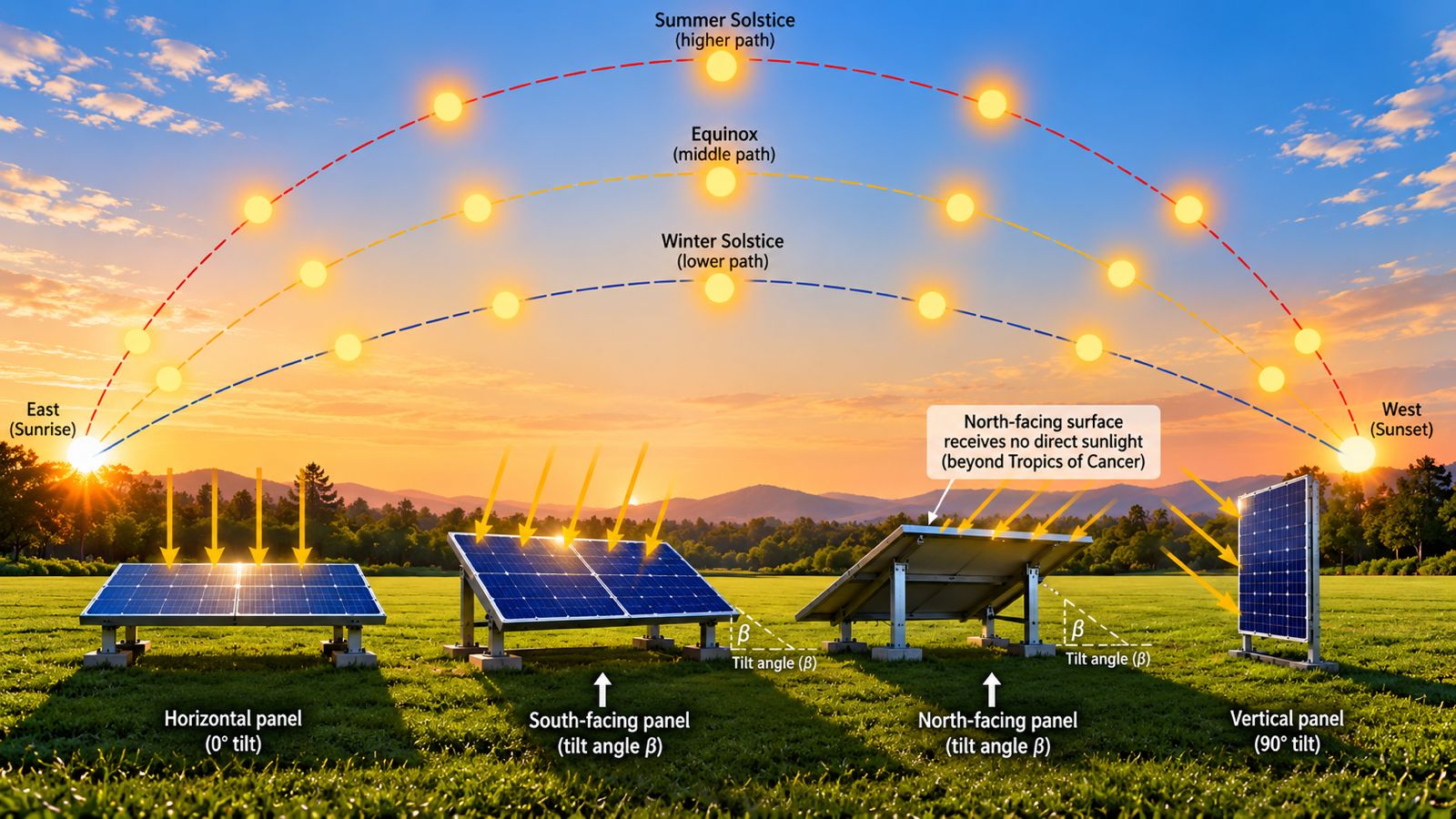
On a winter morning, sunlight may illuminate a south-facing wall while leaving a nearby north-facing wall in the shade. During summer, however, the pattern changes. The Sun is the same, the geographical location remains unchanged, and neither wall has moved. What causes such striking differences in their exposure to sunlight?
The answer lies in the geometrical relationship between the Sun and the receiving surface. Two solar panels installed at the same location may intercept different amounts of direct sunlight simply because they face different directions or have different inclinations. In our previous article, “How Solar Angles Work Together to Determine the Radiation Received by Solar Panels,” we explored the mathematical relationships governing the angle of incidence. Now, let us move beyond the equations and observe how sunlight behaves on horizontal, inclined, and vertical surfaces, and why these differences matter for photovoltaic (PV) installations.
Consider a flat rooftop or ground exposed to sunlight throughout the day. During the early morning and late afternoon, when the Sun is relatively low, its rays strike the horizontal surface obliquely. Consequently, the incoming direct solar energy is spread over a larger area. As the Sun climbs higher, its rays approach the surface more directly, increasing the direct beam energy received per unit area under otherwise identical conditions. This changing relationship is described by the angle of incidence, which, for a horizontal surface (β = 0°), equals the solar zenith angle.
Interestingly, a horizontal surface has no preferred facing direction. Rotating it towards any compass direction does not change its exposure to direct sunlight. Instead, the incidence angle depends on geographical latitude (φ), solar declination (δ), and hour angle (ω), which together describe the Sun’s apparent position at a particular location and time.
Consider Delhi, situated at approximately 28.5° north latitude. During summer, the Sun follows a relatively high path across the sky, allowing its rays to strike a horizontal rooftop or ground more directly around solar noon. During winter, its lower path produces more oblique incidence. Because Delhi lies north of the Tropic of Cancer, the Sun never appears directly overhead. A horizontal rooftop or ground therefore experiences changing patterns of direct solar exposure throughout the year, despite remaining stationary.
What happens when the receiving surface is inclined towards the south? Imagine two identical panels installed side by side, one horizontal and the other tilted southwards. Both experience essentially the same prevailing sunlight conditions, but the incoming rays strike their surfaces at different angles. Since the Sun remains towards the southern sky around solar noon in Delhi, a suitable southward inclination can improve the interception of direct sunlight, particularly during winter. The inclination is represented by β, while a due-south orientation corresponds to a surface azimuth angle (γ) of 0°.
However, the most favourable inclination depends on geographical location. The Sun follows different apparent paths at different latitudes, meaning that a panel tilt suitable for one location may not be equally effective elsewhere. This explains why geographical latitude is commonly used as an initial reference when selecting the inclination of fixed solar panels.
An interesting example occurs in Delhi during the equinoxes, around March and September. Consider a south-facing panel inclined at approximately 28.5°, equal to the city’s latitude. At solar noon on an equinox, sunlight strikes its surface almost perpendicularly, bringing the incidence angle close to zero. Under these conditions, the panel intercepts the maximum possible direct beam energy per unit area for the prevailing direct normal irradiance. This demonstrates how latitude and inclination can combine to produce particularly favourable geometrical alignment.
Does this mean that a panel should always be inclined at an angle equal to its geographical latitude? Not necessarily. During summer, when the Sun follows a higher path, a smaller inclination may provide more favourable exposure around solar noon. During winter, a steeper inclination may be advantageous. Therefore, the latitude-based tilt is a useful starting point rather than a universal optimum. The most suitable fixed inclination depends on the intended operating period, seasonal radiation patterns, local weather, shading, and other site-specific conditions.
Now imagine turning the same inclined panel through 180°, making it face north instead of south. Its location, inclination, and surrounding sunlight conditions remain unchanged, yet its exposure changes considerably. In Delhi, the Sun remains towards the southern sky around solar noon throughout the year. Consequently, direct sunlight generally strikes a north-facing inclined panel more obliquely than a suitably inclined south-facing panel, or may not reach its front surface at all, depending on the tilt and season.
The seasonal contrast is particularly revealing. During winter, when the Sun follows a low southern path, a north-facing inclined panel may receive little or no direct sunlight for substantial periods. During summer, however, the Sun rises north of due east and sets north of due west. This allows north-facing surfaces to receive direct sunlight during parts of the early morning and late afternoon. Thus, even an orientation that appears unfavourable around midday may experience direct solar exposure at other times.
Our exploration need not stop at rooftops. Consider the exterior walls of a building. A vertical wall has an inclination of 90° (β = 90°), but its exposure to sunlight depends strongly on the direction it faces. Two walls of the same building, one facing south and the other north, can therefore experience remarkably different patterns of direct sunlight.
A south-facing vertical wall in Delhi presents an interesting seasonal contrast. During winter, when the Sun remains relatively low in the southern sky, its rays approach the wall more directly. During summer, the higher midday Sun strikes the same wall more obliquely. Thus, while a horizontal rooftop generally benefits geometrically from the higher midday Sun, a south-facing vertical wall can intercept direct sunlight more favourably when the Sun is lower.
The north-facing wall behaves differently. During winter, the Sun travels across the southern sky, leaving a due-north-facing vertical wall without direct sunlight. In summer, however, the Sun’s more northerly rising and setting positions allow sunlight to reach the wall during the early morning and late afternoon. Around solar noon, it remains shaded from direct sunlight because the Sun is still towards the southern sky. These contrasting patterns demonstrate why building orientation influences solar exposure, daylight availability, and thermal conditions.
Such observations have practical significance beyond conventional rooftop installations. Building façades can also contribute to solar electricity generation through building-integrated photovoltaics (BIPV), where photovoltaic components form part of the building envelope. This approach may be particularly relevant where rooftop space is limited. However, the potential of a photovoltaic façade depends on its orientation, geographical location, shading, and surrounding conditions. The same principles of solar geometry that guide rooftop installations are therefore important when evaluating vertical surfaces.
Does this mean that every solar panel should face south? Not necessarily. Although suitably inclined south-facing panels are generally preferred for maximising annual solar energy generation in much of the Northern Hemisphere, alternative orientations may offer practical advantages. East-facing panels receive more favourable morning exposure, while west-facing panels are better positioned to intercept afternoon sunlight. These differences can be useful when electricity consumption is concentrated during particular hours. The preferred orientation must therefore balance solar exposure with roof geometry, shading, available space, and the intended use of electricity.
Another important consideration is the difference between favourable sunlight interception at one moment and accumulated solar energy over time. A panel may be perfectly aligned with the Sun at solar noon but experience less favourable incidence angles during other hours. Similarly, an inclination that performs well during winter may not maximise annual solar energy. For fixed installations, the relevant consideration is generally the energy received over the intended operating period rather than the radiation intercepted at a single instant.
Ultimately, two solar panels installed under the same sky do not necessarily receive the same amount of solar radiation. Their orientation and inclination determine how they interact with the Sun’s changing apparent position, influencing their exposure to direct sunlight throughout the day and across seasons. Understanding this relationship provides a scientific foundation for informed photovoltaic system design. Yet incidence angle explains only part of the picture. Sunlight scattered by the atmosphere and radiation reflected from the surroundings also contribute to the total radiation received by a surface. How these components combine, and how they influence the energy available to a solar panel, will be the subject of our next exploration.