Sometimes, nature answers our questions without uttering a single word. All we need is a moment of silence, an open sky, and a willingness to observe.
For the past two days, I had been contemplating what to write for the next edition of Reflections from Nature, a series I publish on every full-moon day. As I wandered outdoors, searching for inspiration, my eyes repeatedly turned towards the sky, almost as though I were seeking divine guidance.
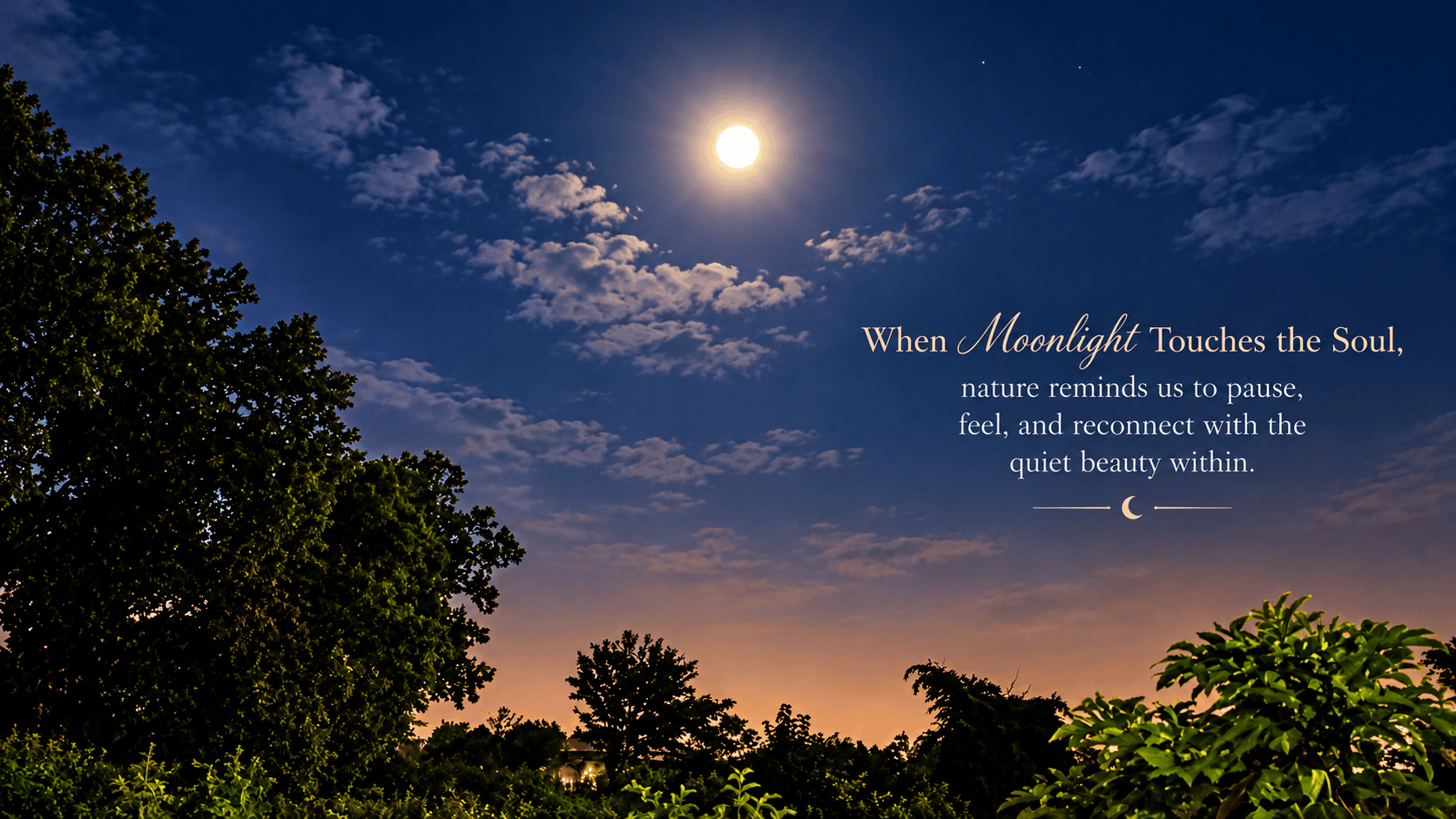
There, suspended in the vast darkness, was a magnificent silvery-white Moon, casting its gentle bluish-white glow across the landscape. Below it stood towering sal trees, their leaves and branches softly illuminated by the moonlight. The surroundings appeared unusually peaceful, as if nature had momentarily withdrawn from the noise and restlessness of everyday life.
The air was changing, too. The warmth of the departing season was gradually giving way to the first cool whispers of winter. It reminded me of a railway announcement signalling the arrival of long awaited train bringing relief and anticipation to waiting passengers. Similarly, the cool breeze seemed to announce the arrival of a new season.
Suddenly, a thought flashed through my mind. Earlier that day, my wife had reminded me that it was Sharad Purnima and that we should prepare kheer, the traditional Indian dessert made from milk and rice. According to a long-standing custom in many Indian households, kheer is placed under the full Moon on this night and shared among family members as prasad.
Since childhood, I had heard that the moonlight of Sharad Purnima possesses special nourishing and healing qualities. According to traditional belief, kheer exposed to these rays acquires properties believed to promote health and well-being.
Standing beneath that beautiful Moon, I began to wonder: What makes this particular full-moon night so special? Is there something scientifically unique about its light, or does its significance lie in the deeper relationship between nature, seasonal rhythms, and human consciousness?
Sharad Purnima falls on the full-moon day of the Hindu lunar month of Ashwin, generally during September or October. It marks an important seasonal transition, from monsoon to autumn, when skies become clearer and the contrast between warm days and cool nights becomes increasingly noticeable.
Scientifically, a full Moon occurs when the Moon is positioned approximately opposite the Sun as viewed from Earth, revealing nearly its entire illuminated surface. The moonlight we admire is simply sunlight reflected from its surface.
A popular belief associates Sharad Purnima with the Moon’s closest approach to Earth. However, the Moon follows an elliptical orbit, and its closest point, called perigee, does not necessarily coincide with Sharad Purnima. A full Moon occurring near perigee, is commonly called a supermoon. Thus, Sharad Purnima is not necessarily the closest or brightest full Moon of the year. Nevertheless, the clearer skies following the monsoon often make the autumn moon appear particularly striking.
In Sanatan tradition, Sharad Purnima holds significance beyond its astronomical beauty. The Moon symbolizes coolness, tranquillity, nourishment, and the human mind. On this night, it is believed to manifest the fullness of its sixteen kalas,representing completeness and perfection.
Sharad Purnima is also celebrated as Kojagari Purnima, when Goddess Lakshmi believed to ask, “Ko Jagarti?”—“Who is awake?” Devotees observe the night through prayer and worship, seeking her blessings. Beyond its religious meaning, this tradition symbolises spiritual wakefulness and conscious living.
In the sacred traditions of Brij, Sharad Purnima is associated with Lord Krishna’s Maha Raas, the divine dance with the gopis of Vrindavan. This moonlit autumn night symbolises divine love, devotion, and the soul’s longing for union with the Supreme.
The Moon’s gentle illumination offers a profound lesson: not every transformation requires force. Sometimes gentleness, patience, and awareness can achieve what intensity cannot.
In traditional belief, the Moon’s nectar-like rays, often described as Amrit Varsha, are associated with nourishment and healing. These rays are also believed to enhance the medicinal properties of plants and herbs.
Scientifically, there is no convincing evidence that moonlight directly enhances human immunity, heals diseases, or increases the medicinal potency of herbs. Although environmental conditions and biological rhythms influence plant physiology, the specific healing properties attributed to Sharad Purnima moonlight remain scientifically unverified.
The nutritional value of kheer comes from its ingredients, with no scientifically established enhancement from moonlight. However, leaving milk-based preparations outdoors overnight may cause spoilage, making proper food safety precautions essential.
Does this scientific understanding diminish the beauty of the tradition? I do not think so. Science helps us understand the physical world, while spiritual traditions preserve the meanings generations have attached to nature. A tradition may carry emotional, social, and symbolic value even when its medicinal explanation remains scientifically unverified.
Returning to that evening, I recall continuing my walk beneath the moonlit sky.
My residential complex stood on slightly elevated ground, overlooking a dense forest of towering sal trees. Their dark silhouettes stretched into the distance beneath the moonlit sky.
Wearing a half-sleeved T-shirt, I could feel the evening chill, prompting me to walk a little faster to keep myself warm.
Unexpectedly, a gentle breeze emerged from the forest, rustling through the trees as though someone had switched on an invisible fan. The cool air brushed against my exposed arms, sending a slight shiver through my body. That was when I truly felt the meaning of Sharad-not merely a season marked on the calender, but a living experience unfolding around me.
Later that night, as midnight approached, I sat on my balcony, writing these reflections beneath the gentle moonlight. Its soft glow fell upon my face and uncovered hands.
The gentle sensation awakened a childhood memory.
Whenever I felt distressed or troubled, my mother would softly place her hand upon my forehead or caress my face. Her touch calmed my restless mind like a soothing balm applied to a wound—not through any mysterious healing power, but through the affection, reassurance, and protection it conveyed.
Sitting beneath the Moon, I experienced something remarkably similar.
The moonlight seemed to touch my skin with the same tenderness. For a few moments, the worries of everyday life faded away. There was no urgency to achieve, no desire to compete, and nothing to prove. Only the silent sky, the distant forest, the cool autumn breeze, and a profound sense of peace remained.
Was the moonlight healing my body?
Science may not support such a conclusion. Yet the comfort I experienced was undeniable. The peaceful surroundings, and awakened memories, created a deeply restorative moment, reminding me that nature’s greatest gift may lie in its ability to calm our minds and reconnect us with ourselves.
The Moon reminds us that light can be gentle, beauty can exist in silence, and inner peace can emerge when we momentarily step away from the endless pursuit of material achievements.
The changing season reminds us that transformation is an essential part of life. Just as warmth gives way to coolness, our lives move through periods of activity, uncertainty, rest, and renewal.
The tradition of preparing and sharing kheer reminds us that festivals are more than rituals. They bring families together, inspire gratitude and strengthen the emotional bonds that connect generations.
As I looked once more towards the Moon, I realised that the inspiration I had been searching for during the previous two days had been present above me all along. I had been looking towards the sky for an idea, but nature had quietly offered something more meaningful—an experience.
Whatever the scientific understanding of moonlight’s healing properties, the peace I experienced beneath that Moon was real, and the memory of its gentle light will remain with me.
Perhaps the true Amrit of Sharad Purnima is not something that descends invisibly through moonlight, but something that awakens within us when we pause to appreciate the beauty of existence.
The Moon may not heal every wound of the body, but a quiet moment beneath its light can remind us of the tenderness, gratitude, and inner peace that our restless lives so often overlook.