
Look at the vastness of the universe—the countless stars, galaxies, and worlds moving within an astonishing order—and a question naturally arises: What lies behind it all? The mind instinctively wonders whether such an intricate and ordered universe points to some supreme consciousness behind its existence. At the same time, creation seems to require something from which it could arise, for how can anything come into existence without some fundamental substance as its basis?
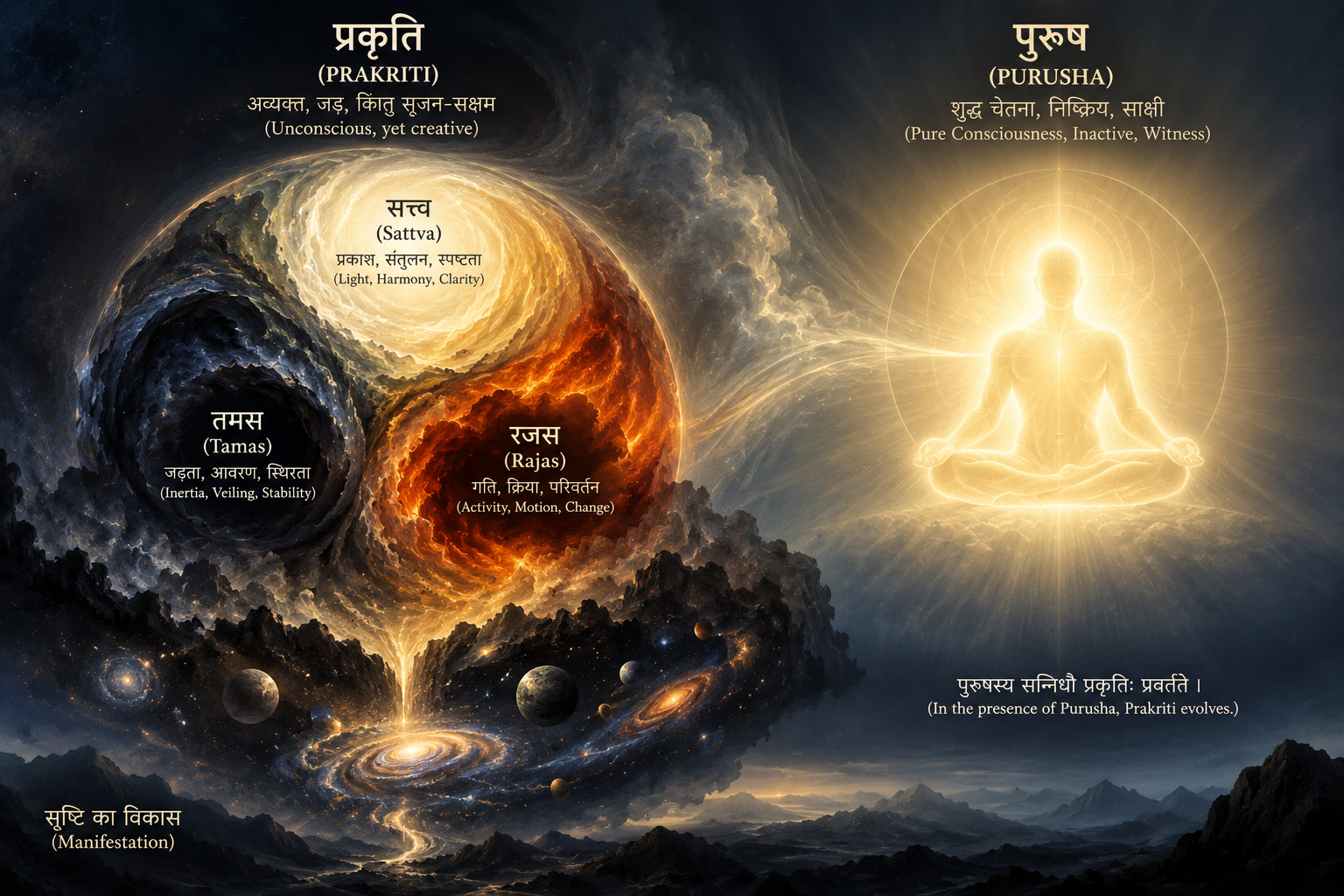
Sankhya approaches these questions through two fundamental principles—Purusha and Prakriti. Purusha represents consciousness, while Prakriti is the primordial material cause underlying the manifest universe. Understanding their distinct natures and their relationship provides the foundation for exploring Sankhya’s explanation of existence.
Purusha: The Principle of Consciousness
In Sankhya philosophy, Purusha is the principle of pure consciousness. It is independent, inactive, unchanging, and remains a witness to the activities and transformations taking place within Prakriti. In Indian philosophical traditions, the nature of consciousness has been explained in different ways. Some traditions associate it with the Supreme Being or Supreme Consciousness, but the Sankhya perspective is different. Here, Purusha is not the name of a single universal creator God. Classical Sankhya accepts the existence of multiple Purushas, each representing independent and witnessing consciousness.
But why does Sankhya accept the plurality of Purushas rather than a single universal consciousness?
Consider the experiences of living beings. Not everyone is born at the same time, nor does everyone die at the same time. The same situation may bring happiness to one person while causing discomfort or suffering to another. Sankhya considers such differences in individual experiences significant in supporting the plurality of Purushas.
This distinction also helps us understand Sankhya’s position on the question of God. Classical Sankhya, particularly as presented in the Sankhya Karika, does not establish a creator God as an essential principle for explaining the universe. For this reason, it is generally described as a non-theistic philosophy, ‘daivatwad’.
However, this does not mean that Sankhya denies the existence of one supreme consciousness. On the contrary, consciousness, represented by Purusha, is one of the two fundamental principles upon which its philosophical framework rests.
Prakriti: The Fundamental Material Principle
Now, let us understand the second fundamental principle—Prakriti.
In contrast to Purusha, Prakriti is the ultimate material cause (Upādāna Kāraṇa) of the manifest universe. It is the primordial, unmanifest principle from which all mental and physical elements evolve. The Earth, stars, planets, Sun, and Moon—everything we perceive through our senses—are manifestations of Prakriti.
Prakriti does not evolve through conscious intention or deliberate action. Rather, it contains within itself the potential for evolving the countless forms, all which we may or may not able to perceive through our senses that including the mind, intellect, and ego. Although Prakriti is fundamentally unconscious, it possesses the inherent capacity for transformation. Consciousness, however, belongs to Purusha and does not originate from Prakriti.
According to Sankhya, Prakriti consists of three fundamental Gunas—Sattva, Rajas, and Tamas.
In simple terms, Sattva represents illumination and clarity, Rajas represents movement and activity, and Tamas represents inertia and resistance. However, the term Guna should not be understood merely in its modern sense as a quality or characteristic of an object. In Sankhya, these three Gunas are the fundamental constituents or tendencies of Prakriti.
It is also important to understand that Sattva, despite its association with illumination and clarity, is not consciousness. All three Gunas belong to unconscious Prakriti.
When Sattva, Rajas, and Tamas remain in equilibrium, Prakriti exists in its unmanifest state.
To understand this, we can take a simple example of three primary colours.
Imagine three primary colours—red, blue, and green—mixed in perfect balance. Together, they produce white light, in which the individual colours are no longer separately visible. But when their relative proportions change, different colours and countless shades begin to appear.
This analogy can help us understand the unmanifest state of Prakriti in Sankhya philosophy. In its original state, Prakriti exists in perfect equilibrium, with its three Gunas—Sattva, Rajas, and Tamas—in a balanced condition. None of the three predominates, and therefore the diversity of the manifested world has not yet emerged.
When this equilibrium is disturbed, the relative dominance of the three Gunas begins to change. Just as different proportions of red, blue, and green can produce a vast range of colours, different proportions of Sattva, Rajas, and Tamas give rise to the immense diversity of the manifested universe.
Thus, everything that arises from Prakriti and can be experienced through our senses carries the influence of all three Gunas; what differs is their relative proportion. For this reason, Prakriti and its manifestations are described as Trigunatmaka—composed of the three Gunas.
An important distinction must be kept in mind here—the example of colours is merely an analogy to explain the equilibrium of the three Gunas and their changing proportions. Treating Sattva, Rajas, and Tamas as physical substances like colours would oversimplify the Sankhya concept.
How Does Cosmic Evolution Begin?
Now, an important question arises: If the three Gunas of Prakriti exist in equilibrium, what initiates their transformation?
According to Sankhya, the association of Purusha and Prakriti provides the basis for cosmic evolution. Purusha remains an inactive and unchanging witness, while Prakriti undergoes transformation through the interactions of its three Gunas.
This relationship is sometimes illustrated through a philosophical metaphor: when the ‘light’ of Purusha’s consciousness falls upon Prakriti, the equilibrium of its three Gunas is disturbed, and its inherent potential gradually begins to manifest.
Here, ‘light’ should not be understood as physical light or a force acting upon matter. It is a philosophical metaphor for the presence of consciousness. Purusha does not enter Prakriti, perform any action, or deliberately initiate creation.
But how can the presence of something inactive be associated with such an extensive process of transformation?
We can explore this question through another simple analogy.
The Analogy of a Seed
A tiny seed already contains the potential to grow into a magnificent tree. Under favourable conditions, this potential gradually unfolds. The seed first germinates, develops into a sapling, and eventually, through successive stages of growth, may become a fully grown tree.
We can draw a simple analogy between sunlight and Purusha, and between the seed’s inherent potential for growth and Prakriti.
The Sun does not directly perform the biological activities taking place within a seed, yet its presence is essential for sustaining the conditions necessary for plant growth. Without sunlight, photosynthesis would cease, seasonal patterns would be disrupted, and the water cycle responsible for rainfall would be severely affected.
Similarly, in Sankhya, Purusha does not actively participate in Prakriti’s transformations, yet its presence is considered essential for the manifestation of Prakriti’s inherent potential.
However, this analogy has its limitations. A reader may naturally ask: Can sunlight alone cause a seed to germinate?
Certainly not. Water, air, suitable temperature, and other favourable conditions are also necessary for its growth. Moreover, sunlight is a physical source of energy, whereas Purusha is not. The analogy is intended only to illustrate how the presence of something can be essential without its directly performing the activities involved.
In Sankhya, the transformations themselves belong to Prakriti, whose three Gunas interact to produce the diverse elements of the manifest universe.
From the Two Fundamental Principles to the Manifest Universe
We can now see the basic framework upon which Sankhya builds its explanation of existence. At its foundation stand two fundamentally different principles: Purusha, the conscious but inactive witness, and Prakriti, the unconscious but dynamic source of the manifest universe.
Their roles remain distinct throughout the process. Purusha does not transform, create, or become part of the material world. Prakriti, on the other hand, contains within itself the potential for all transformation. Consciousness belongs to Purusha; change and manifestation belong to Prakriti.
In its unmanifest state, Prakriti remains in equilibrium, with Sattva, Rajas, and Tamas perfectly balanced. But once this equilibrium is disturbed in the presence of Purusha, Prakriti’s inherent potential begins to unfold. From this point onward, the process belongs entirely to Prakriti: one principle gives rise to another, gradually producing the mental and physical framework of the world we experience.
This brings us to the next fascinating question: How does one unmanifest Prakriti unfold into such an extraordinarily diverse universe?
To answer this, we must follow the sequence of manifestation itself—from Mahat to Ahamkara, from Ahamkara to the senses, Manas and Tanmatras, and finally to the Mahabhutas. Together with Purusha and Prakriti, these stages form Sankhya’s systematic framework of the twenty-five Tattvas—a philosophical map tracing the journey from the unmanifest to the manifest universe.