
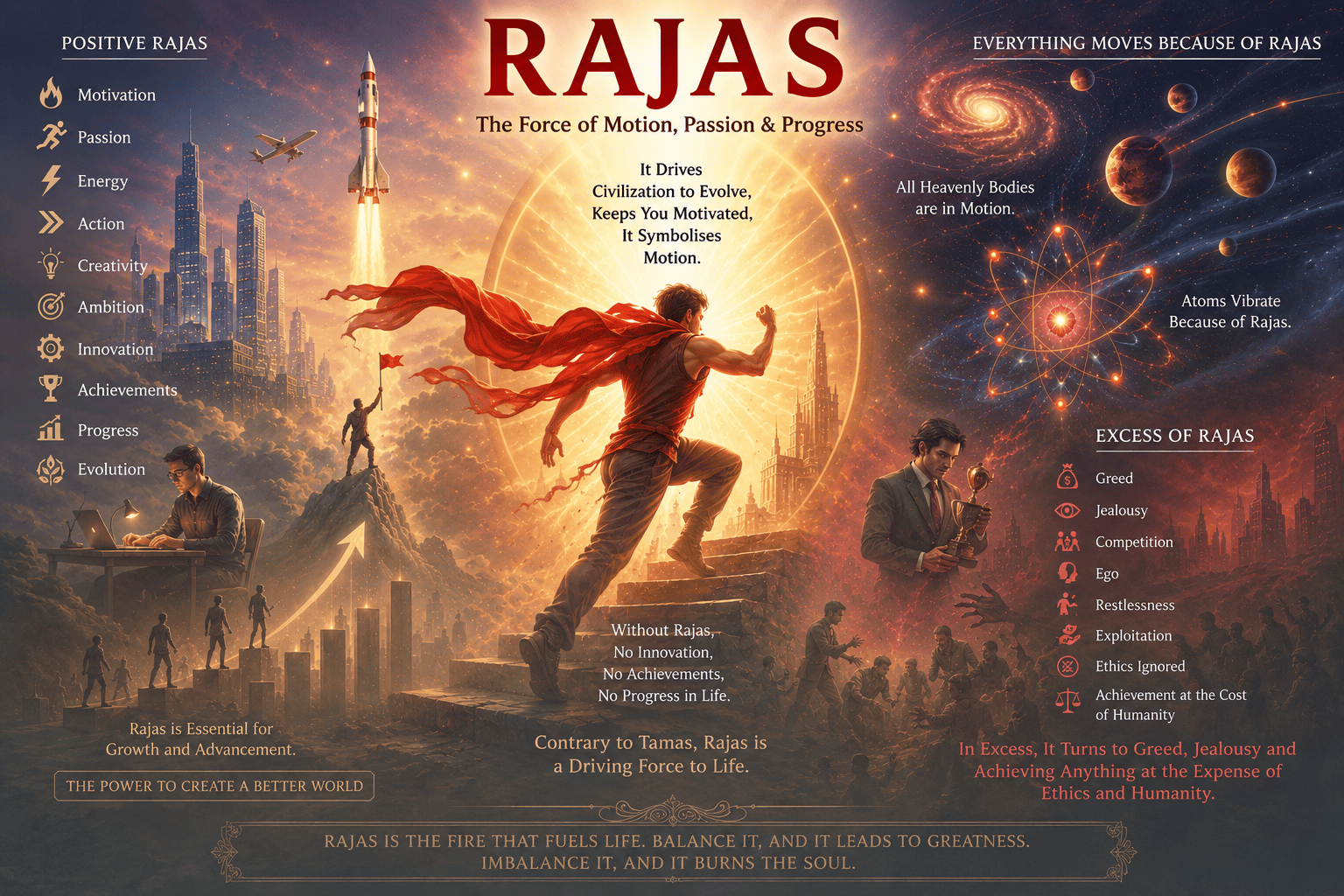
In Sāṃkhya philosophy, the entire cosmos is understood through three fundamental forces—Sattva (balance), Rajas (activity), and Tamas (inertia). Among these, Rajas is the force that refuses to sit still. It is motion, energy, transformation—the very pulse of existence. If Sattva is light and clarity, and Tamas is stillness and rest, then Rajas is the force that sets everything into motion. It is not just a philosophical idea; it is something you experience every single moment of your life.
Think about it—right now, as you read this, your eyes are moving, your mind is processing, your breath is flowing. You can walk, speak, eat, think, act—all because of Rajas. It is the invisible engine within you. The same force operates on a cosmic scale as well. The Earth rotates on its axis, creating day and night. It revolves around the Sun, sustaining life through seasons. From the movement of galaxies to the vibration of atoms, everything that moves does so because of this dynamic principle. Without Rajas, the universe would not just slow down—it would come to a complete standstill.
But Rajas is not merely about physical motion. It is also the source of your inner drive—the reason you want to achieve something, to become someone, to move forward in life. That ambition you feel, the urge to succeed, the restlessness that pushes you to do more—that is Rajas at work. Every achievement, every innovation, every step of progress in human civilization carries the imprint of this force. In this sense, Rajas is not just important—it is indispensable. Without it, there would be no growth, no action, no evolution.
Yet, like fire, Rajas has two sides. When controlled, it cooks your food and gives you energy. When uncontrolled, it burns everything in its path. On a psychological level, Rajas gives rise to powerful emotions—desire, greed, jealousy, anger, excitement, and sorrow. It fuels ambition, but it also fuels comparison. It pushes you to achieve, but it also makes you restless. The moment one desire is fulfilled, another arises. This creates an endless loop—a cycle where satisfaction is always just out of reach. You run, you achieve, you celebrate… and then you run again.
This is why Rajas is often described as both a blessing and a burden. It builds civilizations, yet it also creates conflict. It drives competition, innovation, and success, but it can also lead to stress, anxiety, and dissatisfaction. In society, excessive Rajas shows up as constant comparison, aggression, and the fear of losing what one has gained. In individuals, it appears as lack of focus, attachment to pleasures, and difficulty in finding inner peace.
And yet, calling Rajas a “problem” would be a mistake. It is more accurate to call it a necessary force. In fact, it is much like friction in physics—something that resists and agitates, yet without it, movement itself would be impossible. Without Rajas, we would become inactive, unmotivated, and stagnant. With too much of it, we become restless, overwhelmed, and even destructive. The key, therefore, is not to eliminate Rajas, but to balance it.
When Rajas is guided by Sattva—clarity, wisdom, and morality—it becomes the force of purposeful action. It leads to meaningful success, creativity, and growth. But when it is dominated by Tamas—ignorance and inertia—it can turn into blind ambition, where success is pursued at any cost, even at the expense of ethics and humanity.
So the real question is not whether Rajas exists in your life—it certainly does. The question is: How are you using it? Is it driving you toward mindful growth, or pushing you into endless restlessness?
Understanding Rajas is like understanding the fire within you. It is the force that moves the universe and shapes your destiny. Harness it wisely, and it becomes your greatest strength. Let it run unchecked, and it can quietly become your greatest limitation.