
Have you ever looked at your rooftop on a sunny day and wondered, “Can this space actually power my home?” It is an exciting thought. After all, the Sun is shining on your roof every day, offering a free and clean source of energy.
But going solar is not just about having sunlight. A roof that looks bright at noon may receive shadows in the morning or afternoon. The usable space, direction of the roof, nearby trees or buildings, strength of the structure, local solar availability, your electricity use and even grid connectivity all influence how much solar power your home can really generate.
In this blog series, we will take these questions step by step in a simple, practical way. You will learn how to observe your own rooftop, make a few basic calculations and begin estimating whether a solar photovoltaic system can meaningfully support your household’s electricity needs.
So, before jumping straight to the common question, “How many solar panels do I need?”, let us pause and ask something even more basic:
Is my home really ready to harness the Sun?
The answer begins not in a solar-panel catalogue, but with a careful look at your own rooftop.
The first step in answering whether your home is solar-ready is to understand how much of your rooftop actually receives useful sunlight.
Visit your rooftop around noon on a clear, sunny day and it may appear flooded with sunshine. This can easily create the impression that abundant solar energy is available and that the entire roof could be used for generating electricity. However, a single bright moment does not reveal the true solar potential of a rooftop.
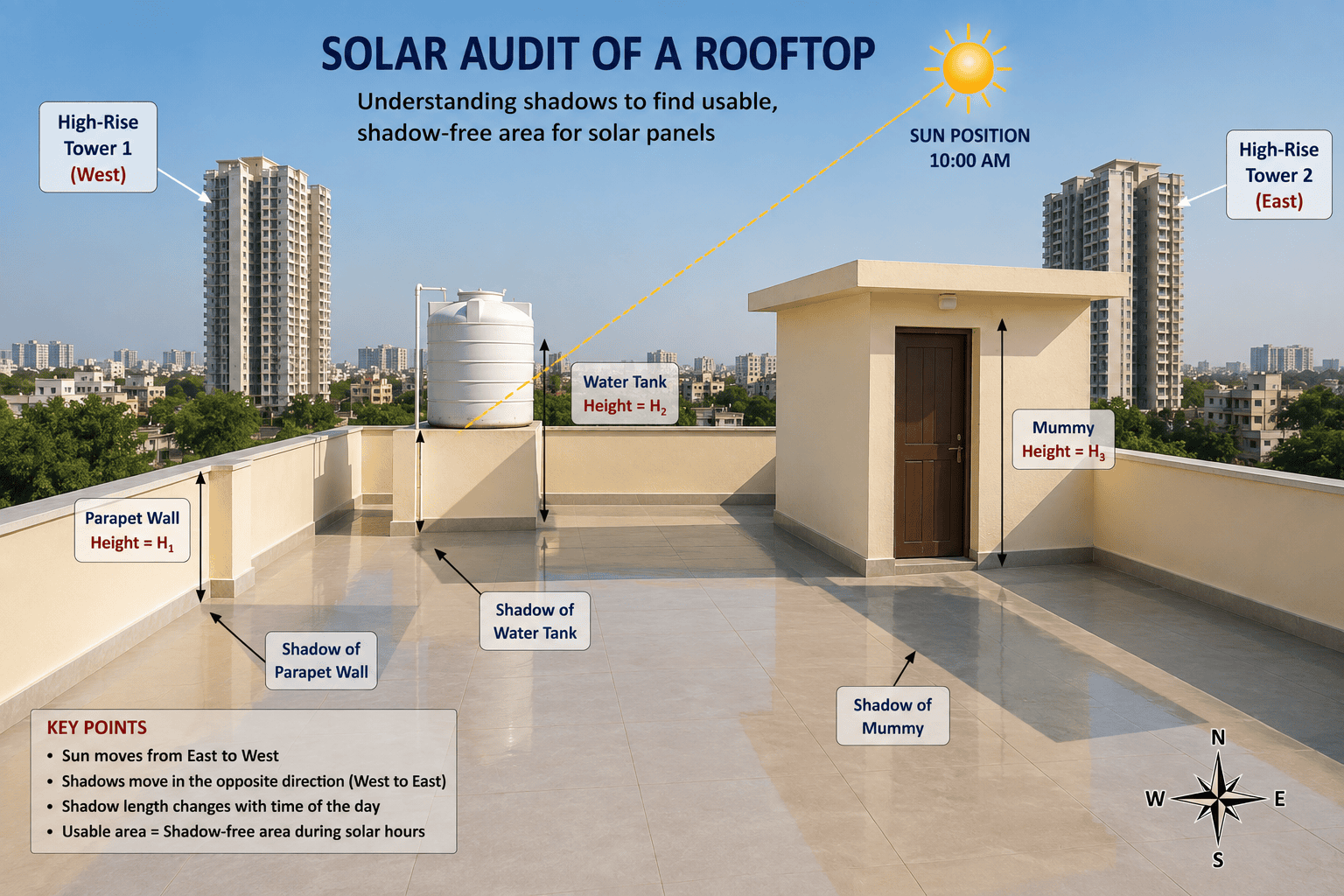
The Sun continuously changes its position across the sky, and the shadows on your roof change with it. An area that appears completely sunny at noon may have remained shaded for several hours in the morning or may become shaded later in the afternoon. Neighbouring buildings, trees, water tanks, parapet walls, staircases, mumty structures and other rooftop obstructions can all reduce the duration of direct solar exposure.
For a solar photovoltaic (PV) system, this distinction is important. Solar panels generate electricity from the solar radiation falling on their surface. Therefore, what matters is not simply the total rooftop area, but the usable area that remains sufficiently free from shadow during the important solar hours of the day.
Your first task, therefore, is to conduct a simple solar audit of your rooftop. Observe the roof at different times of the day: Where do the shadows fall in the morning? Which areas remain clear around noon? How far do the shadows of water tanks, walls or neighbouring buildings extend? And which portions begin to fall under shade as the Sun moves towards the west?
In this article, we will learn how to make this preliminary rooftop solar audit using simple observations and calculations. By identifying the usable, shadow-free area and understanding the sunlight available to it, you can make your own first estimate of whether your rooftop has sufficient solar potential to contribute meaningfully towards your household’s electricity requirement.
Let’s Conduct a Solar Audit on Your Own Roof
The solar audit require to check the shadow length on your rooftop due to neighbouring structures on obstructions and the direction of shadow as sun appears to move from east to west due to earth rotation from west to east on its axis.
The shadow length for a vertical obstruction, such as a neighbouring wall, parapet or rooftop structure, can be calculated by using simple following mathematical relation:
the solar elevation angle—the angle of the Sun above the horizon at that particular place and time.
The magnitude of solar elevation angle ( ) depends on the latitude of the location, time of the day and year both. The value of solar elevation for any time and day of the year can be obtained by the following simple relation;
Solar Elevation Angle () = Time of the Day (q) – [ latitude  – Day of the Year
  ]
]
() = (q) – [ – ]
For knowing the value of Time of the Day (q), we may assume an idealised day in which the Sun rises at approximately 6:00 a.m., reaches its highest position at 12:00 noon, and sets at approximately 6:00 p.m. Since the Earth rotates through approximately 15° of longitude per hour, the Sun appears to move across the sky at an average angular rate of about 15° per hour.So value of (q) may be approximated as increasing by 15° for every hour after 6:00 a.m.: approximately 15° at 7:00 a.m., 30° at 8:00 a.m., 45° at 9:00 a.m., 60° at 10:00 a.m., 75° at 11:00 a.m., and 90° at noon. After noon, the angle is assumed to decrease in the same manner until sunset.
The latitude  represents the geographical position of the location where your home is situated, whether in a city, town, or village. This value can be easily obtained from a map or online geographical tool. For example, if your home is located in Delhi, the latitude may be taken as approximately 28.6° N for solar calculations.
Another important parameter for estimating the Sun’s position is the solar declination angle  . It represents the angular position of the Sun relative to the Earth’s equatorial plane and varies throughout the year between approximately +23.45° and −23.45°. The declination is considered positive when the Sun is north of the equator and negative when it is south of the equator.
For any particular day of the year, the solar declination angle can be estimated using the following relation:
where in above relation (n) represents the Julian day of the year. For example, for 30 March, (n = 89), obtained by adding 31 days of January, 28 days of February, and 30 days of March: [n = 31+28+30=89]
Thus, by knowing only the date, you can estimate the solar declination angle required for calculating the Sun’s position over your rooftop.
Where Will the Shadow Fall?
Shadow length alone is not enough. Its direction also matters.
Use the Solar Azimuth Angle to Determine Shadow Direction. The solar azimuth angle helps you identify the direction in which a shadow will fall on your rooftop. It describes the Sun’s horizontal position, measured clockwise from true north. Because a shadow forms in the direction opposite to the Sun, the solar azimuth angle can be used to estimate where shadows from water tanks, parapet walls, trees, staircases, or neighbouring buildings are likely to fall.
Avoid unnecessary calculations by using an online solar-position tool. Instead of calculating the azimuth manually, you can use an online tool by entering the key inputs:
- Latitude of your location
- Date for which you want to estimate the shadow
- Local solar time
- Solar declination and hour angle, if required by the tool
Once you obtain the solar azimuth angle, add approximately 180° to estimate the shadow direction, since the shadow falls opposite to the Sun’s position.
In short, a rooftop becomes truly solar-ready only when we understand both how long shadows are and where they fall. By combining the solar elevation angle for shadow length with the solar azimuth angle for shadow direction, you can identify the portions of your roof that remain useful for solar panels during the most productive hours of the day. A simple rooftop sketch, marked with nearby obstructions and observed shadow movement, can give you a practical first picture of your home’s solar potential. This small exercise is an important step before choosing panel numbers, system size or installation layout. Once the usable, shadow-free area is known, the next question becomes clearer: how much electricity can that area actually generate?