
Sustainable Reflection | Samkhya Philosophy Series | Vaikrita Ahamkara
Could it ever happen that, as our knowledge increases, our ego takes on an increasingly subtle form instead of diminishing? Generally, ego manifests as pride and a sense of superiority, but in a knowledgeable person, it may also remain hidden behind scholarship, morality, and spiritual understanding. Samkhya philosophy makes an important distinction between intellect and Ahamkara to explain this experience. Intellect is the basis of knowledge and decision-making, while Ahamkara associates the sense of ‘I’ with experience. When this sense becomes associated with knowledge, it can sometimes take the form of subtle pride.
To understand this relationship between intellect and Ahamkara, it is necessary to understand the role of Vaikrita Ahamkara described in Samkhya philosophy. This sattvic form of Ahamkara is considered the basis for the emergence of the mind and the senses. In the previous article, we explored its nature and the predominance of Sattva Guna. Now, through the 23rd, 24th, and 25th verses of the Samkhyakarika, we will understand how intellect, Ahamkara, and mindare interconnected, and how the classical nature of Vaikrita Ahamkara differs from the subtle pride arising from knowledge.
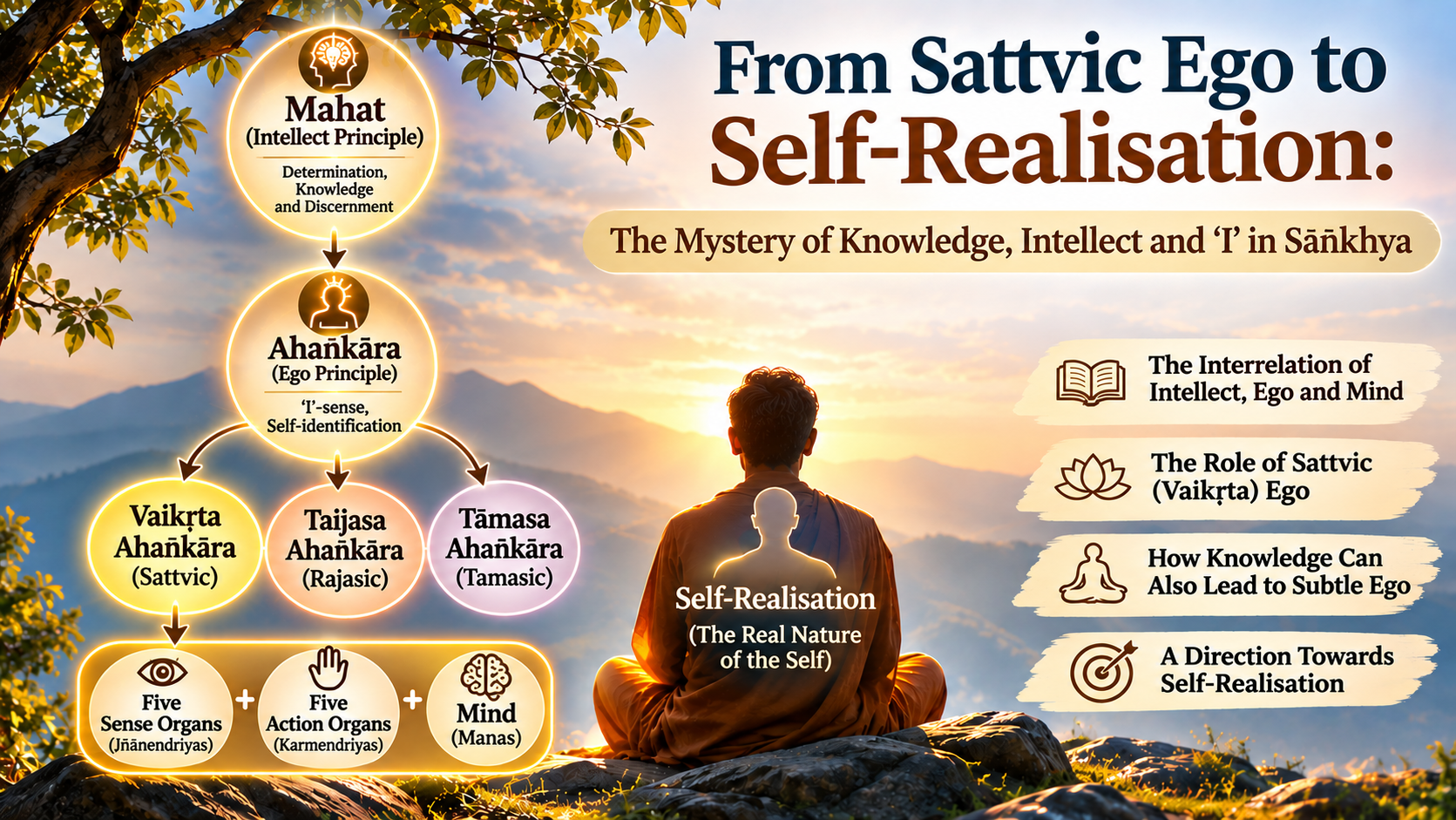
To understand the role of Vaikrita Ahamkara, we must first understand the principle from which Ahamkara originates. According to Samkhya philosophy, Mahat, or the principle of intellect (Buddhi), is the first to emerge from Prakriti. The 23rd verse of the Samkhyakarika explains the nature of intellect as follows—
अध्यवसायो बुद्धिर्धर्मो ज्ञानं विराग ऐश्वर्यम्।
सात्त्विकमेतद्रूपं तामसमस्माद्विपर्यस्तम्॥ २३॥
According to this verse, the fundamental characteristic of intellect is Adhyavasaya, meaning determination. Dharma, knowledge, detachment, and power are its sattvic attributes, while Adharma, ignorance, attachment, and lack of power are its tamasic attributes. When we evaluate a situation, decide what is right or wrong, or understand a subject, intellect plays a major role. The predominance of Sattva Guna manifests knowledge, clarity, and discernment within it.
There is an important philosophical distinction here—knowledge is a sattvic attribute of intellect, not a direct characteristic of Vaikrita Ahamkara. However, when the sense of ‘I know’ becomes associated with this knowledge, the role of Ahamkara comes into view. The next verse of the Samkhyakarika explains this relationship.
According to Samkhya philosophy, the principle of Ahamkara emerges after intellect. The 24th verse of the Samkhyakarika explains its nature and the creation arising from it—
अभिमानोऽहंकारस्तस्माद्द्विविधः प्रवर्तते सर्गः।
एकादशकश्च गणस्तन्मात्रपञ्चकश्चैव॥ २४॥
According to this verse, the fundamental characteristic of Ahamkara is Abhimana, from which two types of creation proceed—the group of eleven senses and the five Tanmatras. Here, Abhimana does not mean ordinary arrogance or conceit, but the sense of ‘I’ associated with experience. For example, understanding a subject is the function of intellect, whereas the experience of ‘I know this subject’ reflects the role of Ahamkara.
Thus, Ahamkara is an essential principle in the evolutionary process of Prakriti, rather than an inherently negative tendency. However, the two groups of creation arising from it are associated with different forms of Ahamkara, which are explained in the next verse of the Samkhyakarika.
The 25th verse of the Samkhyakarika explains the role of the different forms of Ahamkara in the emergence of the two groups of creation proceeding from it—
सात्त्विक एकादशकः प्रवर्तते वैकृतादहंकारात्।
भूतादेस्तन्मात्रः स तामसस्तैजसादुभयम्॥ २५॥
According to this verse, Ahamkara has three forms—Vaikrita (sattvic), Taijasa (rajasic), and Bhutadi (tamasic). From Vaikrita Ahamkara emerge the group of eleven senses, namely the five organs of knowledge, the five organs of action, and the mind. From Bhutadi Ahamkara emerge the five Tanmatras, while Taijasa Ahamkara provides the necessary activity for both processes.
Here, the mind is also considered a distinct sense organ that coordinates with the organs of knowledge and action. Thus, the classical significance of Vaikrita Ahamkara lies in the emergence of the mind and senses, rather than in the feeling of personal superiority arising from knowledge. The question now is how mind, intellect, and Ahamkara work together in our everyday experience.
Intellect, Ahamkara, and Mind: Three Distinct Roles, One Unified Experience
Imagine that you are reading a book. Your eyes perceive the words, the mind organizes the information received, and the intellect determines their meaning. However, when you say, ‘I have understood this subject,’ the association of Ahamkara with that knowledge becomes apparent. This simple experience helps us understand the distinct roles of mind, intellect, and Ahamkara.
In Samkhya philosophy, the characteristic of the mind is Sankalpa-Vikalpa, the characteristic of intellect is Adhyavasaya, meaning determination, and the characteristic of Ahamkara is Abhimana, meaning the sense of ‘I’. All three are distinct yet interconnected unconscious principles of Prakriti, while Purusha is the pure conscious witness, separate from them.
Thus, understanding a subject and regarding that understanding as ‘my knowledge’ are two different aspects of experience. This distinction raises an important question—when the sense of ‘I’ becomes associated with knowledge, can it sometimes take the form of subtle pride?
How Can Subtle Pride Become Associated with Knowledge?
Imagine a person who acquires profound knowledge through years of study and contemplation. Gradually, their scholarship begins to receive recognition, and they start guiding others. However, along with this recognition, a thought may sometimes arise within them: ‘My understanding is deeper than that of others.’
This change can be so subtle that humility remains visible in outward behaviour, while an attachment to one’s own scholarship begins to develop within. The person listens to others’ views, but finds it difficult to accept ideas that differ from their own beliefs. Here, knowledge itself is not the problem; rather, the sense of superiority associated with that knowledge becomes a subject for self-reflection.
In Samkhya philosophy, knowledge is a sattvic attribute of intellect, while the sense of ‘I’ is the characteristic of Ahamkara. The possibility of subtle pride can be understood through the relationship between these two, but it should not be considered a classical characteristic of Vaikrita Ahamkara. This raises another question—if pride can become associated even with knowledge and virtues, does sattvic nature itself guarantee freedom from ego?
Does Sattvic Nature Mean Freedom from Ego?
Sattva Guna is the basis of knowledge, illumination, and discernment, but does its predominance guarantee freedom from ego? In Samkhya philosophy, Sattva, Rajas, and Tamas are all qualities of Prakriti. Therefore, the predominance of Sattva may enhance clarity and discernment in the intellect, but it does not, in itself, constitute ultimate liberation.
A person may be virtuous, disciplined, and humble, yet still associate the sense of ‘I’ with their qualities. Even the thought ‘I am free from ego’ may indicate subtle self-identification. In such a situation, the question of self-reflection is not merely how sattvic we are, but also whether we have made our own virtues the basis of our superiority.
Samkhya philosophy gives this self-examination an even deeper direction. It leads us beyond the qualities of Prakriti towards recognizing the real distinction between Purusha and Prakriti.
Towards Self-Realization: From Knowledge to Discernment
In Samkhya philosophy, the true basis of self-realization is the discriminative knowledge of the distinction between Purusha and Prakriti. Intellect, Ahamkara, and mind are unconscious evolutes of Prakriti through which the processes of thought, experience, and decision-making take place. In contrast, Purusha is the pure conscious witness, distinct from all of them. When this distinction between Purusha and Prakriti is recognized as it truly is, the path towards Kaivalya, or liberation, opens according to Samkhya philosophy.
From this perspective, the significance of knowledge lies not only in acquiring information or increasing one’s scholarship, but also in understanding the distinction between the instruments of experience and the conscious witness that is separate from them. In everyday life, this idea inspires us towards self-examination—our knowledge should make us more aware of our thoughts and sense of ego, rather than more convinced of our superiority.
From the Light of Knowledge to Self-Realization
Can the light of knowledge ever cast the shadow of ego? The journey that began with this question has revealed an important fact—knowledge itself is not ego, but the sense of ‘I’ associated with it can sometimes become the basis of a subtle sense of superiority.
Knowledge enriches our thoughts and increases our ability to understand the world. But does it also teach us to recognize our own limitations? Does our scholarship make us more receptive to the views of others, or do we begin to regard our own understanding as the ultimate truth? Such questions give self-reflection a new direction.
Samkhya philosophy gives this reflection greater depth. It does not remain limited to understanding the relationship between knowledge and Ahamkara, but leads towards the true discriminative knowledge of Purusha and Prakriti. Knowledge helps us understand the world, while discriminative knowledge guides us towards recognizing the distinction between the instruments of experience and the conscious witness that is separate from them.
Perhaps self-reflection begins with this very awareness—that we should not regard our knowledge merely as an achievement, but also make it an opportunity to understand ourselves.
Because as important as the light of knowledge is, it is equally important to examine whether the shadow of our ego is growing within that very light.