
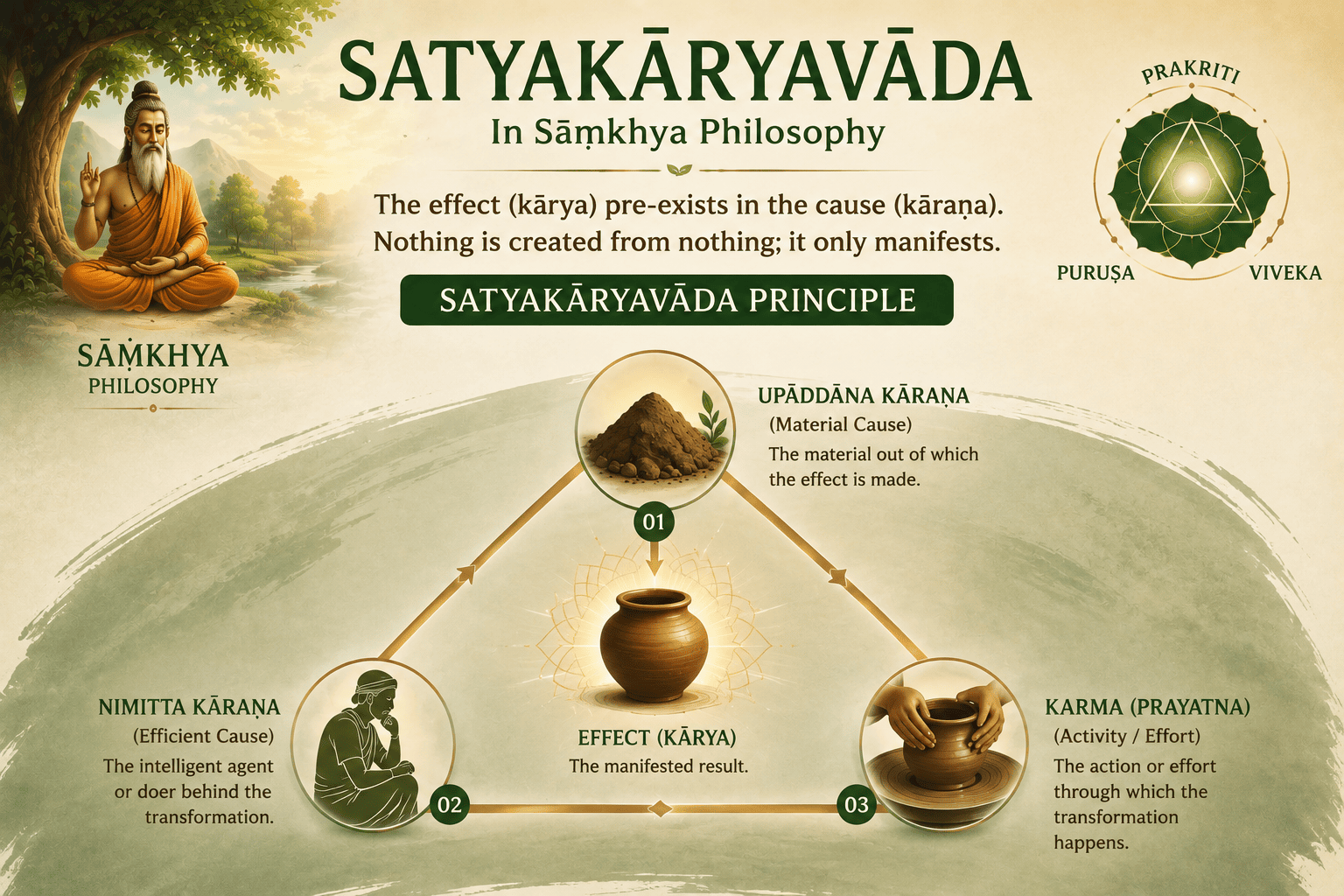
Satkāryavāda is one of the fundamental principles of Sāṃkhya philosophy. The term Satkāryavāda means that the effect already exists in its cause before it becomes manifest. In other words, nothing can arise entirely out of nothing. Every effect is already present in its cause in a potential form and becomes manifest when suitable conditions are available.
In simple terms, something can arise only from a cause in which the potential for its production already exists.Nothing can arise from absolute nothingness. If a cause does not contain the potential to produce a particular effect, that effect can never come into existence.
Modern science also supports, in a broad sense, the idea that every effect has some cause behind it. Here, the term cause refers specifically to the material cause (Upādāna Kāraṇa), that is, the substance from which something is made. Every material object is formed from some pre-existing material. For example, when a gold ornament is made, gold is its material cause, while the ornament is the effect. If gold is not available, a gold ornament cannot be produced.
However, the mere existence of a cause is not sufficient. The cause must also contain the potential for the corresponding effect to arise from it. For example, if wood is available instead of gold, a gold ornament cannot be made from it because wood does not possess the required potential or properties. Similarly, butter cannot be obtained from water because water does not contain the potential for producing butter, whereas this potential naturally exists in milk.
Therefore, according to Satkāryavāda, two conditions are essential for the production of any effect. First, there must be a cause; and second, the potential for that particular effect must already exist within that cause. If the cause does not contain such potential, the effect cannot arise from it.
According to Sāṃkhya philosophy, however, the presence of the material cause (Upādāna Kāraṇa) alone is not sufficient for the production of an effect. For the potential contained within the material cause to become manifest as an actual effect, another activating or facilitating factor is required. Sāṃkhya philosophy refers to this factor as the efficient cause (Nimitta Kāraṇa).
For example, even if clay is available, the mere presence of clay does not cause a pot to form by itself. The making of a pot requires a potter, a potter’s wheel, and the process of shaping the clay. Together, these factors function as the efficient cause. Similarly, for any effect to become manifest, the material cause alone is not enough; an efficient cause is also necessary.
Thus, Sāṃkhya philosophy concludes that two types of causes are necessary for the production of an effect—the material cause (Upādāna Kāraṇa) and the efficient cause (Nimitta Kāraṇa). The material cause provides the physical basis of the effect, while the efficient cause provides the means through which the potential inherent in the material cause becomes manifest in an actual form. The two complement each other and are necessary for the production of an effect.
The presence of the material cause is indispensable for the production of any effect because, without it, the effect cannot come into existence. This is the fundamental basis of Satkāryavāda, upon which Sāṃkhya philosophy explains the evolution of the entire universe.
While accepting the principle that every effect must arise from an appropriate material cause, Sāṃkhya philosophyrecognizes two eternal and independent realities: Puruṣa, the principle of pure consciousness, and Prakṛti, the primordial material principle and the Material Cause (Upādāna Kāraṇa) of the universe. According to Sāṃkhya, Prakṛti possesses the inherent potential to manifest the entire material universe. Everything that we observe around us, whether living or non-living, is understood as a manifestation or transformation of Prakṛti. For this reason, Prakṛti is described in traditional philosophical and scriptural language through expressions such as Sarvagarbhā (“the womb of all existence”) and Jagat Jananī (“the mother of the universe”), emphasizing its role as the source from which the diverse forms of the material world emerge.
However, Sāṃkhya does not hold that Prakṛti, as the Upādāna Kāraṇa, independently brings forth its effects (Kārya) merely by its own existence. Rather, the process of cosmic manifestation begins through the proximity and interaction of Puruṣa and Prakṛti. Puruṣa remains pure consciousness and does not itself undergo transformation, while Prakṛti, containing within itself the potential for the entire material universe, undergoes a progressive process of evolution through which the manifold forms of existence become manifest. Thus, the visible universe is understood not as a creation out of nothing, but as the manifestation of possibilities already inherent within Prakṛti—an idea that reflects the central principle of Satkāryavāda.
In the next article, we will explore an important question that naturally follows from this discussion: What is it within Prakṛti that gives it such immense potential to manifest the extraordinary diversity of the universe?