
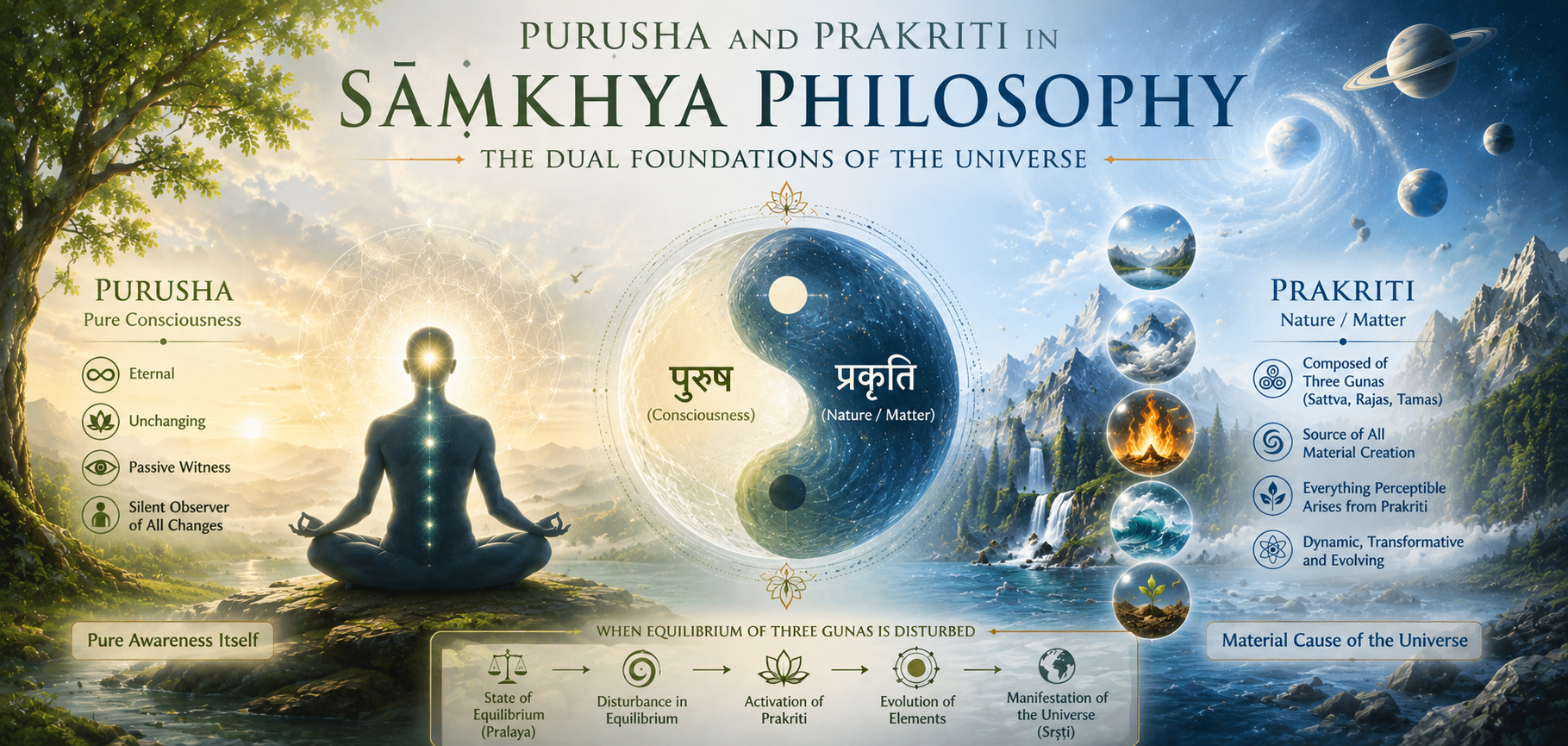
According to Sāṃkhya philosophy, the universe is fundamentally constituted by two primary principles: Purusha and Prakriti.
Purusha represents pure consciousness. It is unchanging, eternal, and inactive. It does not participate in the creation of the universe (Sṛṣṭi) or in any transformations of Prakriti. Instead, it remains a silent observer, witnessing all changes without being affected by them. In Sāṃkhya thought, Purusha is thus identified as the principle of awareness or consciousness itself.
In contrast, Prakriti is the material principle and the source of the entire physical universe. Everything perceptible, including the human body, arises from Prakriti. At a subtle level, transformations within Prakriti give rise to finer elements, which subsequently evolve into the gross physical forms that constitute the world.
Prakriti is composed of three fundamental constituents known as gunas: sattva, rajas, and tamas. At the time of pralaya(cosmic dissolution), these three gunas exist in a state of perfect equilibrium. This balanced condition is itself referred to as Prakriti, as expressed in the Sāṃkhya formulation: “sattva–rajas–tamasāṃ samyāvasthā prakṛtiḥ.” When this equilibrium is disturbed, the process of creation begins. The interplay of the three gunas gives rise to the diversity of material existence. Accordingly, Prakriti is regarded as the fundamental cause of creation (Sṛṣṭi), while all other forms are understood as its effects.
It is important that readers do not misconstrue the term guna in its ordinary sense as merely “quality” or “attribute.” In Sāṃkhya philosophy, the term is used metaphorically to denote the binding constituents of Prakriti. These gunas bind Purusha (pure consciousness) to Prakriti. Under their influence, Purusha mistakenly identifies itself with Prakriti and becomes entangled in worldly experiences, including pleasure and suffering.
If the gunas were interpreted solely as qualities or attributes, they could not function as the causal basis for the emergence of other elements. However, Sāṃkhya philosophy regards them as fundamental constituents that give rise to further evolutes, ultimately leading to the formation of the physical world. Therefore, they are not merely descriptive properties but essential components of Prakriti, emerging when its equilibrium is disturbed. Consequently, Prakriti is understood as the ultimate source of the universe, while all other entities are considered its manifestations or effects.